Figures · Politics
George Washington
He helped win a revolution, showed a new presidency how to behave, and never escaped the contradiction between liberty and slavery.
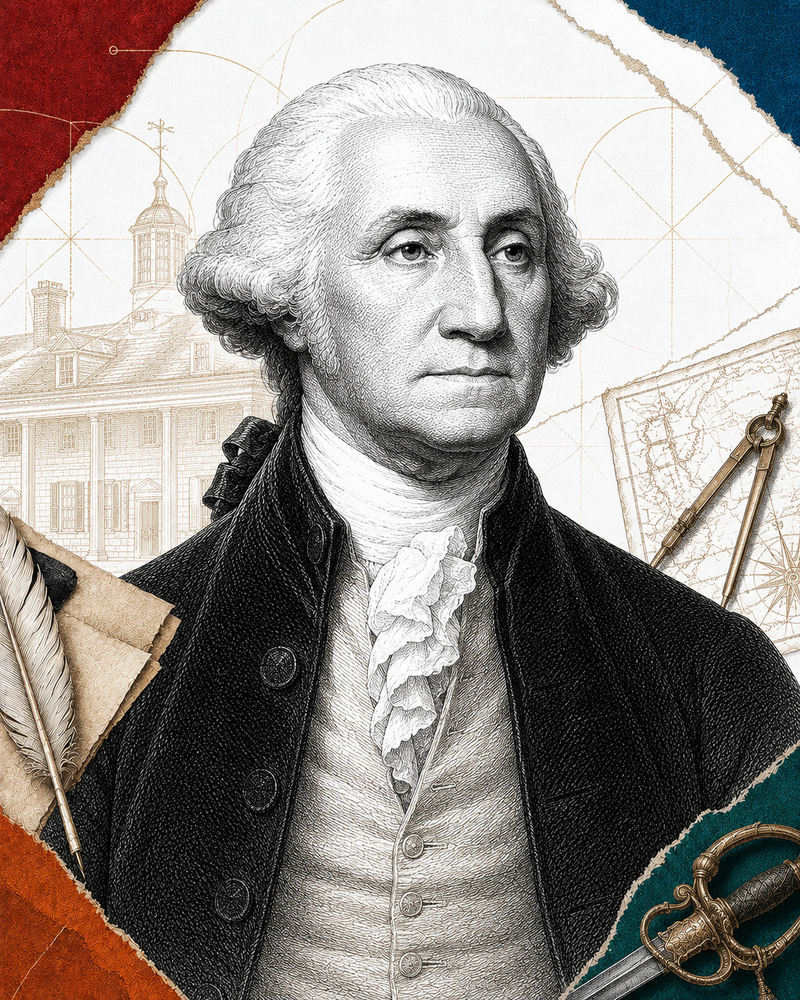
Washington entered public life as an ambitious young Virginian with little formal schooling and a strong instinct for advancement. He worked first as a surveyor, then joined the colonial militia. At twenty-two, he led troops into the contested Ohio Country, where an encounter at Jumonville Glen ended with the death of a French commander. Accounts of those few violent minutes differ, though the Haudenosaunee leader Tanaghrisson is widely reported to have killed the wounded Joseph Coulon de Jumonville after the initial fighting. A French counterattack soon trapped Washington at the hastily built Fort Necessity and forced his surrender. It was an embarrassing beginning—and one of the sparks that helped ignite the French and Indian War. Washington repaired his standing during General Edward Braddock’s disastrous 1755 campaign, later commanded the Virginia Regiment, entered the House of Burgesses, and married the wealthy widow Martha Dandridge Custis. The life they built at Mount Vernon rested heavily on enslaved labor. Encyclopedia Virginia
The Revolution handed Washington a far larger test. Congress selected him unanimously to command the Continental Army on June 15, 1775, and issued his formal commission four days later. His record was uneven: the defense of New York nearly collapsed in 1776, and he lost more battles than the heroic version of his story tends to remember. Yet he kept the army alive. Victories at Trenton and Princeton restored a cause that had begun to look hopeless, and indispensable French military and naval support made the victory at Yorktown possible in 1781. Two years later, Washington did something just as important as winning. He stood before Congress, resigned his commission, and went home—placing the army beneath civilian authority when he had the stature to reach for more. Library of Congress
Then came a job no one had held before. Washington presided over the Constitutional Convention and was the unanimous choice of the presidential electors who participated in the first election. As president, even ordinary decisions became precedents: how to consult advisers, deal with Congress, receive foreign representatives, enforce federal law, and leave office. His administration created the first cabinet, kept the country neutral during war in Europe, and demonstrated federal power during the Whiskey Rebellion. He retired in 1797 and died at Mount Vernon two years later. The estate he left behind reveals the central contradiction of his life. Washington’s 1799 census listed 317 enslaved people at Mount Vernon—124 held by him in his own right, 153 belonging to the Custis estate, and 40 rented from Penelope French. His will freed William Lee immediately and ordered the other 123 people he legally owned to be freed after Martha Washington’s death. Martha instead signed a deed in December 1800 that made their freedom effective on January 1, 1801. Mount Vernon
Preserve What Makes Future Victory Possible
Washington was not a general who won his way steadily across a map. He retreated, regrouped, and endured long stretches when the Revolution appeared close to failure. His essential achievement was keeping the army alive long enough for political resolve, French aid, and the right opportunity to meet.
PrincipleSurvival can matter more than a costly short-term victory.
Restraint Can Strengthen Authority
Washington understood something many powerful people never do: leaving can become part of the achievement. By resigning his commission after the Revolution and stepping away from the presidency after two terms, he made his earlier use of power more credible.
PrinciplePower becomes more trustworthy when its holder accepts limits.
Achievement Does Not Erase Complicity
Washington could defend liberty in public while denying it to people at Mount Vernon. His views on slavery changed, and his will eventually ordered the emancipation of the people he owned, but neither fact cancels the lives spent in bondage under his control.
PrincipleAccomplishment does not erase the injustice that helped sustain it.
Formation
1732Born at Popes Creek in Westmoreland County, Virginia.
1749Commissioned as surveyor of Culpeper County.
1753Carried Virginia’s demand that French forces leave the Ohio Country
Revolution
1759Married Martha Dandridge Custis and settled at Mount Vernon.
1774Represented Virginia at the First Continental Congress.
1775Selected and commissioned as commander in chief of the Continental Army.
Nation Building
1787Presided over the Constitutional Convention.
1789Inaugurated as the first president of the United States.
1793Issued the Neutrality Proclamation as war spread through Europe.
Fort Necessity
Washington’s troops and allied Indigenous warriors surprised a French party at Jumonville Glen. What happened after the first exchange of fire remains disputed. Tanaghrisson is widely reported to have killed the wounded French commander, Joseph Coulon de Jumonville, but whether the French party had come as diplomats or military scouts became part of the argument over responsibility. Washington then withdrew to Great Meadows and built Fort Necessity in a position that proved dangerously vulnerable. When French troops and their Indigenous allies surrounded the fort, Washington accepted surrender terms written in French that described Jumonville’s death as an “assassination.” He later said his translator had rendered the disputed word as “death” or “killing.” Whatever the translation, the expedition had ended in defeat.
Washington returned as a volunteer during Braddock’s campaign in 1755. After Braddock’s force was routed, Washington helped organize the retreat and gradually recovered enough public confidence to receive command of the Virginia Regiment.
Courage after a failure matters, but it cannot replace an honest account of the decisions that caused it.
The Collapse in New York
Washington’s defense of New York became a chain of defeats—Long Island, Kip’s Bay, White Plains, and finally Fort Washington, where approximately 2,800 American troops were captured. By late 1776, the surviving army was retreating across New Jersey and the Revolution looked dangerously close to collapse.
Washington preserved what remained of the army and stopped treating every piece of ground as something that had to be defended at any cost. Then, at Trenton and Princeton, he used speed, surprise, and calculated risk to reverse the mood of the war.
When the original plan breaks, protect what remains and change the conditions of the fight.
A Failure Left Unresolved
Washington inherited, purchased, rented, controlled, and exploited enslaved people throughout his adult life. While president, he secretly rotated enslaved members of his household out of Pennsylvania so they would not qualify for freedom under the state’s gradual abolition law. When Ona Judge escaped in 1796, he tried repeatedly to recover her. His private criticism of slavery grew stronger with age, but he never turned that belief into a public campaign for abolition.
He did not. His will freed William Lee immediately and provided for the later emancipation of the other people he legally owned. That decision mattered, but it came at the end of a lifetime and could not undo decades of bondage. It also left the Custis estate’s enslaved people in slavery; Washington could not legally free them, though he had controlled their labor and profited from it.
Regret is not repair. Confront an injustice while you still have the power to alter it.
Defeat at Fort Necessity
Washington’s first public test of command ended badly. French troops and their Indigenous allies surrounded his exposed position; trees stood within firing range, rain soaked the fort, casualties mounted, and his exhausted men could not hold out. The surrender exposed how much the twenty-two-year-old officer still had to learn. It also helped turn a struggle over the Ohio Country into open war in North America.
Command of the Continental Army
On June 15, Congress placed a collection of separate colonial forces in Washington’s hands; his formal commission followed on June 19. The assignment was larger than battlefield command. He had to build an army, keep it together, and retain the trust of Congress, thirteen states, unpaid soldiers, uneasy civilians, and foreign allies—often all at once.
An Office Without a Blueprint
Every participating presidential elector voted for Washington, but winning the office was the easy part. There was no established presidency to inherit. With every appointment, ceremony, cabinet discussion, dispute with Congress, and use of executive authority, Washington was helping decide what the office would become.
History does not survive as a perfect record. This profile draws from surviving primary evidence and reputable historical scholarship, but some events, motives, and accounts remain incomplete or disputed; when that uncertainty materially changes the story, it is stated in the text. The lessons and applications are editorial interpretations—not claims that Washington intended his life to teach them.