Figures · Technology
IK
The man who taught machines to think — and broke the code that helped end a war.
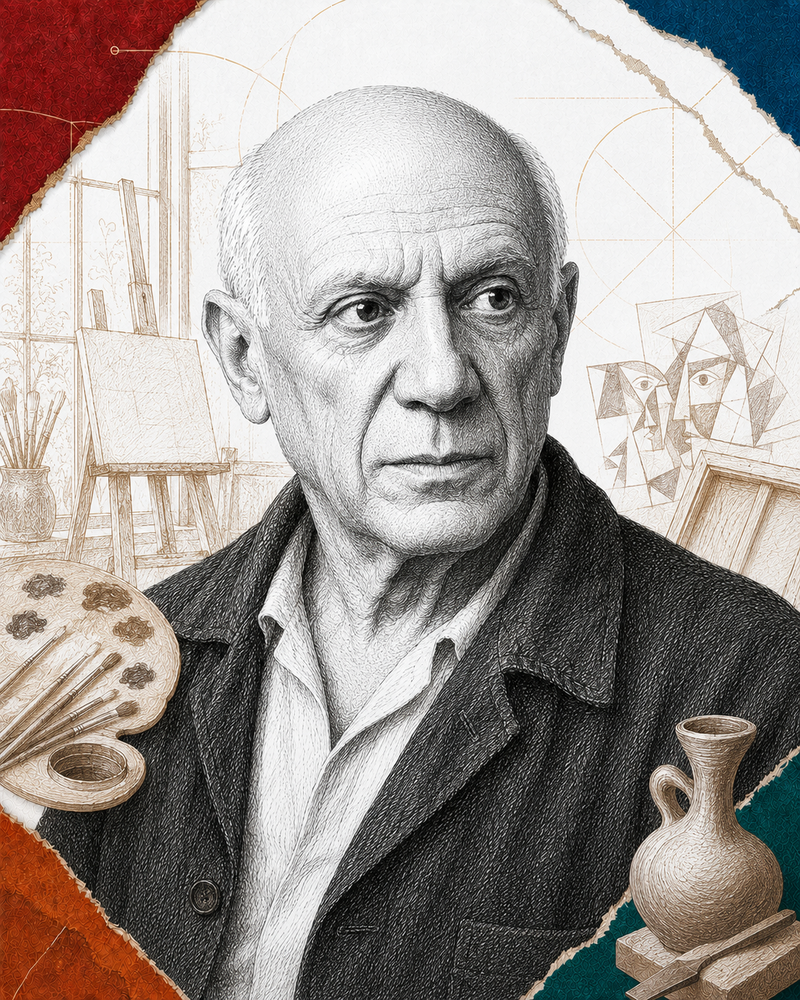
Alan Turing showed an early gift for mathematics and science, though he struggled to fit into the rigid English boarding school system of the 1920s. At Cambridge, he developed the idea of a "universal machine" — an abstract device that could compute anything computable by following a set of stored instructions. Published in 1936, this paper effectively invented the theoretical basis for every computer built since.
When war broke out, Turing joined the Government Code and Cypher School at Bletchley Park, where he designed the Bombe, an electromechanical machine that dramatically sped up the cracking of German Enigma-encrypted messages. His work there, alongside colleagues, is credited by historians with shortening the war by an estimated two years and saving countless lives, though it remained classified for decades after his death.
After the war, Turing turned to building real computers and asking deeper questions about machine intelligence, proposing what's now called the Turing Test as a way to judge whether a machine could think. In 1952, he was prosecuted for homosexuality, then illegal in the UK, and accepted chemical castration as an alternative to prison. He died in 1954 of cyanide poisoning, ruled a suicide, though the exact circumstances remain debated. He received a posthumous royal pardon in 2013.
Boolean Logic
Reducing reasoning to ones and zeros, with operations like and, or, and not, turned logic into something a machine could compute — the seed of every computer. Formalizing thought made it mechanizable: make a process precise enough, and a machine can run it. Make reasoning precise enough and a machine can do it.
The Limits of Computation
Turing didn't just show what machines could do — he proved some problems (like the Halting Problem) can never be solved by any algorithm, no matter how powerful. Knowing a problem's boundaries is as valuable as solving it. Some questions have no computable answer, and proving that is itself a discovery.
Ideas Outlast Persecution
Despite being destroyed by the same society he helped save, his ideas became the foundation of an entire industry. Institutional cruelty can end a life but not the value of the work behind it. A good idea survives its author, even when the author doesn't survive their era.
Formation
Childhood in England, early brilliance in math and science, Cambridge fellowship, and the publication of "On Computable Numbers."
Bletchley Park
Recruited into wartime codebreaking; designs the Bombe; helps crack Naval Enigma; work remains secret for decades.
Machines and Downfall
Postwar work on early computers (ACE, Manchester Computer) and machine intelligence; the Turing Test; prosecution in 1952; death in 1954.
 1936
1936The Universal Machine
His paper "On Computable Numbers" introduced the theoretical model behind every computer since — turning an abstract logic problem into the blueprint for computing.
 1939
1939Bletchley Park
Recruited to break Enigma, he designed the Bombe machine, converting pure mathematics into a decisive wartime weapon.
 1952
1952Prosecution
Convicted of "gross indecency," he lost his security clearance and was subjected to chemical castration — a personal catastrophe that cut short his most productive years.