Business Lab - Vol. 02
How To Know If Anyone Will Pay Before You Build It
A shoe store with no shoes, a $400 juicer beaten by two hands, and a web page with a price on it show how to find real demand for your idea before you spend months and savings building it.
Why So Many Businesses Fail This Way
In 1999, a young man named Nick Swinmurn went to a mall in the San Francisco Bay Area looking for a pair of Airwalk desert boots. He couldn't find them.
One store had the right color in the wrong size, and another had the right size in the wrong color. He went home empty-handed and had an idea: why wasn't there a store online where you could find any shoe in any size?
Plenty of people have ideas like that. What Swinmurn did next is the part worth studying. He didn't rent a warehouse, buy inventory, or raise money to build a big website.
He went to a local shoe store, Footwear Etc. in Sunnyvale, California, and made them an offer. In his own words: "I'll take some pictures, put your shoes online, and if people buy them, I'll buy them from you at full price." The store said okay.
So he photographed their shoes and put them on a simple website. When someone ordered a pair, he went back to the store, bought the shoes at the regular retail price, and shipped them to the customer himself.
He made little or no money on each sale. That wasn't the point. The point was to find out whether people would actually buy shoes online, at a time when almost everyone assumed nobody would buy shoes without trying them on first.
They did. He got orders. When he later pitched the idea to about ten venture capital firms, they turned him down and told him nobody would buy shoes without trying them on first.
But Swinmurn already had evidence they were wrong, because people had already done it. The company became Zappos, and in 2009 Amazon bought it for about $1.2 billion.
If you're thinking about starting something, you're probably facing the same question Swinmurn faced. Will anyone actually pay for this? Maybe you've asked friends and family, and they told you it's a great idea.
Maybe you've been planning it for months, or already building it, and you're hoping that when it's ready, people will come. The trouble is that you won't really know until you ask people for money, and most people wait until after they've spent months and savings building the whole thing to find out.
This issue is about how to find out first. It covers why so many businesses skip this step, why asking people "would you buy this?" gives you the wrong answer, what real evidence of demand looks like, and simple ways to test your idea with real people before you build it, the way Swinmurn did with a camera and a borrowed shoe store.
A Shoe Store With No Shoes
First, a few terms. Demand means people wanting something enough to pay for it. Testing an idea, sometimes called validating it, means finding real evidence of demand before you commit your time and money.
In Vol. 1, we covered where the money in a business comes from: people pay when they get something they value more than what they give up. Testing is how you find out whether your idea actually does that for enough people.
Skipping this step is one of the most common ways businesses die. The research firm CB Insights has studied the post-mortems, the written explanations founders publish after their companies shut down. In an early analysis of 101 failed startups, "no market need" was the most common reason given, cited by 42 percent of them.
In a later analysis of 111 more, it was cited by 35 percent, second only to running out of money. And the two are closely connected. A business that makes something nobody wants enough will usually run out of money trying to sell it.
The most famous recent example is Juicero. Starting in 2014, the company raised about $120 million from investors, including Google's venture fund, to build a Wi-Fi-connected juice press that squeezed juice out of packs of chopped fruit and vegetables that customers bought by subscription. The press launched at around $700, and the price was later cut to $400.
In April 2017, reporters at Bloomberg News did something simple. They took the juice packs out of the machine and squeezed them by hand. It worked. The juice came out about as well, in about the same amount, and faster.
Customers didn't need a $400 machine. The company cut a quarter of its staff, offered refunds, and shut down in September 2017, about 16 months after the press went on sale.
The machine itself was well built. Juicero's problem was that the company spent years and a fortune building the product before finding out whether people needed it. Swinmurn found out whether people needed his idea in a few weeks, with almost no money.
Why Asking "Would you buy this?" Doesn't Work
The most natural way to test an idea is to describe it to people and ask what they think. Almost everyone does this, and it almost always gives a misleading answer. There are two reasons.
People are polite
When you describe your idea to someone, especially someone who knows you, they don't want to hurt your feelings. So they say it sounds great. The entrepreneur Rob Fitzpatrick built a whole book around this problem, called The Mom Test.
The title comes from the idea that you shouldn't ask your mom whether your business idea is good, because she loves you and she'll tell you it is. Most people you ask will do some version of the same thing.
What people say they'll buy isn't what they buy
Even when people aren't being polite, they're bad at predicting their own behavior. Companies have asked customers about their purchase intentions for decades, and researchers have studied how well those answers predict actual sales.
The marketing researcher Vicki Morwitz reviewed about 60 years of that research and concluded that purchase intentions are related to sales and do predict them, but imperfectly.
A lot of people who say they'll buy something never do. Saying yes to a question costs nothing, and paying costs money.
Fitzpatrick's answer is to stop asking people about your idea and start asking about their lives. His rules are simple: talk about their life instead of your idea; ask about specific things that happened in the past, not opinions or guesses about the future; and talk less and listen more.
Here's what the difference looks like. Say you want to start a meal-prep service for busy parents. A bad question is, "Would you use a service that delivers healthy prepped meals every week?" Almost everyone will say yes.
Better questions are: "What did you have for dinner last Tuesday?" "When was the last time you tried to solve the weeknight dinner problem? What did you try?" "How much did you spend on takeout last month?" "Have you ever paid for a meal kit? Why did you stop?" These questions ask about what people have actually done and spent.
If a parent has already tried three meal kits and spends $400 a month on takeout, that's a real problem. If they say it sounds nice but have never tried to solve it, that tells you something too.
The Difference Between Interest And Commitment
The key idea in testing is that some signals mean much more than others, because a compliment costs nothing and a payment costs something real. Fitzpatrick describes the stronger signals as commitments, where someone gives up something they value, whether that's their time, their reputation, or their money.
It helps to think of the signals as a ladder, from weakest to strongest:
Compliments. "That's a great idea." "I'd totally use that." These cost nothing and mean almost nothing.
Likes, follows, and shares. A little better, since people took an action, but still very little effort.
Email signups. Someone gives you a way to reach them and wants to hear when it's ready. This is real interest, but it's still free.
Time. Someone agrees to a 30-minute call, tries an early version, or gives you detailed feedback. Time is valuable, so this is a stronger signal.
Reputation. Someone introduces you to their boss, their friends, or others who have the same problem. They're putting their own name behind you.
Money in advance. A deposit, a pre-order, or a signed agreement to pay. This is close to the real thing.
An actual purchase. Someone pays you and receives what they paid for. This is the strongest evidence there is.
Swinmurn went straight to the top of the ladder. He didn't ask people whether they'd buy shoes online. He let them do it. Most people testing an idea stay near the bottom, collecting compliments and likes, and then are surprised when nobody pays. The goal of testing is to get as high up the ladder as you can, as early and cheaply as you can.
Where To Find People To Test With
Every test in this issue depends on getting in front of the right people, and for someone starting from zero, that's often the hardest part. Friends and family are a fine place to start asking for introductions, but they shouldn't be your main test group. They like you, they may not have the problem, and they'll tend to tell you what you want to hear.
The people you want are the ones who already have the problem and are already trying to solve it. Here's where to look.
Where they already gather
Almost every group of people with a shared problem gathers somewhere: online forums, Facebook groups, Reddit communities, Discord servers, industry associations, meetups, conferences, church groups, or local business clubs. Fitzpatrick's advice in The Mom Test is to go to those places and have real conversations about the problem, not to post an ad for your idea.
Where they complain about what they're using now.
Reviews of competing products, forum threads asking for alternatives, and comments under related videos are full of people describing exactly what frustrates them. Those people have already shown the problem is real, because they've tried to solve it.
Fitzpatrick, borrowing a term from the entrepreneur and professor Steve Blank, calls the best early customers "earlyvangelists": people who have the problem, know they have it, have the budget to solve it, and have already put together some makeshift solution of their own.
Through introductions
At the end of every good conversation, ask, "Who else do you know who deals with this?" An introduction is one of the commitments on the ladder in section 04, since the person is putting their name behind you, and each one can lead to two or three more conversations.
One person at a time
In early testing, reaching out to people one by one usually works better than broadcasting to everyone. Paul Graham, a cofounder of the startup program Y Combinator, wrote in his 2013 essay "Do Things That Don't Scale" that recruiting users manually is the most common thing founders have to do at the start, and that nearly all startups have to do it.
When Ryan Hoover tested the idea that became Product Hunt, a daily email of new tech products, he set it up in about 20 minutes and personally invited a hand-picked group of about 30 founders, investors, and bloggers to contribute. Within two weeks, more than 170 people had subscribed.
He was open about the fact that years of blogging and building relationships had given him a network to start from. If you don't have one yet, the places and introductions above are how you build it, one conversation at a time.
A good goal for the first round is 10 to 20 conversations with people you didn't already know, who have the problem right now.
Ways To Test Before You Build
There's no single right test. Here are five that work for most ideas, roughly in the order you'd use them.
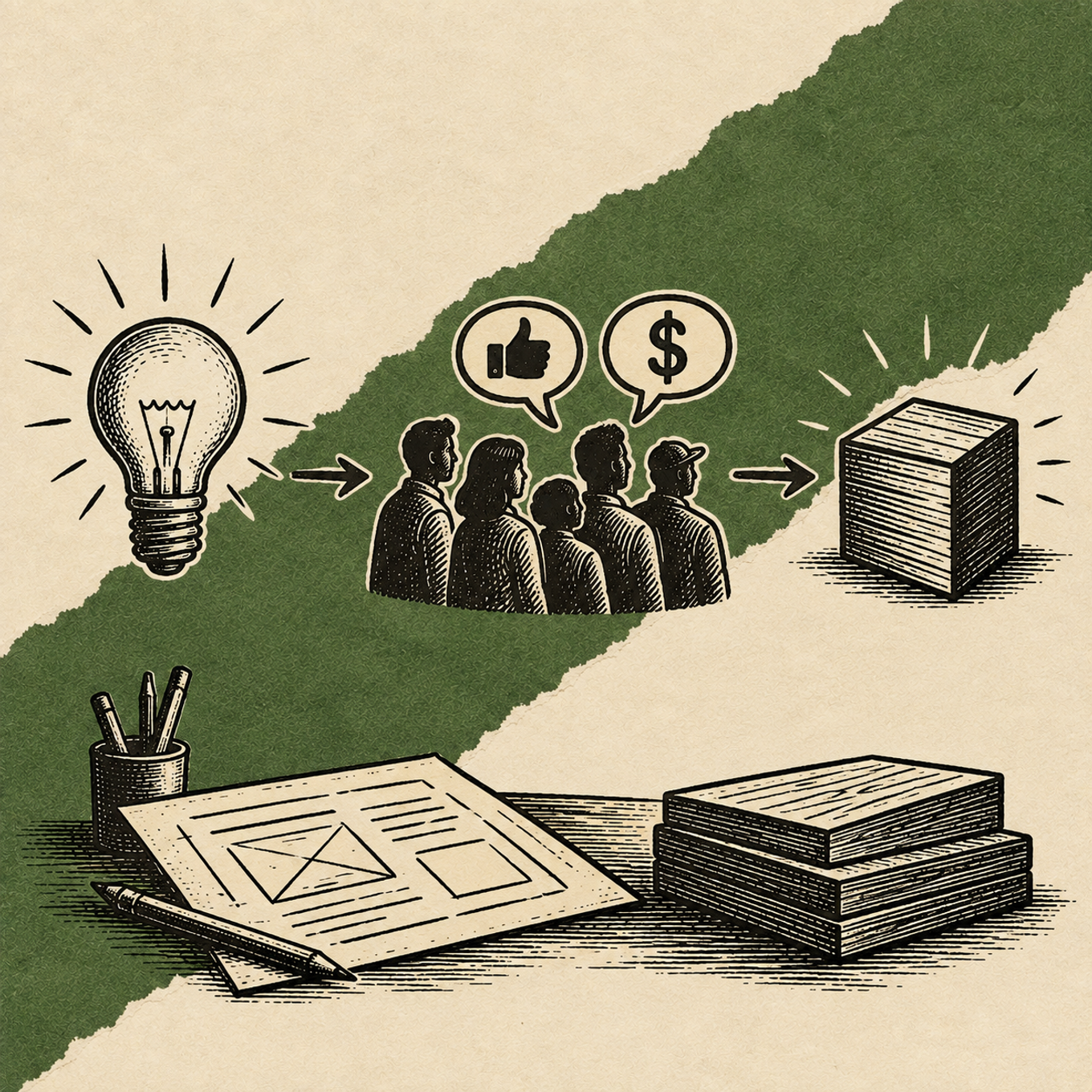
1. Conversations about the problem
Start by talking to 10 to 20 people who have the problem you want to solve, using the Mom Test rules from section 03. You're not pitching yet. You're finding out whether the problem is real, how often it happens, what they've already tried, and what they spend on it now. If you can't find people who have already tried to solve this problem, that's an early warning sign.
2. A simple page with a price on it
In 2010, Joel Gascoigne had an idea for a tool that would let people schedule their posts on Twitter. Before writing any real code, he built a simple web page that described what the tool would do, with a button to see plans and pricing. People who clicked it saw a message explaining the tool wasn't ready yet and asking for their email.
Then he added a page in between showing actual price plans, so he could see whether people would keep going after seeing what it would cost. People kept signing up, and a small number clicked on the paid plans. That was enough for him to spend the next seven weeks building a first version. He got his first paying customer four days after launch. The company became Buffer.
You can do the same thing with a free website builder in an afternoon. Describe what you're offering, show a real price, and add a button to buy or sign up. The price matters. A page with no price only tells you whether people are curious.
3. Do it by hand first
This is what Swinmurn did. Instead of building the full business, you deliver the product or service yourself, manually, to a few customers. If your idea is an app that matches dog owners with walkers, start by matching them yourself with a spreadsheet and text messages.
If it's a meal-prep service, cook for five families yourself for a month. It won't scale, and you may lose money on it. But you'll find out whether people pay, what they actually want, and what goes wrong, before you spend anything building a system.
4. Pre-sell it
Ask people to pay before the product exists, with a clear promise of when they'll get it and a refund if it doesn't happen. Crowdfunding sites like Kickstarter are built around this. In 2012, the company behind the Pebble smartwatch couldn't get enough money from investors, so it asked for pre-orders on Kickstarter instead.
It raised more than $10 million from about 69,000 backers before most of the watches were made. For a smaller idea, pre-selling can be as simple as asking five people for a deposit on a service you'll start next month.
5. Build the smallest version that works
Once the earlier tests show real demand, build the smallest version of the product that actually delivers the value, and charge for it. Gascoigne's first version of Buffer was missing features most people would consider essential.
When someone paid, he had to upgrade their account by hand because he hadn't built automatic upgrades yet. It didn't matter. People paid for the core value, and he improved the rest once he knew they would.
Testing When The Product Is Other People
Some ideas have a special problem. In a paid community, a membership, a club, or a marketplace that connects buyers and sellers, a big part of what people pay for is the other people who are there.
That creates a chicken-and-egg problem. The first customer shows up to an empty room, and nobody wants to pay to join an empty room. The tests above still work, but you have to adjust them.
Be the first supply yourself
In October 2007, Brian Chesky and Joe Gebbia were struggling to pay the rent on their San Francisco apartment. A big design conference was coming to town and the hotels were sold out. So they bought three air mattresses, put up a simple website called AirBed & Breakfast, and rented out space in their own living room. Three guests paid $80 each.
That company became Airbnb. Before there were any hosts on the site, the founders were the hosts. If your idea needs one side to exist before the other shows up, find a way to fill that side yourself at first. For a community, that can mean you are the main value in the beginning: your teaching, your connections, and your time.
Start with a small, hand-picked founding group
Hoover didn't open Product Hunt to everyone. He hand-picked the first 30 contributors so the early experience would be good from day one.
A community can be tested the same way. Instead of launching to hundreds of people, invite 8 to 15 people who fit your ideal member, and run the community with them for a set period, like two months.
Charge from the start, and be clear about what it is
Even a small founding group should pay something, because payment is the strongest signal on the ladder. Tell them plainly that they're founding members, that it's early, and that they'll help shape it, and consider a lower founding price in exchange.
Then watch what they do. Do they show up? Do they talk to each other, or only to you? Do they invite others? And when the trial period ends, do they renew? For a community, renewals are the real test, because they show whether the people in it found enough value in each other to keep paying.
How To Read The Results
A test is only useful if you know what counts as a yes. Three rules help.
Decide what success looks like before you start. Write down ahead of time what result would convince you to keep going, what would make you change the idea, and what would make you stop.
For example: "If at least 5 of the 20 people I talk to have already paid for a solution in the past year, I'll build the landing page. If at least 3 people pay a deposit, I'll start delivering it by hand." Deciding in advance keeps you from talking yourself into a weak result because you want the idea to work.
Count commitments, not compliments. Go back to the ladder in section 04. A hundred people saying "great idea" is weaker evidence than three people paying. When you look at your results, ignore the top of your notes and look for the moments when someone gave up time, reputation, or money.
Connect it to the math. In Vol. 1, we talked about how big a business can get: how many people want it, how badly, and how much you can collect. Use your results to check that math.
If 3 out of 20 people paid a deposit, that's 15 percent of people who have the problem. Is that rate, at your price, enough to support the business you want, given how many people you can realistically reach? If the numbers don't work, it's much better to find out now.
A weak result still tells you something useful. Often it means the problem is real but your solution, your price, or your customer isn't quite right. Many successful businesses started with a test that didn't work, and then changed one piece and tested again.
One Person, Start To Finish
Here's what the whole process can look like for one idea, including a result that didn't work.
Picture a man named Marcus. He's been a real estate agent for eight years, and he remembers how lonely and confusing his first year was. His idea is a paid online community for new agents, at $40 a month, where they can ask questions, share leads, and learn from people who've been through it.
He writes down what has to be true. New agents struggle enough in their first year to pay $40 a month for help. That's the assumption that would sink the idea if it's wrong. He sets his success line: if at least 5 of the first 50 people who see his page put down a deposit, he'll launch.
He finds people and talks to them. Friends aren't new agents, so he looks where new agents gather: a Facebook group for agents in his state, his local real estate association's newcomer events, and introductions from brokers he knows. He has 15 conversations.
He doesn't pitch the community. He asks about their first year so far. What's been hardest? What have they tried? What have they paid for? Most have spent money on something already: coaching programs, courses, lead lists.
The same pain comes up again and again. They don't know how to get their first few deals, and they feel like they're guessing.
He puts up a page with a price. The page describes the community and shows the $40 monthly price, with a button to reserve a founding spot for a $40 deposit.
He sends it to the people he talked to and posts it in the groups. About 60 people visit the page. Twelve join the email list. Nobody puts down a deposit.
He reads the result. Zero deposits is well below his success line. The old Marcus might have decided the idea was dead, or launched anyway and hoped. Instead, he goes back to his notes. The pain was real, and people had paid for help before.
But what they paid for were things with a clear outcome: a course, a coaching program. A community where they could ask questions sounded nice, but it didn't promise to fix the thing that was keeping them up at night, getting their first deals.
He changes one thing and tests again. He keeps the same customer and the same pain, and changes the offer: an eight-week small-group program for new agents, focused on getting their first three deals, with weekly calls led by him, for $300. He goes back to the people he talked to and asks for a $50 deposit. Six of them pay.
He does it by hand. He runs the first group himself on video calls, with a shared document for notes and no app, platform, or website beyond his simple page. Five of the six finish. Several close deals during the eight weeks. At the end, three of them ask if they can keep meeting every month, and they offer to pay for it.
That's when Marcus has real evidence for the community he originally wanted. It just had to start as something more specific, with a clear result, before people would pay to belong to it.
He spent about six weeks and almost no money to learn that. Building the full community platform first would have cost him months and still left him with an empty room.
Test Your Idea In Four Weeks
Week 1: Write down what has to be true
Write your idea in one sentence, then list what has to be true for it to work. Who has the problem? How often? What do they do about it now? What would they pay? Circle the one assumption that would kill the idea if it's wrong. That's what you're testing first.
Week 1: Set your success line
Before you talk to anyone, write down what result means keep going, what means change something, and what means stop.
Weeks 1–2: Have 10 to 20 problem conversations
Find people who have the problem, not just friends, using the places in section 05. Ask about their past behavior and spending, not your idea. Take notes on what they've tried and what they've paid for.
Week 3: Put up a page with a real price
Describe what you're offering, show the price, and add a way to buy, pre-order, or sign up. Send it to the people you talked to and anyone else who has the problem.
Week 3–4: Ask for a real commitment
Ask for a deposit, a pre-order, or a first paid order. If you can, deliver it by hand to the first few customers, the way Swinmurn bought and shipped each pair of shoes himself. If your idea is a community or depends on other members, start with a small, paid founding group, as in section 07.
Week 4: Compare the results to your line
Count the commitments, not the compliments. Compare them to the success line you wrote in week 1, and decide whether to build, change the idea and test again, or stop. Either way, you'll know far more than you did four weeks earlier, and you'll have spent very little to find out.
Go Further
The Mom Test, by Rob Fitzpatrick
A short, practical guide to talking with customers so you get the truth instead of compliments.
The Lean Startup, by Eric Ries
The book that made testing ideas before building them a standard practice, with many real examples.
"Idea to Paying Customers in 7 Weeks: How We Did It," by Joel Gascoigne
Buffer's founder explains his landing page and pricing page tests step by step, on the Buffer blog.
Delivering Happiness, by Tony Hsieh
The story of Zappos from the early days, told by the investor who later became its CEO.
Nick Swinmurn didn't know whether people would buy shoes online, so he found out with a camera and a borrowed shoe store. Juicero didn't know whether people needed a $400 juicer, and spent years and about $120 million before finding out.
Joel Gascoigne put up a page with a price on it before writing any real code. The Airbnb founders rented out their own living room before there was anyone else to host.
Every one of those stories comes down to the same question, will people actually pay for this? What separated them was when they asked it, and how.
You can ask it now, before you've spent months and savings. Talk to people who have the problem about what they've already done and spent. Put up a page with a real price.
Ask for a deposit, deliver it by hand to the first few people, and decide ahead of time what result means keep going. Count commitments, not compliments
If the answer is yes, you'll build with evidence behind you. If it's no, you'll have found out in a few weeks what could have cost you years, and you'll know what to change for the next test.