How To Master Anything
A cook whose knife stayed sharp for nineteen years, a kick practiced ten thousand times, an apprentice who made the same egg dish two hundred times, and a swordsman's thousand days show how mastery is actually built, what it costs, and how to keep going when progress stops.
The Cook Whose Knife Never Dulled
More than two thousand years ago, a Chinese philosopher named Zhuangzi told a story about a cook named Ding. One day Ding was cutting up an ox for his lord, Wenhui. The lord watched him work and couldn't believe what he was seeing.
Every movement of Ding's hands, shoulders, feet, and knees fit together, and the sound of the knife moving through the meat kept a steady rhythm, like music at a dance. "Ah! Admirable!" the lord said. "That your art should have become so perfect!"
Ding put down his knife and explained how he got there. When he first started cutting up oxen, all he could see was the whole animal in front of him. "After three years I ceased to see it as a whole," he said.
He had learned where every joint, gap, and hollow was. Now he didn't have to hack through anything. His knife slid through the natural openings in the body. Then he told the lord something that shows exactly what mastery looks like:
A good cook changes his knife every year; (it may have been injured) in cutting - an ordinary cook changes his every month - (it may have been) broken. Now my knife has been in use for nineteen years; it has cut up several thousand oxen, and yet its edge is as sharp as if it had newly come from the whetstone.
The ordinary cook works hard. He swings the knife into bone, over and over, and wears out a blade every month. The good cook is better and only needs a new knife once a year.
Ding, after years of doing the same work, had reached a point where the work barely wore on the knife at all. He was using far less force than the others, because he understood the ox so well that he knew exactly where to cut.
And even then, he didn't get careless. He told the lord that whenever he came to a complicated joint, he slowed down, kept his eyes on it, and moved his hand carefully. The master still took the hard parts seriously.
Most of us know what it's like to be the ordinary cook. You work hard at something for years, whether it's your job, a sport, an instrument, a business, or a craft, and it still feels like hacking through bone.
You're tired all the time, you're not getting much better, and you look at the people who seem to do it effortlessly and assume they were born with something you weren't.
Ding's story says something different. His skill came from years of doing one thing over and over, paying close attention each time, until he could see what beginners couldn't.
The Japanese and Chinese traditions of mastery have spent centuries thinking about how that happens. They have words for it, methods for it, and stories about it, from the martial arts school to the sushi counter to the tea room.
This article walks through what they teach, what modern research says about it, and how to use it on whatever you want to master.
Why Masters Look Gifted
When we watch someone who's great at something, it's natural to assume they have a gift. It's hard to see the thousands of hours behind what they do, so what we see instead looks like talent.
How you explain skill matters, because it changes what you do when things get hard. In the 1980s and early 90s, the psychologists Harold Stevenson and James Stigler spent years studying schools and families in the United States, Japan, China, and Taiwan.
One of the biggest differences they found was in what people believed about success. American parents more often believed that doing well in school came from ability, while the Japanese and Chinese parents they studied put much more weight on effort.
A 2001 study by the psychologist Steven Heine and his colleagues showed what this looks like in practice.
They gave Japanese and North American college students a task, told some of them they had done well and others that they had done poorly, and then watched how long each group kept working on a similar task afterward.
The North American students worked longer after they'd succeeded. The Japanese students worked longer after they'd failed.
That second group had the mindset every tradition in this article is built on. Falling short didn't mean they should quit. It meant there was more work to do. Mastery is something people build over time, and the traditions below are about how they build it.
Kata: Practicing The Form
In Japanese martial arts, and in many other traditional Japanese arts, students practice what's called kata.
The word means "form." A kata is a set sequence of movements, the same every time, that a student repeats over and over.
In karate, a kata might be a series of blocks, strikes, and steps performed against imaginary opponents in a fixed pattern. Students practice the same kata for years.
To an outsider, this can look pointless. Why keep repeating the same moves in the air when you could be sparring? But kata does something sparring can't.
It lets you practice each movement exactly right, thousands of times, without anyone hitting you back and throwing off your form.
Over time, the movements stop being something you think about and become something your body just does. When a real situation comes, you don't have time to think. You fall back on what you've practiced most.
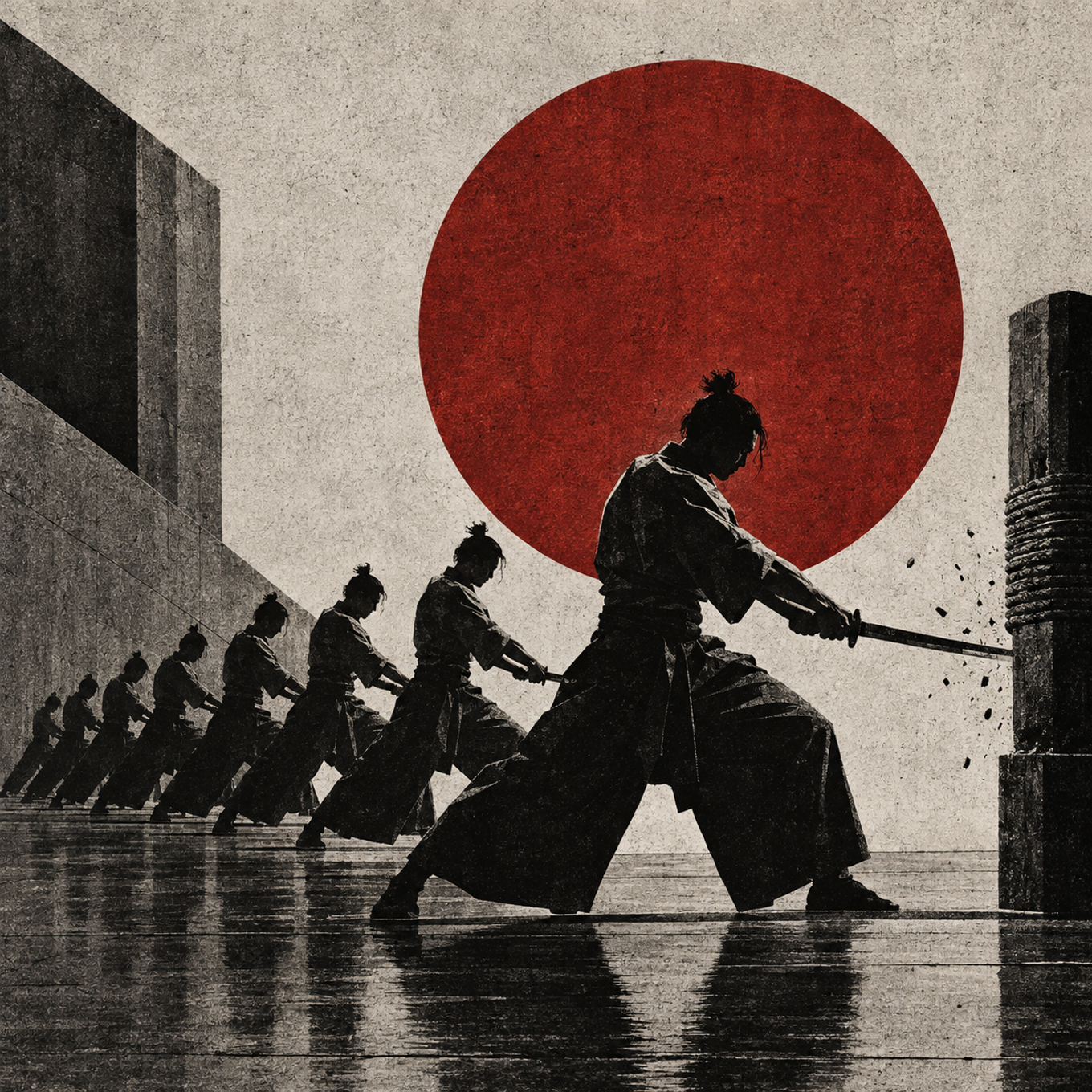
You don't need a dojo to use kata. Any skill can have its own. A pianist practices scales. A basketball player shoots the same free throw the same way hundreds of times. A public speaker practices the first two minutes of a talk until it comes out smoothly every time, even when they're nervous. A salesperson rehearses how they open a call. Each of these is a kata: a fixed form, repeated until it no longer takes thought.
Cook Ding had his own kata. He cut up oxen day after day, for years, the same work each time. That's how, after three years, he stopped seeing the whole ox and started seeing the joints.
One Kick, Ten Thousand Times
The man with 10,000 kicks knows a little about a lot. He's seen every technique, and he can do each one about as well as anyone who's tried it once.
The man with one kick has done it so many times that it's fast, strong, and accurate without him having to think about it. When it matters, he doesn't have to choose among 10,000 options. He has one thing that works, and it works every time.
I fear not the man who has practiced 10,000 kicks once, but I fear the man who has practiced one kick 10,000 times.
Bruce Lee himself studied many different martial arts, including fencing and boxing, so the quote doesn't mean you should only ever learn one thing.
It means that whatever you learn, going deep is what makes it useful. Mastery comes from a few fundamentals practiced until they're part of you.
You can see this almost everywhere. A salesperson who has made thousands of calls has heard every objection and knows exactly what to say, while one who keeps switching scripts never gets good at any of them.
A writer who writes every day gets better faster than one who reads a dozen books on writing and rarely writes. The pull today is to keep collecting new techniques, new apps, and new courses. The masters did the opposite. They picked a few things and did them over and over.
What Changes In A Master's Mind
It's fair to ask why repeating the same thing thousands of times works at all. The answer is that repetition changes what's happening inside you, in two big ways.
The first is that the skill moves from thinking to doing. In the 1960s, the psychologists Paul Fitts and Michael Posner described three stages that people go through when they learn a new skill.
In the first, which they called the cognitive stage, you think about every step. You're figuring out what to do, trying different approaches, and making a lot of mistakes.
In the second, the associative stage, you make fewer big errors and get more efficient, and you don't have to concentrate as hard.
In the third, the autonomous stage, the skill runs on its own. You can do it without thinking about it.
You've been through all three stages with driving. The first time you drove, you thought about every mirror, pedal, and turn signal. Now you can drive home while having a conversation.
That's what kata is for. Every repetition moves a skill a little further toward the stage where it runs by itself, which frees your attention for the parts that still need it.
The second change is in what you see. Remember that Cook Ding said that at first all he could see was the whole ox, and after three years he stopped seeing it as a whole.
Research on experts has found the same thing. In a famous 1973 study, psychologists William Chase and Herbert Simon showed chess positions from real games to players for a few seconds and asked them to rebuild the positions from memory.
Masters did far better than beginners. But when the pieces were placed at random, in positions that could never happen in a real game, the masters lost most of their advantage.
The masters didn't have better memories. After years of play, they saw the board in meaningful chunks, like a well-known attack or a common defense, where beginners saw separate pieces.
That's what Cook Ding meant. After thousands of oxen, he didn't see a mass of meat and bone. He saw the joints, the gaps, and the hollows, and that's why his knife never had to fight its way through.
Mastery changes how you see the work as well as how fast you do it. A master electrician looks at a panel and sees the problem. A master teacher looks at a classroom and sees which student is about to fall behind. Beginners look at the same scene and see a lot of things at once.
Follow The Form, Break It, Then Leave It
Kata raises a fair question. If you spend years copying someone else's form, when do you get to do things your own way? The Japanese answer is a three-stage idea called shu-ha-ri.
The idea is usually traced to Sen no Rikyū, the most influential tea master in Japanese history, who lived in the 1500s.
A poem attributed to him says, roughly, that you should keep the rules faithfully, and even when you break them or leave them behind, you should never forget where you started.
Later, another tea master, Kawakami Fuhaku, brought the concept to a wider audience, and it spread into the martial arts and other disciplines.
The three stages work like this:
Shu (守), "protect" or "keep." You follow the form exactly as your teacher shows you. You don't change anything, even if you think you have a better idea.
Ha (破), "break." Once you truly know the form, you start to see where it can bend. You study other teachers and styles, and you begin adapting what you've learned.
Ri (離), "leave." You're no longer bound by any form. You create your own way, drawing on everything you've learned.
The Japan Karate Association puts it plainly: first you have to master the kata your instructors teach you, then establish your own kata, and from there aim for a free state of mind that isn't bound by any set form.
The order matters. You can't skip to ri. The freedom of a master only comes after years of following the form. Most people want to start at ri.
They want to find their own style on day one, break the rules before they know what the rules are for, and skip the boring part where you copy someone better than you. That's usually why they stall. The masters spent years in shu first.
This is also why the traditions put so much weight on having a teacher. In 1985, the education researcher Benjamin Bloom published a study of 120 people who had reached the top of six fields, including concert pianists, Olympic swimmers, tennis players, sculptors, mathematicians, and research neurologists.
Almost none of them had been spotted as prodigies early on. What they had in common was a long series of teachers. Their first teachers tended to be warm and encouraging, which kept them interested in the work.
Later teachers were more demanding experts who pushed them hard and corrected every detail. That's shu in practice. You spend years learning the form from people who can see what you're doing wrong before you can.
Shokunin And Kaizen
The Japanese word shokunin means "craftsman" or "artisan," but it carries more than a job title. A shokunin is someone who devotes their life to one craft and keeps trying to do it better, long after everyone else would say they've gotten it right.
The best-known modern example is Jiro Ono, the sushi chef whose tiny restaurant in a Tokyo subway station was the subject of the 2011 documentary Jiro Dreams of Sushi.
Jiro had been making sushi for more than 70 years when the film was made, and he still described himself as climbing toward a top that no one could see. "No one knows where the top is," he said.
The film follows one of his apprentices, Daisuke Nakazawa. After about ten years working at the restaurant, Nakazawa was finally allowed to make the tamagoyaki, a sweet, layered egg omelet served as sushi.
He made it again and again, and Jiro rejected it again and again. It took him more than 200 attempts over many months before Jiro finally approved one, and when he did, Nakazawa cried. Nakazawa later moved to New York and opened his own restaurant, Sushi Nakazawa.
He spent ten years at the restaurant before he was allowed to make the egg, and then tried more than two hundred times to get one dish right. To a shokunin, that's simply what the work takes.
A related Japanese word is kaizen, which means "improvement" or "change for the better."
It became known around the world through Japanese manufacturing, especially Toyota, where workers were expected to look for small ways to improve their work every day, and through the 1986 book Kaizen by Masaaki Imai.
The idea is that you don't wait for a big breakthrough. You make one small thing better today, another tomorrow, and keep going. Over years, those small improvements add up to something no single leap could produce.
Gongfu And The Chinese Masters
Most English speakers know the word kung fu as a name for Chinese martial arts. But the word itself, 功夫, pronounced gongfu in Mandarin, originally meant something broader: skill built through time and hard work.
A calligrapher, a cook, or a carpenter can have gongfu. So can anyone who has put in the years it takes to get truly good at something. The word itself holds the lesson that skill and effort are the same thing seen from two sides.
Around the third century BC, the philosopher Xunzi wrote an essay called "Encouraging Learning," which Chinese students still read today. It's full of images about how mastery accumulates.
One of the best known says: if you carve and then give up, you can't even break rotten wood; if you carve and don't stop, you can engrave metal and stone. In the same essay he wrote that without piling up small steps, you can never travel a thousand miles.
Xunzi's point is the same one Cook Ding lived out. Nothing about carving stone is fast or dramatic. What matters is that you don't stop. The stone gives way because the carver keeps coming back, day after day.
Confucius, who lived about two centuries before Xunzi, added a warning that keeps practice from turning mindless:
Learning without thought is labour lost; thought without learning is perilous.
Repetition alone isn't enough. You have to think about what you're doing while you do it, the way Ding slowed down and watched closely at every difficult joint. And thinking alone isn't enough either. The person who reads and plans but never practices doesn't get anywhere.
The Pain Of Practice And The Pleasure Of Mastery
Everything so far has a hard truth underneath it. Doing the same thing ten thousand times, at the edge of your ability, while someone corrects you, is hard and often unpleasant. Every tradition in this article knows it.
There's a well-known Chinese saying, 吃得苦中苦,方为人上人. It means, roughly, that only by enduring the bitterest of hardships can you rise above others.
In Chinese, enduring hardship is described as chi ku, literally "eating bitterness." Musashi wrote in The Book of Five Rings that everything is difficult at first, from drawing a bow to swinging a sword, and that the strength comes from training.
Nakazawa's two hundred rejected egg dishes weren't pleasant. Neither were Cook Ding's first three years, when all he could see was a whole ox.
Research backs this up. When Ericsson studied the Berlin violinists, he defined deliberate practice as practice that takes a lot of effort and isn't inherently enjoyable, because it's designed to work on what you can't yet do well, and he found that the best violinists did the most of it.
Angela Duckworth and her colleagues later studied finalists in the National Spelling Bee. Of all the ways the spellers prepared, they rated deliberate practice, like studying words alone and memorizing, as the most effortful and the least enjoyable. It was also the kind of preparation that best predicted how far they advanced in the competition.
Not every study agrees that practice has to feel bad, and some find that people enjoy it more than Ericsson thought. But nearly everyone agrees it takes real effort.
That effort has limits, and the research on it may be the most useful thing in this article for anyone trying to master something while living a normal life. Ericsson found that even world-class performers could usually do only about an hour of deliberate practice before they needed a break, and about three to five hours a day in total.
The best violinists in his study also slept more than the others, including more afternoon naps. The masters practiced hard in focused sessions and then rested, instead of grinding all day. People who try to push through six or eight hours of intense practice a day usually burn out or get hurt.
The Pleasure
If mastery were only pain, almost no one would stay with it for ten thousand days. The other side is pleasure, and it grows as the skill grows.
The psychologist Mihaly Csikszentmihalyi spent decades studying what he called flow: the state where you're so absorbed in something that you lose track of time and the work seems to carry you.
He found that flow tends to happen when the challenge of a task matches your skill, when you have a clear goal, and when you get immediate feedback on how you're doing.
When a task is too easy you get bored, when it's too hard you get anxious, and when it's just past what you can easily do, you're most likely to find flow.
That's what Lord Wenhui saw when he watched Cook Ding work. Every movement fit together like a dance. And when Ding finished a hard cut, he told the lord, he would stand there with the knife in his hand, look around with satisfaction, and then wipe the blade and put it away.
That's the pleasure at the end of a long road: doing something hard and doing it well. Jiro Ono put it simply in the documentary about his restaurant. Once you decide on your work, he said, you have to fall in love with it and dedicate your life to mastering it.
The masters in this article endured decades of practice because they loved what the pain was building, and discipline alone would not have carried them that far. If you're trying to master something you don't care about, the bitterness will win.
If you love it, or come to love it as you get better, the pleasure gives you a reason to keep eating the bitterness.
A Thousand Days To Forge
Miyamoto Musashi was a Japanese swordsman who lived from about 1584 to 1645. By his own account, he fought more than 60 duels and never lost. Near the end of his life, he wrote The Book of Five Rings, a short book on strategy and training that is still read around the world.
In it, he describes training in two stages: one thousand days of training to forge, and ten thousand days of training to refine. The image comes from swordmaking. First the metal is heated and hammered into shape. Then it is polished, slowly, until it's sharp.
Do the math on Musashi's numbers. A thousand days is almost three years of daily training, and that's just to forge the basic shape of the skill. Ten thousand days is more than 27 years, and that's to refine it. Musashi was describing something that takes most of a lifetime, far longer than any 30-day challenge.
That can sound discouraging, but it's actually freeing. If mastery takes a thousand days just to form, then a bad week or a slow month doesn't mean you've failed. It means you're on day 40 of a thousand. What matters each day is whether you trained.
When you stop getting better
Almost everyone who works at a skill for long enough hits a point where they stop improving, even though they're still practicing. It's one of the most common reasons people quit, and the Fitts and Posner stages explain why it happens.
Once a skill reaches the autonomous stage, you can do it without thinking. That's useful, but it also means you stop paying attention to it, and when you stop paying attention, you stop getting better.
Think about typing. Many people type for hours every day, for years, and never get any faster. They reached a speed that was good enough, their fingers went on autopilot, and they've stayed there ever since.
The journalist Joshua Foer ran into this while training for the U.S. Memory Championship, which he went on to win in 2006. After months of practice, his speed at memorizing a deck of cards stopped improving.
He asked Ericsson for help, and he gave the problem a name that stuck: the OK plateau, the point where you're good enough that your brain stops trying to get better.
The way off the plateau is to pull the skill back out of autopilot. On Ericsson's advice, Foer timed himself with a metronome and forced himself to go faster than his usual pace, and whenever a card gave him trouble, he stopped to figure out exactly why.
That's what deliberate practice is for. Find the specific part you're weakest at, push past the pace or difficulty that feels easy, get feedback, and fix what the feedback shows you.
It's also what kaizen and Cook Ding's careful attention at the hard joints are about. Masters never let the whole skill go on autopilot. They keep finding the part that still needs their full attention.
What Research Adds
Modern research on expertise mostly backs up what these traditions figured out long ago, with a few important additions.
In 1993, the psychologist K. Anders Ericsson and his colleagues studied violin students at a top music academy in Berlin. They found that the best violinists had spent far more hours on solitary practice than the good ones, and the good ones more than those headed to become music teachers.
But it wasn't just any practice. Ericsson called it deliberate practice: practice designed to improve a specific part of your performance, done with full concentration, at the edge of what you can currently do, with feedback on how you're doing, and repeated over and over.
That lines up closely with the traditions. Kata is repetition of a specific form. Shu is learning from a teacher who can correct you. Kaizen is improving one small thing at a time.
Cook Ding slowing down at every hard joint is concentration at the edge of your skill. Confucius warning that learning without thought is wasted is the difference between deliberate practice and going through the motions.
The research also adds a limit that the traditions don't always mention. In 2014, psychologists Brooke Macnamara, David Hambrick, and Frederick Oswald combined the results of 88 studies on practice and performance.
They found that deliberate practice explained a meaningful share of the differences between people in games like chess (about 26 percent), music (21 percent), and sports (18 percent), but much less in education (4 percent) and professional work (less than 1 percent).
Practice matters a great deal, especially in fields with clear rules and clear feedback. But other things matter too, like when you start, how you're taught, and the abilities you bring.
That makes practice even more important to focus on, because you can't control most of those other things. You can control whether you practice, how often, and how well. Mastery is built mostly from the part that's in your hands.
Is it too late to start?
Many people who read about masters wonder whether they've missed their chance. The research gives a mixed answer, and both halves matter. In some fields, when you start makes a real difference.
The largest study ever done on learning a second language, published in 2018 by Joshua Hartshorne, Joshua Tenenbaum, and Steven Pinker, looked at nearly 670,000 people.
It found that the ability to learn a new language's grammar stays strong until about age 17 or 18 and then declines, and that people who want grammar as good as a native speaker's generally need to start by about age 10.
Top-level classical music and elite sports work in a similar way, which fits the Macnamara finding that the age you start is one of the things besides practice that matters.
But look at what that same study found about everyone else: people who started later still learned quickly and became very good. They just didn't sound exactly like someone who grew up with the language.
For almost everything else people want to master, like a trade, a business, cooking, writing, a subject, or an instrument played for the love of it, the three stages of learning work the same way at 45 as they do at 15.
Julia Child didn't enroll at the Le Cordon Bleu cooking school in Paris until 1949, when she was 37. Twelve years later she published Mastering the Art of French Cooking, which changed how Americans cooked. Musashi's thousand days are the same length at any age.
Mastering What You Learn In Your Head
Most of the stories in this article are about the body: cutting, kicking, making sushi, swinging a sword. But many people want to master something they mostly learn in their head, like a language, coding, law, medicine, investing, or a subject in school.
Everything above still applies. But for these skills there are two more findings from learning research that make a big difference, and most people ignore both of them.
Space it out
In the 1880s, a German psychologist named Hermann Ebbinghaus spent years memorizing lists of made-up syllables and testing himself on how quickly he forgot them.
He found that memory fades fast at first and then more slowly, a pattern now called the forgetting curve. He also found that when he spread his practice out over several days, he remembered far more than when he crammed the same amount into one sitting.
More than a century of research has confirmed this. In 2006, Nicholas Cepeda and his colleagues reviewed hundreds of experiments on the question and found that spreading practice out over time consistently beat cramming it together.
Each time you come back to something after a gap, just as you're starting to forget it, you strengthen it more than if you'd kept going while it was fresh.
This is the research behind Xunzi's small steps and Musashi's daily training. An hour a day for a week does more than seven hours on a Sunday.
Test yourself
The second finding surprises almost everyone. In 2006, Henry Roediger and Jeffrey Karpicke gave college students passages to learn. Some students read the passage several times.
Others read it once and then practiced writing down everything they could remember. When the students were tested five minutes later, the ones who kept rereading did better.
But when they were tested two days or a week later, the students who had practiced recalling it remembered much more.
Pulling something out of your memory strengthens it far more than looking at it again. The trouble is that rereading feels productive, because the material looks more and more recognizable, so it's what most students do.
Surveys have found that most college students study mainly by rereading and rarely test themselves.
This is kata for the mind. A karate student doesn't learn a kata by watching someone else perform it. They learn it by performing it themselves, from memory, over and over.
For a language, that means closing the book and trying to say the sentence. For coding, it means building the program again without the tutorial open. For law or medicine, it means working practice questions instead of rereading your notes. It's harder, and you'll get things wrong, which is exactly why it works.
What mastery costs
There's one more thing the stories in this article show, and it's worth facing before you begin. Mastery takes time, and time spent on one thing is time not spent on something else.
In Jiro Dreams of Sushi, Jiro admits that he was rarely home when his sons were growing up, and that he was probably more like a stranger to them. He tells a story about sleeping in on a rare Sunday, and his youngest son telling their mother there was a strange man sleeping in the house.
His sons both became sushi chefs, and his work made him one of the most respected chefs in the world. But the cost was real, and he said so.
So pursue mastery, but choose it on purpose. Decide what you're willing to give up for it and what you're not, and protect the things that matter more to you than the craft.
Musashi's thousand days can fit around a family, a job, and a life, as long as you decide ahead of time where the practice fits and where it doesn't.
How To Master Anything
Choose your one kick
Pick one skill you want to master, and inside it, pick the one fundamental that matters most. For a writer, it might be writing a clear first sentence. For a salesperson, it might be the first 30 seconds of a call. For a lifter, it might be the squat. Write it down. This is what you'll practice ten thousand times.
Build your kata
Turn that fundamental into a fixed drill you can repeat the same way every time. Keep it short enough to do daily, around 15 to 30 minutes. A pianist's scales, a player's free throws, and a speaker's opening two minutes are all kata. Do the same form every day until it stops taking thought.
Start in shu
Find someone who does this better than you, whether it's a teacher, a coach, or a person whose work you can study closely, and copy how they do it exactly. Resist the urge to put your own spin on it yet. Your own style will come after you know the form.
Slow down at the hard joints
In every practice session, find the part that's hardest for you and give it your full attention, the way Cook Ding did with every difficult joint. Get feedback on it, whether from a teacher, a recording, or a result you can measure. This is what turns repetition into deliberate practice.
Push past autopilot
Once a week, check whether you're still improving. If you've stopped, find the one part of the skill you've let run on autopilot, and work on it at a pace or difficulty that's hard for you. Record yourself or measure the result, look closely at where you fail, and fix that.
Space it out and test yourself
Spread your practice across the week instead of saving it for one long session. And whenever you're learning something in your head, close the book and pull it from memory: say it, write it, build it, or answer a question about it. Check what you got wrong, and come back to those parts first next time.
Practice hard, then rest
Keep your deliberate practice sessions to about an hour at a time, with breaks in between. Don't try to grind all day. Protect your sleep, because the research on top performers shows that rest is part of how they got good.
Find what you love in it
Write down what you enjoy about the craft, whether that's the feeling of getting something right, the flow when the challenge is just right, or what the skill lets you do for other people. On the days the practice is bitter, read it. You'll stay with something for a thousand days only if part of you loves it.
Make one thing better
At the end of each session, write down one small thing you'll do better next time. That's kaizen: one small improvement, every day, for a very long time.
Count your thousand days
Mark every day you practice. Your first goal is Musashi's thousand days, about three years. Measure yourself by whether you trained today, and keep going on the days it feels like nothing is changing.
Go Further
Jiro Dreams of Sushi (2011)
The documentary about Jiro Ono and his apprentices, including Nakazawa's long road to making the egg sushi.
The Book of Five Rings, by Miyamoto Musashi
A short book the swordsman wrote near the end of his life on strategy, training, and the thousand and ten thousand days.
Make It Stick, by Peter Brown, Henry Roediger, and Mark McDaniel
A practical guide to spacing, self-testing, and the other learning methods that work best for skills you learn in your head.
Peak, by Anders Ericsson and Robert Pool
Ericsson's own explanation of deliberate practice, written for everyday readers, with examples from music, sports, medicine, and memory.
Think back to Cook Ding standing over the ox, with a knife he had used for nineteen years that was still as sharp as the day it came off the whetstone. He didn't start that way.
For his first three years, all he could see was a whole ox, and he was hacking through bone like everyone else. What got him from there to the day the lord stood amazed wasn't a gift or a secret.
It was the same work, done thousands of times, with attention, until he could see where to cut. Bruce Lee's one kick, the karate student's kata, Nakazawa's two hundred egg dishes, and Musashi's thousand days are all the same story told in different places.
So pick the one thing you want to master, and start your first thousand days. Learn the form from someone better than you, and repeat it until it becomes part of you.
Slow down at the hard joints, rest when you need to, and push past the point where good enough starts to feel easy. On the days it's bitter, remember what you love about it.
And when it feels like nothing is changing, keep going, because that is exactly how the people in this article kept going too.