Under the fig tree: an essay on temptation
How To Stop Giving In To Urges
A weeping man in a garden in Milan, a slave running from a house in Egypt, a sailor lashed to his own mast, and a psychologist who told a smoker to picture the ocean. What they each discovered about temptation, and what the research has since confirmed about the people who manage to leave an old habit behind for good.
A Garden In Milan
In the late summer of the year 386 AD, a thirty-one-year-old professor of rhetoric walked out of his lodgings in Milan and into the small garden behind the house, followed at a distance by his closest friend, who could see that something in him was about to give way.
His name was Augustine, and by the standards of his world he had done very well for himself. He had come from a provincial town in North Africa, the son of a minor official who had strained the family's money to educate him, and he had risen through Carthage and Rome to one of the most prestigious teaching posts in the Western empire.
He was admired for his speeches and courted by people with influence. He was also, by his own later account, a man who had spent more than a decade chained to appetites he no longer wanted and could not seem to put down. He had prayed about them for years. The prayer he remembered best, and later confessed with a kind of rueful honesty, was this one: "Give me chastity and continency, only not yet."
That morning a visitor had told him the story of two government officials in the city of Trier who had stumbled on a book about the life of a desert monk and, within the hour, walked away from their careers to live the way that monk had lived. Augustine had listened with mounting shame. He had spent years reading and arguing and understanding, and these two men had simply read one book and acted.
When the visitor left, he went into the garden, threw himself down beneath a fig tree, and wept. He tells us what he was saying to himself in the dirt: how long, how long, tomorrow and tomorrow, why not now, why not this hour an end to my uncleanness?
Then, from the house next door, he heard a child's voice, a boy or a girl, he could never say which, chanting the same words over and over in a sing-song rhythm, as if it were part of a game. Take up and read. Take up and read. He could not remember any children's game that went that way.
He got up, went back to the bench where his friend Alypius was sitting, picked up the book of Paul's letters he had left there, and opened it to the first passage his eyes fell on.
Romans 13:13–14 (KJV)
...not in rioting and drunkenness, not in chambering and wantonness, not in strife and envying. But put ye on the Lord Jesus Christ, and make not provision for the flesh, to fulfil the lusts thereof.
He wrote later that he had no wish to read further and no need to, because as he reached the end of the sentence a light seemed to flood into his heart and every shadow of doubt drained away.
He went inside and told his mother, who had prayed for him since he was a boy. He resigned his post at the end of the term. He would live another forty-four years, and become one of the most influential thinkers in the history of the Western world, and he would never go back to the life he had wept over in that garden.
People who tell this story tend to dwell on the child's voice and the flash of light, which is understandable, since those are the parts that feel like a miracle. I want to draw your attention to something often overlooked. Look again at the instruction Augustine's eyes landed on. The final clause of that verse is practical to the point of being almost domestic.
Make no provision for the flesh. Do not stock the pantry for the part of you that wants to fall. It is advice about arrangement and supply, about what you keep within reach, and it turns out to be very close to the conclusion that psychologists would arrive at, after a great deal of expensive research, some sixteen centuries later.
If you have picked up this essay, there is a fair chance you know something of what Augustine felt under that tree. Perhaps it's a phone at midnight, or a bottle, or standing in the kitchen eating in the middle of the night, or a message you know you shouldn't send, or a mood you let curdle into something uglier. The shape is usually similar.
You make a promise, often in the morning and nearly always in earnest, and you keep it for a while, sometimes long enough to start believing that this time is different. Then an evening arrives when you're tired and alone and the old wanting walks back in as though it had only stepped out for a moment, and you argue with it for a while, and at some point in the arguing you stop, and afterwards there’s that familiar judgment about what it says about you.
You are in very large company. In 2012 a team of researchers led by Wilhelm Hofmann gave 205 adults in and around the German city of Würzburg a device that buzzed at random moments throughout the day for a week, and each time it went off the participants recorded whether they were feeling any kind of desire and what they were doing about it.
Between them they logged nearly eight thousand episodes of wanting. People reported feeling some desire about half the time they were awake, and a good share of those desires were pulling against something else the person cared about.
What I want to do in the pages that follow is to lay the old wisdom and the new research side by side and let them talk to each other, because they turn out to agree on far more than either side usually admits.
And the thing they agree on most is something Augustine's verse was already hinting at: the people who finally get free tend to be those who learned to arrange their lives so the moment of temptation came less often, who prepared for it long before it arrived, and who knew what to do with themselves on the other side of a fall.
The Cookie Experiment & The Myth Of Willpower.
In 1998 a group of undergraduates at Case Western Reserve University arrived for a psychology experiment having been asked to skip a meal beforehand. They were shown into a room where a batch of chocolate chip cookies had just been baked, so that the whole place smelled of warm sugar and butter, and on the table in front of them sat two bowls, one of cookies and another of raw radishes.
Some of the students were told they could eat the cookies. The unlucky ones were told to eat only the radishes and to leave the cookies alone, and then they were left by themselves in that fragrant room to do it.
Afterwards everyone was given a set of geometric puzzles which, unknown to them, had no solution. The researchers, led by Roy Baumeister, measured how long each person kept trying before giving up. The students who had spent their willpower resisting the cookies gave up far sooner than the students who had eaten them. From that experiment and many that followed, a compelling idea took hold.
The idea was given the name ego depletion, and for about fifteen years it shaped a great deal of what psychologists believed and what self-help books told their readers. It had the great advantage of matching how people feel at eleven o'clock at night.
Then, in 2016, more than twenty laboratories on several continents agreed on a single careful protocol and ran the experiment again at the same time, with thousands of participants between them, and the effect all but disappeared.
Psychologists still argue about what remains of the idea, and some of them believe a smaller, subtler version may survive. What did not survive very well was the comfortable picture in which some people are simply born with bigger tanks, and the way to beat temptation is to train yourself to hold out longer.
So in short, the old idea of willpower as a limited resource has been seriously questioned. Some researchers think there may still be some truth to the idea that self-control can become harder under certain conditions, but it probably isn't as simple as having a fixed "tank" of willpower.
The research that grew up in the space left behind is, I think, more interesting and a good deal more hopeful. When Hofmann's team in Würzburg looked at the people in their study who scored high on self-control, they expected to find that those people resisted their temptations more often and more successfully than everyone else.
They found nothing of the sort. People with high self-control did not seem to be any better at the moment of resistance. What distinguished them was that they reported running into fewer temptations to begin with, and that they did more of the ordinary things that kept temptations from arising.
A few years later, Marina Milyavskaya and Michael Inzlicht followed 159 university students across a whole semester. Several times a day the students' phones asked them what goals they were pursuing, what temptations they were facing, and how hard they were working to hold themselves back.
When the term ended, the researchers checked who had actually reached their goals. Effortful self-control, the grinding, teeth-clenched kind, turned out to be consistently unrelated to success, while the sheer amount of temptation a student had faced was a strong predictor of failure.
Every temptation you face and defeat still costs you something, and a life organized around winning dozens of those contests a week is a life that is almost certain to lose one of them eventually. The people who seemed so strong were, for the most part, fighting fewer battles.
Angela Duckworth, working with the philosopher Tamar Szabó Gendler and the psychologist James Gross, gave this insight a useful shape. They pointed out that there are several moments in the life of a temptation at which a person can intervene.
You can choose which situations you walk into in the first place. You can change a situation once you're in it. You can steer your attention away from the tempting thing, or change the way you think about it. And last of all, when the desire is already fully formed and in front of you, you can try to suppress it.
Their argument, drawing on a large body of evidence, is that the earlier interventions tend to work better and cost less, and that the final one, sheer suppression, is the most exhausting and least reliable of them all. Most of us, of course, spend nearly all of our effort on that last one.
There is one more piece to the picture. When the psychologist Wendy Wood and her colleagues asked people to keep diaries of what they were doing and thinking at regular points through the day, they found that about 43 percent of what people did was something they did almost every day, usually in the same setting, and often while their minds were somewhere else entirely.
A great deal of what we do is set off by a place, a time, a mood, or an object in our hands, long before any decision is made.
A good many of the battles we blame on our own weakness have been half decided in advance by a sofa, a charger beside the bed, a particular route home, or the silence of an empty apartment after a hard day.
The Charioteer And The Mast
The Greeks would not have been surprised by any of this. Around 370 BC, in a dialogue called the Phaedrus, Plato described the human soul as a winged chariot pulled by two horses.
One of them is well-bred and upright, obedient to a word, and needs no whip. The other is crooked and heavy and hot-blooded, deaf to the voice of the driver, and forever lunging toward whatever it wants.
The charioteer, who stands for reason, spends the whole journey trying to keep the pair pulling in the same direction, and Plato describes, with real sympathy, the sweat and the struggle it takes when the dark horse catches sight of something it desires.
Anyone who has ever felt divided against themselves will recognize the scene. We tend to speak of the self as a single thing that chooses, and Plato saw that it often behaves more like a team in harness that will not agree on where to go. His student Aristotle took up the same problem a generation later and gave it the name that philosophers still use.
Akrasia is the condition of knowing perfectly well what is better and doing the worse thing anyway,
and in the seventh book of his Nicomachean Ethics Aristotle circles around it for page after page, trying to understand how a person can act against their own judgment. In the course of that investigation he draws a distinction that lines up with the modern research almost eerily well.
The continent person
Feels the wrong desire in full force, struggles with it, and usually wins. Aristotle admires this person, but he sees that they live in a state of permanent conflict, paying for every victory.
The temperate person
Has shaped their desires over time so that the wrong thing has lost most of its pull. They are rarely seen struggling, because there is very little left to struggle against.
For Aristotle, continence was only a step along the way. The real goal was to become the kind of person whose desires had changed. He was equally clear that the change comes slowly, through practice, in much the way a person learns to play an instrument or build a house.
We become just by doing just acts, temperate by doing temperate acts, brave by doing brave acts.
Augustine, looking back on the years before the garden, described the same process running in the opposite direction, and he described it so precisely that it could stand as a definition of addiction in any modern textbook.
An unruly will, he wrote, gave birth to a lust; the lust, once served, became a custom; and the custom, left unresisted, hardened into a necessity. He could feel the links of that chain around him and could not find the strength to break them, because he was held by nothing more than his own habit, which had become by then a second will living alongside the first.
The Sailor Who Did Not Trust Himself
Older than any of these is a story told by Homer, perhaps eight centuries before Christ. Odysseus, making his long way home from Troy, is warned by the enchantress Circe that his ship must pass the island of the Sirens, whose singing is so lovely that sailors who hear it steer toward the sound and wreck themselves on the rocks, where the bones of earlier crews lie heaped along the shore.
Circe tells him how to get past. He softens a cake of beeswax in the sun, kneads it in his hands, and presses it into the ears of every man on his crew. Then he has them bind him upright to the mast, hand and foot, and he gives them a strict order that if he begs to be released while the song is playing they are to tie the ropes tighter.
When the ship draws near, the Sirens begin to sing to him by name, promising knowledge of everything that happens on the earth. Odysseus, in Homer's telling, strains against the ropes and signals frantically to his men with his eyebrows to cut him loose, and two of them rise from their benches and bind him more tightly still, and they row on until the singing fades behind them.
What makes the story so useful is what Odysseus understood about himself before the ship ever came near the island. He knew that when the song reached him he would want it more than he wanted his own life. He made his decision early, in the clear light of the morning, while his head was his own, and he made it in a form that the later, enchanted Odysseus had no power to undo.
Economists and philosophers still call such an arrangement a Ulysses contract, after the Latin form of his name, and it is one of the oldest and most effective tools we have.
The Slave Who Taught Emperors
Epictetus was born into slavery in the first century, in a town in what is now Turkey, and he walked with a limp for most of his life, perhaps from an injury he suffered while enslaved. He was eventually freed, studied philosophy in Rome, and, when the emperor Domitian banished the philosophers from the city, went to the Greek coast and opened a school where the sons of senators came to listen to him.
He never wrote anything down himself, but a student named Arrian took careful notes of his lectures, and a Roman emperor, Marcus Aurelius, would later count those notes among the books that shaped him most.
Epictetus spent much of his teaching on what he called impressions, the images and suggestions that arrive in the mind uninvited and try to carry us along with them.
He had a good deal to say about how to meet them, and we will come back to him later on in this article, because some of the most practical advice about temptation in the whole ancient world was given by a lame former slave to a room full of rich young men who had never been told no.
A Way Of Escape
At first, the Bible's teaching on temptation can seem simple: resist it, don't give in, choose what is right, seek. God. But its stories are more complicated than that. Its most important figures struggle with temptation, and its most respected writers speak openly about their own weakness. Across its pages, you find people giving in, fighting to change, and learning what it takes to resist.
Crouching at the door
The word sin first shows up in the story of Cain and Abel. Both brothers bring God an offering. Abel's is accepted and Cain's isn't, and Cain gets very angry. The text says his face fell. Before he does anything, God speaks to him.
Genesis 4:7 (KJV)
If thou doest well, shalt thou not be accepted? and if thou doest not well, sin lieth at the door. And unto thee shall be his desire, and thou shalt rule over him.
In the Hebrew, sin is pictured crouching at the door like an animal, waiting for its chance, and it wants him. God tells Cain to rule over it. The verb there, timshol, can be read as a promise ("you shall rule over it"), a command ("you must"), or a possibility ("you may"), and translations go different ways.
John Steinbeck took the last reading, which his characters put as "thou mayest," and built much of East of Eden around it. Whichever way you read it, Cain gets the warning while he's still only angry. In the next verse, out in the field, he kills his brother.
How Desire Grows Into An Act
The letter of James describes how temptation works in two sentences.
James 1:14–15 (KJV)
But every man is tempted, when he is drawn away of his own lust, and enticed. Then when lust hath conceived, it bringeth forth sin: and sin, when it is finished, bringeth forth death.
The Greek words behind "drawn away" and "enticed" come from hunting and fishing. The picture is of an animal lured out of cover, or a fish going for bait. Then James switches to the language of pregnancy.
Desire conceives and gives birth to sin, and sin, once it's grown, gives birth to death.
So in James's account, sin comes later, after desire has been allowed to take hold. He doesn't spell out the lesson, but there are stages in his picture, and each one is a point where the whole thing could still be stopped. In the next section you'll see psychologists describing that same stretch of time in much the same way.
Paul's Confession
If you think real faith should make temptation go away, read the seventh chapter of Romans. More books of the New Testament carry Paul's name than anyone else's. He took his message through the cities of the eastern Mediterranean and ended up in Rome as a prisoner. And in this chapter he writes, in the first person, about wanting one thing and doing another.
Romans 7:19 (KJV)
For the good that I would I do not: but the evil which I would not, that I do.
People have argued for centuries about who this "I" is. Some say it's Paul as a Christian, some say it's Paul before his conversion, and some say he's speaking for anyone trying to keep the law in their own strength.
Augustine himself changed his mind about it. Whatever Paul meant, a great many readers have recognized themselves in it, and it isn't far from Plato's two horses or Augustine's two wills. Paul doesn't leave it there, though. At the end of the chapter he asks who will deliver him, and chapter 8 is his answer.
It opens: 'There is therefore now no condemnation to them which are in Christ Jesus, who walk not after the flesh, but after the Spirit.' The man who a few verses earlier couldn't do the good he wanted is now talking about being set free.
He doesn't pretend the struggle is gone. Later in the same chapter he tells his readers that if they 'through the Spirit do mortify the deeds of the body,' they will live, which is the language of an ongoing fight.
What changes is that he's no longer fighting alone, and he's no longer fighting under a verdict of condemnation. He writes that the Spirit 'helpeth our infirmities,' and he ends the chapter by saying that nothing, not death or life or anything else in creation, can separate us from the love of God.
For someone who has failed over and over and is carrying the shame of it, that is a very different place to start from.
The Garment Left Behind
For a story about someone who actually said no, go to Joseph. His brothers sold him to traders, and the traders sold him in Egypt to Potiphar, an officer of Pharaoh and captain of the guard.
Joseph was good-looking, the text says, and Potiphar's wife wanted him. She asked him day after day, and he kept refusing. Then one day he went into the house to do his work and none of the men of the household were there. She grabbed his garment and said, "Lie with me." He left the garment in her hand and ran out of the house.
He paid for it. She kept the garment and used it to accuse him, and he spent years in prison. But in that moment he didn't stay to argue, and he didn't wait around to see how long he could hold out. He ran.
Paul gives the same advice in two words in his first letter to the Corinthians: "Flee fornication." The verse Augustine read in the garden, about making no provision for the flesh, moves the same idea earlier, to before you're ever alone in the house.
A Way Out
When someone is struggling with temptation, there's a good chance someone will quote them this verse from Paul's first letter to the Corinthians.
1 Corinthians 10:13 (KJV)
There hath no temptation taken you but such as is common to man: but God is faithful, who will not suffer you to be tempted above that ye are able; but will with the temptation also make a way to escape, that ye may be able to bear it.
It starts by saying your temptation isn't unusual, which helps if you've been keeping yours a secret. Then it promises a way to escape and the strength to bear it, both at once.
The Greek word for "way to escape," ekbasis, simply means a way out. The Scottish Bible commentator William Barclay pictured it as a mountain pass that opens up for an army that thought it was surrounded. For Joseph, it was the door of Potiphar's house.
Hunger in the wilderness
Matthew, Mark, and Luke all tell about Jesus being tempted in the wilderness. In Matthew, the tempter shows up after forty days of fasting, and the text says plainly that Jesus was hungry.
The first temptation is to turn stones into bread. Notice when it comes and what it goes after. He has been worn down for weeks, and the offer is aimed straight at what he needs most - food.
He's tempted three times, and each time he answers with a line from Deuteronomy, using the words It is written. He doesn't debate the offer. He answers with Scripture he already knew.
In section 07 you'll see that deciding your response ahead of time is one of the best-supported ideas in modern research on self-control.
Later in Matthew, on the night before the crucifixion, Jesus goes with his disciples to a place called Gethsemane. He takes Peter, James, and John a little farther with him and asks them to stay awake while he prays. When he comes back they're asleep, and he says to Peter:
Matthew 26:41 (KJV)
Watch and pray, that ye enter not into temptation: the spirit indeed is willing, but the flesh is weak.
He's telling them to stay alert so they don't walk into temptation in the first place. Before that night was over, Peter had denied three times that he even knew him.
The House That Was Swept Clean
Matthew and Luke both record a strange little story Jesus told. An unclean spirit leaves a man and wanders through dry places looking for rest, and doesn't find any. So it says, "I will return into my house from whence I came out."
When it gets back, the house is empty, swept, and put in order. It goes and brings seven other spirits worse than itself, they all move in, and the man ends up worse off than before.
In Matthew, Jesus applies this to "this wicked generation," the people standing in front of him. But readers have taken a personal lesson from it for a long time. In the ninth century, the scholar Rabanus Maurus read the empty house as a life empty of good works.
On that reading, the trouble is that the house was cleaned and then left empty, and the emptiness is what let the spirit back in.
If you drop a habit and put nothing in its place, whatever the habit was doing for you still needs doing.
Paul says something related in his letter to the Galatians: "Walk in the Spirit, and ye shall not fulfil the lust of the flesh." His answer is to give your life a new direction to walk in.
Getting Up Again
The writer of Ecclesiastes says two are better than one, because if one falls, the other can help him up. Then he adds: "woe to him that is alone when he falleth; for he hath not another to help him up."
And there's a line in Proverbs that people quote often.
Proverbs 24:16 (KJV)
For a just man falleth seven times, and riseth up again: but the wicked shall fall into mischief.
In context, the verse is a warning to anyone plotting against a good person, and the "falling" most likely means trouble and hard times rather than sin.
Still, people have long read it more broadly, as a picture of someone who keeps getting knocked down and keeps getting back up. That idea comes back in section 08, where the research on relapse suggests that what you do in the hours after a slip matters about as much as anything you do before it.
Other traditions.
The Qur'an tells Joseph's story too. Near the end of it, when the truth comes out, there's a line saying the soul pushes a person toward wrong except where God shows mercy (Qur'an 12:53). "And I do not seek to free myself from blame, for indeed the soul is ever inclined to evil, except those shown mercy by my Lord." (Qur'an 12:53, Surah Yusuf, trans. Mustafa Khattab, The Clear Quran).
Muslim commentators disagree about who says it. Ibn Kathir said it was the official's wife, the Qur'an's version of Potiphar's wife. Others, going back to early figures such as Ibn Abbas, said it was Joseph.
Islamic tradition, especially Sufi writing, talks about jihad al-nafs, the struggle against the lower self.
Buddhist teaching, which comes up in the next section, pays close attention to the moment a feeling turns into craving, and teaches that seeing that moment clearly is part of getting free. These traditions disagree about plenty, but on this subject they notice a lot of the same things.
The Smoker Who Pictured The Sea
The psychologist Alan Marlatt, who spent most of his career at the University of Washington and did as much as anyone to shape how addiction is treated today, liked to tell a story in later interviews about a man he had once worked with who was trying to give up cigarettes.
As Marlatt remembered it, the man described his cravings as something that just kept building. They grew stronger and stronger, he said, until he felt he had no choice left but to smoke, as though the only way to make the feeling stop was to give it what it wanted.
Marlatt offered him another way to picture it. Think of the urge, he suggested, as a wave coming in from the ocean. It swells as it approaches, rises to a crest, and then breaks and runs back down the sand.
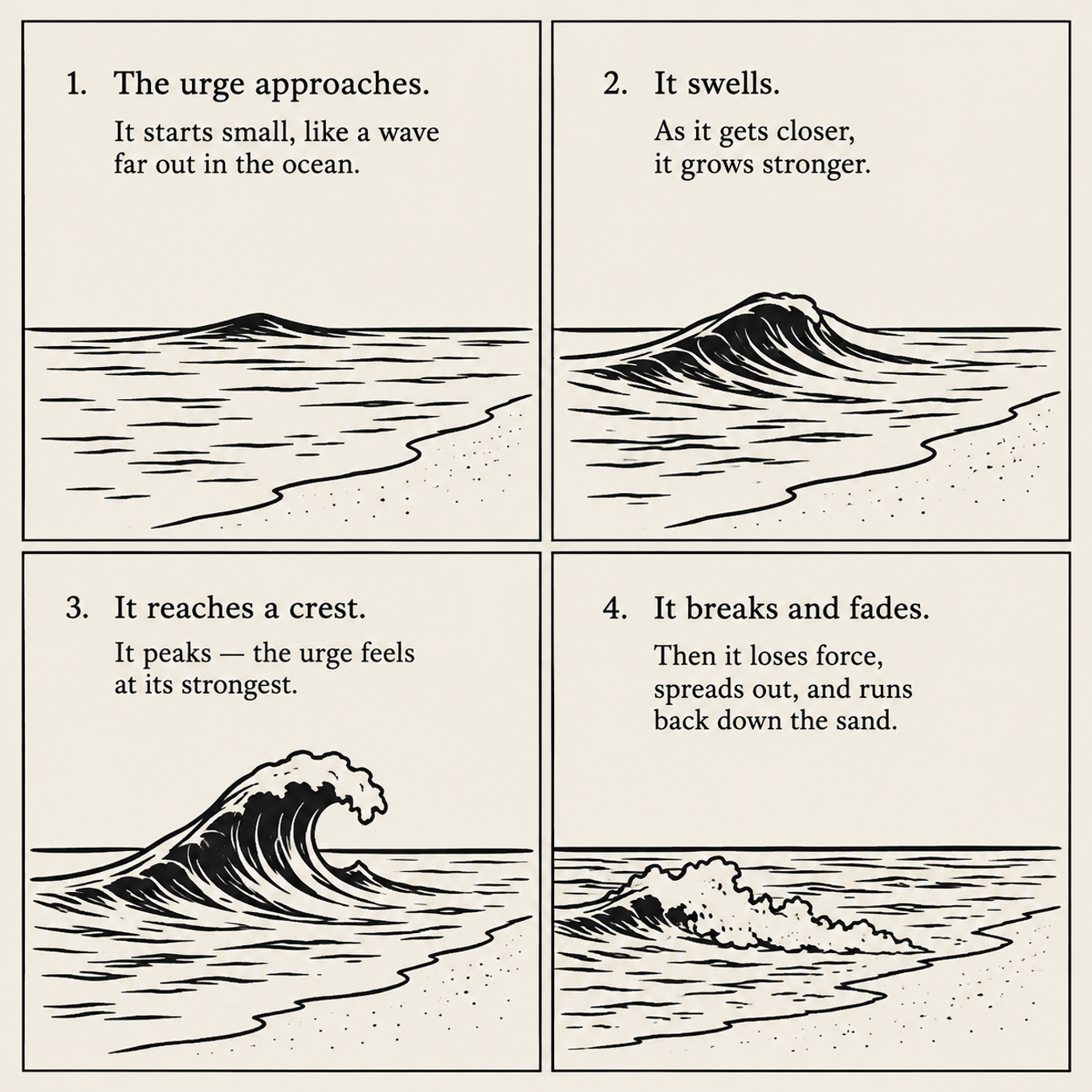
It feels, while it is building, as though it will keep climbing forever, and it never does. What if, instead of trying to hold the wave back or letting it knock him over, the man simply rode it, the way a surfer rides the face of a wave, all the way over the top and down the far side? The practice that grew out of that conversation came to be called urge surfing.
When a craving arrives, the person neither fights it nor obeys it. They turn toward it with a kind of curiosity, noticing where in the body it seems to live, a tightness in the chest perhaps, or a restlessness in the hands, or a hollowness in the stomach. They notice how strong it feels and how that strength shifts from one minute to the next. They breathe, and wait, and watch it change.
In 2009 Sarah Bowen, one of Marlatt's colleagues, put a brief version of the technique to the test with him. They recruited 123 college students who smoked and who wanted to cut back, and they brought each of them into the lab and deliberately exposed them to cigarettes in a way designed to stir up a strong urge to smoke. Half the students were given short instructions in urge surfing beforehand. The other half were given none.
The result is one of the most important findings in this essay, and it is easy to misread. The students who had learned to surf their urges did not report weaker cravings. Their urges were every bit as strong as everyone else's.
Yet over the following week, back in their ordinary lives, they smoked significantly fewer cigarettes than the students who had received no instructions. The wave arrived at full height for both groups. The difference lay entirely in what they did while it was passing over them.
I think this matters so much because of a mistake that almost everyone who struggles makes at some point. We tend to imagine that success will eventually mean the absence of desire, a day when the old wanting simply stops arriving. So when it does arrive, after two good weeks or two good months, it feels like proof that nothing has changed and that the whole effort has been for nothing, and that feeling of defeat becomes the very thing that tips us over.
Bowen's smokers suggest a gentler and more accurate standard. The craving can come at full strength and a person can still sit with it, and let it crest, and remain exactly where they are.
How A Flicker Becomes A Flood
Why, then, does an urge feel as though it keeps building? In 2005 three psychologists, David Kavanagh, Jackie Andrade, and Jon May, proposed an answer that has since been tested in many settings. They called it the elaborated intrusion theory of desire.
In their account, a craving begins with an intrusion, a thought that drops into the mind without being invited, often set off by a cue such as a smell, a time of day, a feeling, or a place.
That first thought is not something a person chooses, and there is no shame in having it. Minds generate such thoughts constantly. What turns the flicker into something overwhelming is the process they called elaboration.
Once the thought has arrived, we begin to build on it. We picture the thing we want, and imagine its taste or its warmth or its relief, and rehearse the scene in which we have it, and each vivid image makes the desire more intense, which in turn produces more images, until a person who was mildly tempted five minutes ago now feels that they will come apart if they don't give in.
By the time most of us notice that we are in trouble, we have already spent a long while constructing the very craving we are trying to resist.
Set that beside the verse from James, with its drawing away and enticing and conceiving, and the resemblance is hard to miss. Set it beside the Buddhist teaching on how suffering arises, in which a pleasant or unpleasant feeling gives rise to craving, and craving to grasping, and in which the practitioner learns to see that chain clearly enough that the link between feeling and craving loosens.
Across two thousand years and several very different ways of understanding the world, observers kept arriving at the same place. The intrusive thought is where the process begins, and the long, lingering entertainment of it is where the process gathers its strength.
Wait For Me A Little
Epictetus, the former slave teaching in his school on the Greek coast, had a practice for precisely this moment. When a powerful impression seizes you, he told his students, don't let its force and vividness sweep you along. Stop it at the threshold, and speak to it.
Wait for me a little, appearance: let me see who you are, and what you are about: let me put you to the test.
He goes on to warn his students against letting the impression lead them forward and paint vivid pictures of what will follow, because if they allow that, it will carry them wherever it pleases.
Instead, he says, they should bring to mind some other image, something noble and good, and set it against the first. That is elaboration, identified and interrupted, eighteen centuries before three psychologists gave it a name.
To see how this might work in an ordinary life, take two examples.
Picture a man lying in bed a little after eleven. He has work in the morning, and he told himself he'd put the phone away early tonight. Then the thought comes: just check one thing. His hand is already reaching for the nightstand.
This is the moment Epictetus meant, and instead of following the thought, he stops and questions it. What are you, and what are you after? He knows the answer. There's nothing he needs to check. It's the urge to scroll, and he knows where it ends up, because it has ended up there most nights this month: one video turns into forty, and suddenly it's half past one.
He catches himself already picturing the feed and wondering what's new, and he knows that's how it starts. So he pictures something else instead: waking up rested for once, and sitting at breakfast with his daughter without yawning through it.
He gets up, leaves the phone on the kitchen counter, and goes back to bed with the book he's been meaning to finish. He still wants the phone for a few minutes, and then the feeling passes.
Now picture someone else at the end of a long, discouraging day. It's late, the house is still, and a thought comes that he recognizes right away, along with the old argument that it would only take a minute and would make him feel better. He has given in to this more times than he can count, and he knows how fast one image leads to the next.
So he stops and asks the thought what it's offering. It's offering relief from a bad day. He also knows what it has given him every other time: a few minutes of escape, then emptiness, then shame, and the bad day still there waiting for him.
He notices his mind starting to replay images, which is exactly what Epictetus warned against, so he doesn't stay put. He gets up, turns on the lights, and goes into the kitchen. Then he thinks about something else: the man he's trying to become, the people who trust him, the number of days he's been counting, and what it will be like to wake up tomorrow without that weight on him.
He texts one word to the friend who knows what he's working on. The urge doesn't disappear right away, but he has stopped feeding it, and within fifteen minutes it's much weaker.
In both cases, what helps is moving their attention somewhere else before the craving has a chance to grow. Some of the best evidence for this comes from an unlikely place: watching small children try not to eat a marshmallow.
You've probably heard this story a thousand times. In the late 1960s, in a nursery school on the campus of Stanford University, the psychologist Walter Mischel began seating four- and five-year-olds alone at a table with a treat in front of them, often a marshmallow, and telling them that if they could wait until he came back, they would get two.
Many of the children who managed to hold out did so in ways that would have delighted Epictetus. They covered their eyes, turned their chairs around, sang little songs, or kicked at the table.
In later versions of the experiment, children who were encouraged to think of the marshmallows as puffy white clouds were able to wait far longer than those encouraged to dwell on how sweet and chewy they would taste. The children who waited longest were the ones who found a way to stop building the temptation up in their own heads.
The Voice That Comes At Night
An urge seldom arrives as a bare sensation. It comes with arguments, and the arguments are persuasive, because they are composed by the person who knows you better than anyone, and who knows which of your reasons are weakest.
It tells you that this once will make no difference. It tells you that you've had a brutal day and have earned a little comfort. It points out, reasonably enough, that what you're about to do isn't really so bad, if you look at it on its own, and it is careful never to let you look at the pattern.
It suggests you might as well begin properly on Monday, which is only Augustine's "not yet" with a date attached. It reminds you that no one will ever know. And if you have already slipped once today, it offers the most dangerous suggestion of all, that the day is lost anyway, so there's no point in stopping now.
These arguments have a peculiar quality that anyone who has struggled will recognize. At eleven at night they seem sensible and even kind, and at seven the next morning they seem so flimsy that it is hard to believe you were taken in. The behavioral economist George Loewenstein spent years studying why this happens, and he gave the phenomenon a name: the hot-cold empathy gap.
When we are calm and our appetites are quiet, in what he called a cold state, we consistently underestimate how powerful hunger or craving or desire will feel once it takes hold of us.
And once we are in the hot state, we find it almost impossible to remember why the goal we set that morning seemed to matter so much. The two versions of ourselves are close to strangers.
That gap explains a great deal about the promises we break. The self who makes the resolution in the morning honestly has no idea what the evening self is going to feel, and so makes plans that assume a calm that will not be there. And the evening self feels no particular loyalty to a promise made by someone who so plainly failed to understand how hard this would be.
Arguing with the voice in the hot moment is a contest on its home ground. The better course, and the one every tradition in this essay seems to point toward, is to make your decisions while you are cold and to set them down in a form that your hot self will find difficult to overturn, the way Odysseus did with his ropes and his crew.
Say Friday nights are when things tend to go too far. Late on a Friday, a few drinks in, is the worst possible time to decide when to stop. Tuesday morning, over coffee, is a much better time. So you decide on Tuesday.
You'll tell a friend you're leaving at ten and ask him to hold you to it, and you won't keep anything in the house for when you get home. When Friday night comes and the voice starts making its case, most of the decisions have already been made, and there's much less left for it to argue with.
Look at what each of those decisions does. Telling a friend you'll leave at ten moves the choice out of your head and puts it where someone else can see it, so going back on it means explaining yourself to another person, and your Friday-night self doesn't want that conversation.
Keeping nothing at home works the same way through distance. Even if the evening goes badly, there's nothing waiting for you when you walk in, and getting it would mean going back out.
Neither step asks you to be stronger on Friday than you usually are. Both assume you'll be about as weak as you've been every other Friday, and they're set up while your judgment is still clear, on Tuesday, when you can see the whole week and the craving is nowhere near.
That's all Odysseus did. He knew the song would reach him, he knew what he'd want when it did, and he arranged things beforehand so that wanting it wouldn't be enough.
People in recovery communities have carried a simple check for decades, and it's worth adopting whatever your struggle happens to be.
They remember it by the word HALT. If the answer to any of those is yes, then you have a real need, and the voice is offering you a poor counterfeit to meet it.
A meal, a conversation, a walk to let the anger out, or an early night will usually do far more for you than what the voice is proposing, and the urge often loses much of its force once the real need has been attended to.
Five Practices
Everything we've talked about in this article is pointless if you don't put it into practice. I'm also not promising you complete freedom. Everyone has desires, and you can't just wish them away. Even Augustine was still bothered by the old images in his sleep years after the garden. What these practices can do is help you face the urge less often, be ready for it when it comes, and get back up faster when you slip. For someone who has been losing this fight for a long time, that makes a real difference.
What follows gathers the old wisdom and the new research into a set of practices, arranged roughly in the order in which they come into play. The first two belong to the calm hours before temptation ever arrives. The third belongs to the moment itself. The last two run through everything else, the ordinary days and weeks that make up a life.
Most people who struggle spend nearly all their effort on the third practice and very little on the rest, and the people who manage to stay free for a year and more tend to have learned all five.
It's worth knowing that the evidence behind them varies in strength. Changing your surroundings and making if-then plans rest on large bodies of research. Urge surfing is supported by smaller, promising studies. Telling another person is practiced almost everywhere people recover from anything, though it has been studied less rigorously than the rest. Taken together, they point consistently in the same direction, and they reinforce one another.
Arranging the room - In the calm hours, before the urge
The moment you give in feels like where the problem is, because that's where you lose. But it's usually the end of something that started much earlier. By the time the urge shows up at midnight, you're tired, alone, and holding your phone in bed, and at that point you're almost certain to lose. The real work is figuring out how you got there, and changing things further back.
Take a man who keeps ending up on a site he shouldn’t be on late at night. If he only looks at the moment itself, all he can do is try harder at midnight, which he's already tried many times. So he traces it back instead. The fall happens around midnight, in bed, on his phone. He's in bed with his phone because he can't sleep. He can't sleep because he's been scrolling since nine, wound up and restless.
He was scrolling because he got home at eight to an empty apartment and ate dinner alone in front of a screen. And on the worst nights, it started even earlier, with a hard day at work that he never talked to anyone about. Seen that way, midnight isn't where he should be fighting.
He can call a friend on the drive home. He can go to the gym after work instead of straight to the empty apartment. He can eat dinner with someone a couple of nights a week. He can charge his phone in the kitchen, go to bed at a set time, and keep a book on the nightstand.
None of these changes has anything to do with lust directly, and together they mean that most nights, he never reaches the midnight moment at all.
This is what Augustine read in the garden when he saw the words "make not provision for the flesh." It's what the research found in people with strong self-control: they run into fewer temptations, because the way they live keeps them out of those situations. Your pattern will look different, but it has a chain too. The earlier you break it, the less the moment itself matters.
Each small change removes a contest you would otherwise have to win, and over months those removed contests add up to a very different life.
Deciding in advance - In the calm hours, before the urge
Even when you've changed the early parts of your day, some nights will still bring you to the edge. You'll be traveling, or something will go wrong, or the week will simply wear you down. When that happens, the worst thing you can do is decide what to do in the moment, because in the moment you're not deciding, you're negotiating, and the urge is better at negotiating than you are.
When Jesus was tempted in the wilderness, he didn't weigh the offer. Each time, he answered with words he already had. The decision had been made long before the hunger came, so there was nothing left to argue about.
Psychologists have studied this kind of preparation for decades under the name implementation intentions. The idea is to replace a vague goal like "I'll stop" with a specific plan: if this happens, then I'll do that.
In 2006, Peter Gollwitzer and Paschal Sheeran pulled together 94 separate tests of this approach and found that people who made if-then plans were substantially more likely to follow through on their goals. The reason seems to be that the plan links the situation directly to the response. When the "if" shows up, you don't stop to think. You just do the "then," the way you'd hit the brakes at a red light.
Go back to the man from the first practice. He's changed his evenings, and most nights he never gets near the old midnight moment. But twice a month he travels for work, and hotel rooms are where he's always been weakest. So before his next trip, he sits down and writes out his plan.
If I'm in a hotel room alone, then I call my wife at nine and leave the phone charging across the room. If I can't sleep, then I go down to the lobby and read until I'm tired. If I hear the thought "just this once," then I say out loud, "I don't do that," and leave the room.
None of it is complicated. The point is that he'll never again be standing in a hotel room at midnight trying to work out what to do.
The plans that work share a few things. They're tied to your real situations, the ones you found when you traced your chain backward. The "then" is something small you can do right away, like standing up, leaving the room, or making a call, instead of a feeling like "be strong." And at least one plan should be for the voice itself, because the thought "just this once" is its own trigger, and it deserves its own answer.
This only works if you treat the plan as unbroken law. When the moment comes, you don't ask yourself whether you feel like following it tonight. You just follow it. If you do break it, don't throw it out. Section 08 is about what to do then. But going in, follow it every time.
Riding out the wave - In the moment itself
The first two practices will keep you away from most of the hard moments, but not all of them. Some nights, the urge will show up anyway, and you'll be right in the middle of it. This practice is for then.
You've already seen the pieces of it in section 05: Marlatt's picture of the urge as a wave, Epictetus stopping the impression at the door, the children who looked away from the marshmallow. Here's how they fit together when it's actually happening.
First, name it, silently or out loud: "This is an urge." That small step matters, because it separates you from the feeling, so it becomes something you're watching instead of something you are. Then notice where you feel it in your body, maybe your chest, your stomach, or your hands, and give it a number from one to ten. Breathe slowly. Every couple of minutes, check the number again.
And the moment you catch yourself picturing it or starting to bargain, get up and change what's in front of you: go to another room, step outside, wash your face, or call someone.
Back to the man from the first two practices. One night, after a date that goes badly, the old pull hits him harder than it has in weeks. His plans are in place, but the urge is strong, and he's standing in the middle of it. So he does what he practiced. He says, "This is an urge." It's in his chest, and he'd call it an eight. He walks out to the back porch, breathes, and doesn't let himself picture anything.
Five minutes later it's still an eight, maybe a nine, and he's sure it's only going to get worse. That's the hardest part, and it's where he's always given in before. He stays on the porch. Around ten minutes in, it's a six. By fifteen, it's a three, and he goes back inside and drinks water.
That night taught him something no article could. The urge that swore it would keep getting worse didn't. The first few times you ride one out, it will feel like it lasts forever, and you'll be tempted to give in right at the peak, because that's when the feeling insists it won't end.
But every time you get through one, you learn from your own experience that it passes, and that makes the next one easier to believe. Remember Bowen's smokers: their cravings were just as strong as everyone else's, and they still smoked less. You don't need the urge to be weak. You only need to stay where you are while it passes. If fifteen minutes go by and it's still strong, start the timer again, or call someone. Either way, you're still doing the practice.
Filling the empty house - Through the ordinary days
Remember the parable of the swept house from section 04. The man got rid of what was living there, cleaned the place up, and left it empty, and he ended up worse off than before. The same thing happens with habits.
Most urges are a clumsy attempt to get something you really need: relief from stress, a break from boredom, a sense of connection, a reward after a hard day, or just rest. If you take away the habit and leave the need unmet, the need doesn't go away. It goes looking for the old door.
So the question to ask is what your urge is actually reaching for. The answer usually isn't obvious, and it's often not what you'd guess. The chain you traced in the first practice is the best place to look, because the need tends to show up right before things start going downhill.
When the man from the earlier practices looked at his chain honestly, he saw the same thing again and again: the empty apartment, eating alone, the hard day he never told anyone about, the date that ended poorly. The urge wasn't really about lust. It was about loneliness, and about carrying things he had no one to talk to about. Falling to lust was the fastest way he'd found to stop feeling that for a few minutes.
Once he saw that, the answer wasn't a hobby to fill the time. It had to be something that actually dealt with the loneliness. He started playing basketball with a group from church on Thursday nights. He began calling his brother on his drive home, just to talk about the day. After a while, he told one of the guys from basketball what he was working on.
At first, none of it felt as good as the old habit. That's the honest part nobody likes to say. The old habit worked in seconds. The new things took weeks to start paying off, and some evenings the basketball felt awkward and the phone call felt forced.
But about two months in, he noticed there were whole weeks where the midnight moment hadn't even crossed his mind. The loneliness that used to drive it had somewhere else to go.
There's research that points the same way. People who pursue a goal because they actually want what it brings them, rather than because they feel they have to, report running into fewer temptations along the way, and weaker ones.
Paul put it this way to the Galatians: "Walk in the Spirit, and ye shall not fulfil the lust of the flesh." A life that's full of something good leaves less room for the old thing to come back.
Saying it aloud - Through the ordinary days
Most of the habits people are ashamed of are ones they do alone and never talk about. The shame keeps them hidden, and being hidden keeps them going. The writer of Ecclesiastes saw this: "woe to him that is alone when he falleth." James went further and told his readers to "confess your faults one to another, and pray one for another, that ye may be healed." He wrote that to people, not to God. Something changes when another person knows.
This is usually the practice people put off the longest, because it's the most uncomfortable. It's easier to delete an app or write an if-then plan than to look someone in the eye and tell them what you've been struggling with. But secrecy gives the habit a place to live. As long as no one knows, every slip stays between you and the urge, and the urge always has the last word.
Who you tell matters. It should be someone you trust to keep it private, who won't shame you or treat you differently, and who is willing to ask you about it later. That might be a close friend, a pastor, a counselor, a sponsor, or a small group of people working on the same thing. It usually shouldn't be someone who would be deeply hurt by the details, because they'll have a hard time being the steady support you need.
The man from the earlier practices had already mentioned his struggle to one of the guys from basketball. A few weeks later, after a game, he told him the whole story over coffee: how long it had been going on, how often, and what he was doing to change it. It was harder to say than he expected, and it took him three tries to get started.
His friend didn't flinch. He said he'd dealt with something similar years ago. They agreed on two things. When the man felt an urge building, he would text his friend the word "wave," and his friend would call or text back. And if he slipped, he would tell him the same day, not a week later, and not only when things were going well again.
A month later, he did slip, on a work trip where his plan fell apart. The next morning he texted his friend. It was the last thing he wanted to do. But his friend called him before breakfast, and instead of feeling like the whole effort was ruined, he felt like he'd had a bad night and was already back on track. Before, a slip like that would have turned into a lost week. This time it stayed one night.
That's what telling someone does. In the moment, it gives you a way out, because a phone call is one of the most reliable ways of escape there is. After a slip, it keeps one bad night from turning into a spiral. And over time, it takes away the secrecy the habit has depended on all along.
Peter By The Fire
On the night Jesus was arrested, Peter followed the soldiers at a distance into the courtyard of the high priest's house. It was cold, and the servants had lit a fire of coals in the middle of the yard, and Peter went and sat down among them to warm his hands.
Only hours earlier he had sworn, in front of everyone, that even if all the others deserted their master he never would, that he was ready to go to prison and to death. Now a servant girl looked at him in the firelight and said that he had been with the man from Galilee, and Peter said that he did not know him.
A little later someone else said the same, and he denied it again. About an hour after that a third person insisted, pointing out his accent, and Peter swore that he had no idea what they were talking about.
While he was still speaking, a rooster crowed. Across the courtyard, Jesus turned and looked at Peter. And Peter went out and wept bitterly.
If the story ended there, it would be the story of most falls: a sincere promise, a cold night, a moment of fear, and the collapse of everything a person believed about themselves.
John's Gospel carries it further. Some days after the resurrection, Peter has gone back to his old trade and spent a fruitless night fishing on the Sea of Galilee, and at dawn a figure on the shore calls out to the boat.
When Peter comes to land he finds breakfast already cooking over another fire of coals. The Greek word John uses for it appears only twice in the whole New Testament, once for the fire in the high priest's courtyard and once for this one on the beach.
Beside it, Jesus asks Peter three times whether he loves him, a threefold question that readers since the early church have heard as an answer to the threefold denial, and three times he gives Peter the same work to do. The man who fell by the first fire is restored by the second, and he goes on to become the rock the early church was built on.
I tell that story because what happens in the hours after a slip turns out to matter a great deal, and because most of us handle those hours very badly.
Alan Marlatt, whose smoker taught him about the wave, spent much of his career studying the difference between a lapse, which is a single slip, and a relapse, which is a full return to the old pattern. Among the most important factors he identified is called the abstinence violation effect. It describes the thought that tends to arrive in the minutes after a slip: I blew it. I guess I'm just someone who can't do this, so I might as well stop trying and go all the way.
That thought can do more damage than the slip itself, because it takes a single event and turns it into a judgment on a person's entire character, and a judgment of that kind leaves very little reason to stop.
Researchers have spent decades testing how strongly this effect predicts relapse. Saul Shiffman and his colleagues, for instance, followed people who had quit smoking through their first cigarette to see what separated those who recovered from those who went back to smoking, and the way people interpreted that first lapse was one of the things they examined.
The findings across studies have been more mixed than the theory's early champions hoped, and it would be dishonest to present the effect as as proven. Yet people who work in recovery see this pattern often enough that relapse-prevention programs still teach their clients to recognize the "might as well" thought and to refuse it.
The research on habits offers some good news here too. When Phillippa Lally and her colleagues at University College London followed people as they tried to build a new daily habit over several months, they found that missing a single day did not meaningfully set back the formation of the habit. The general direction of a person's days mattered far more than an unbroken record.
But there's another side to this we should look at. In 1890 William James, the father of American psychology, offered advice on forming habits that has been quoted ever since.
Never suffer an exception to occur till the new habit is securely rooted in your life.
James and Marlatt can seem to contradict each other, until you notice that they are speaking about two different moments. James is talking about the time before, and his counsel is to leave no openings, to plan no exceptions, and to refuse every negotiation over just this once.
Marlatt is talking about the time after an exception has already happened, and his counsel is to refuse to treat it as a verdict.
A person needs both. Hold the line with everything you have on the way in, and on the way out of a fall, treat yourself the way Jesus on the beach treated Peter, with a question, a meal, and a task to get on with.
Counting The Days
What does it actually look like, then, for someone who has fallen again and again to turn around and stay free for a whole year? Epictetus described it in the same lecture in which he told his students to say "wait for me a little." He was speaking about anger, but his words fit any habit that has taken root in a life.
If then you wish not to be of an angry temper, do not feed the habit... at first keep quiet, and count the days on which you have not been angry. I used to be in passion every day; now every second day; then every third, then every fourth.
The deliverance he held out to his students was a slow and believable one, a habit that shows itself every day, and then every other day, and then every third, weakening a little each time it goes unfed.
Every habit, he told them, is strengthened by the actions that feed it and weakened by the ones that starve it, and so each day on which the old action is not taken counts for something, even when it feels as though nothing is changing.
The modern research on habits tells much the same story. In Lally's study, the median time it took for a new behavior to become automatic was about sixty-six days, but it ranged from as few as eighteen to as many as two hundred and fifty-four, depending on the person and on what they were trying to do.
It is wise, then, to expect the first weeks to be the hardest and to be patient if the ease you were hoping for doesn't come after a month. The urges tend to thin out gradually as they stop being rewarded, and they can return with surprising force in seasons of grief or exhaustion or stress.
When that happens, it means only that your arrangements should stay in place long after they seem necessary, in the way a sailor keeps a good rope coiled on deck even in calm weather.
From "I can't" to "I don't"
Somewhere in the course of that year, if the practices hold, something begins to shift, and it is the change Aristotle described, from the continent person always at war with their desires to the temperate person whose desires have themselves been reshaped.
One small study captures a piece of that change in an unexpected place, in the words people use to refuse a temptation. Vanessa Patrick and Henrik Hagtvedt found that people who turned temptations down by telling themselves "I don't," as in "I don't do that," held to their goals more successfully than people who told themselves "I can't."
It might sound too simple to matter, but try it before you write it off. For the next month, every time the urge comes, say "I don't do that" instead of "I can't." Say it out loud if you can. "I don't look at my phone in bed." "I don't drink on weeknights." "I don't go there anymore." It will probably feel strange at first, because you still do it sometimes. Say it anyway. After a month, notice whether it has changed how you see yourself. That's usually how the change starts: you say it, then you act on it, and eventually it's simply true.
"I can't" sounds like a rule laid on a person from outside, the kind of rule one resents and eventually breaks. "I don't" sounds like a description of who someone is.
Augustine, a little over a decade after the garden, sat down as a bishop in the North African town of Hippo to write the book that would become his Confessions, and when he reached its tenth book he did something that has always moved me.
Having told the story of his deliverance in the eighth, he now admitted that the old images still came to him, especially in sleep, where his will had less command of them, and that he still had to watch and pray over the life of the senses as any other man did.
The fig tree had given him a beginning. What followed was the long, unglamorous work of a direction held for more than forty years, in the company he kept and the work he gave himself to, the rooms he chose to live in and the habits he fed, day after day, until the necessity he had once felt around him like a chain had long since fallen away.
Going further
Confessions, Books VIII and X, by Augustine
The garden in Milan is in Book VIII, along with his description of how a lust becomes a custom and a custom a necessity. In Book X he admits what was still there years later.
Discourses, Book II, Chapter 18, by Epictetus
A few pages titled "How We Should Struggle Against Appearances." It has both "wait for me a little" and the advice to count the days.
Nicomachean Ethics, Books II and VII, by Aristotle
Book II explains how character is formed through repeated action, and Book VII is the classic study of knowing the better and doing the worse.
Urge surfing
Look up "urge surfing" and "mindfulness-based relapse prevention." Guided recordings can walk you through riding out a craving the first few times you try it.
You may have been told, or have told yourself, that what you lack is willpower, and that the people who stay free were given some quantity of it that you were not.
I hope that by now that story has loosened its grip a little. The people in these pages were ordinary in their weakness. Augustine prayed for years to be made pure and added "not yet." Paul did the very thing he hated. Peter swore he would die before denying his friend, and denied him before the night was out.
What set them apart was what they did with the days around the moment of temptation, the arrangements they made in the calm hours, the words they carried with them into the wilderness, the doors they looked for and ran through, the people they let see them, and the way they got up after they fell.
So tonight, before you sleep, change one thing about the room you'll be in when the old wanting usually comes. Write down one sentence that begins with if and continues with then. Tell one person the truth.
And the next time the urge rises in you and insists that it will only grow stronger, try not to argue with it and try not to obey it. Turn toward it, the way Marlatt's smoker learned to turn toward the sea, and wait for it a little, and watch what it does.
It will crest, as every wave does, and then it will fall back, and you will still be standing where you were.