No Breathe, No Life
Mr. Miyagi's advice to Daniel, a coach who kept twelve boys calm in a flooded cave, and a Roman emperor's private journal all point to the same thing: when your life feels out of focus, go back to the basics, starting with your breath.
"No breathe, no life"
At the start of The Karate Kid Part II, released in 1986, Daniel LaRusso has just won the All Valley Karate Tournament, but he isn't happy. His girlfriend has broken up with him, and his mother has left town for a job, so Daniel is staying with Mr. Miyagi, and he tells him his life feels out of focus.
Mr.Miyagi tells him:
When you feel life out of focus, always return to basic of life.
Daniel guesses that he means praying. "Breathing," Mr. Miyagi answers. "No breathe, no life." Then he shows Daniel a slow breathing technique.
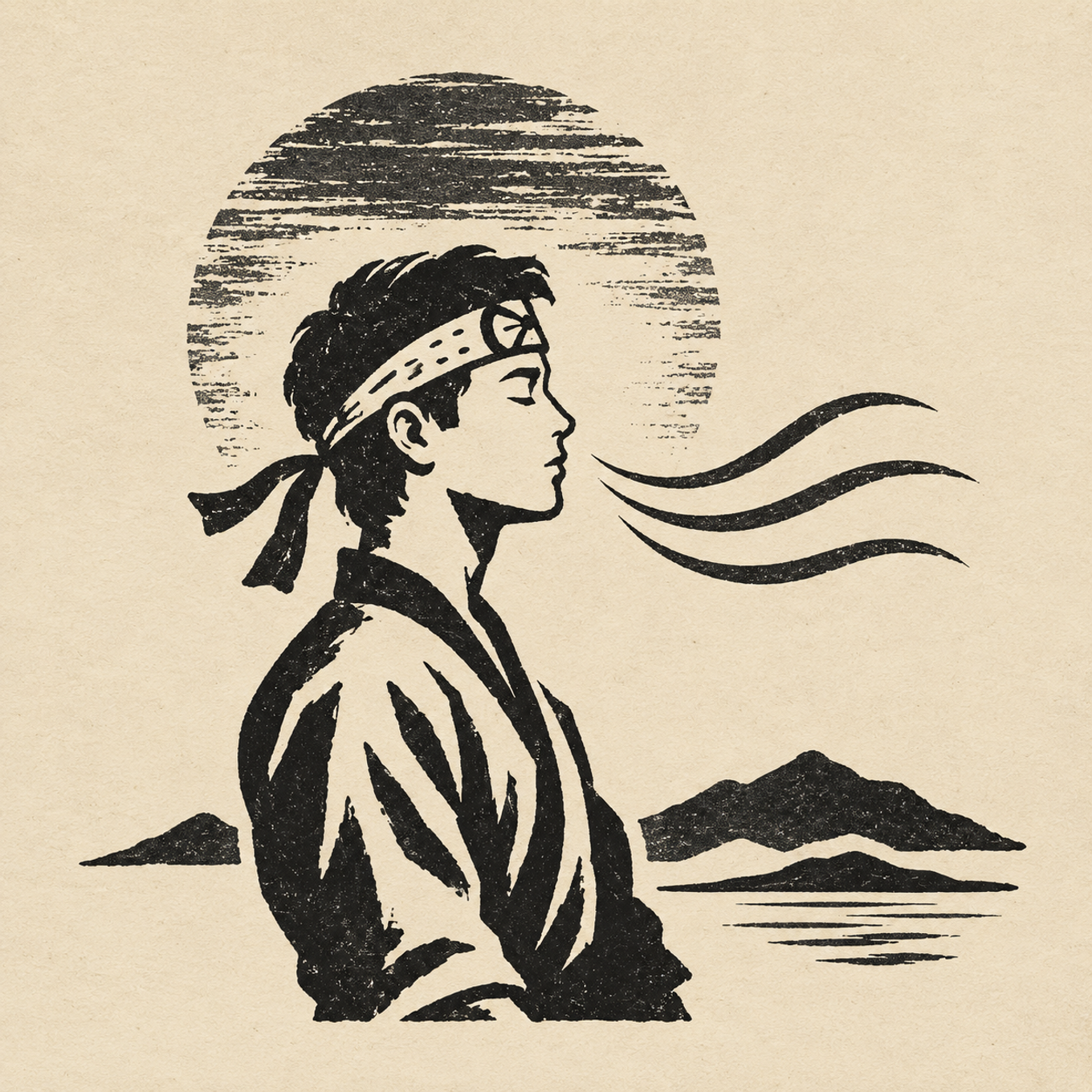
With everything coming apart, Mr. Miyagi tells Daniel to go back to the most basic thing he does: breathe.
Everyone know what Daniel was feeling. Maybe it's a breakup, a job that's going badly, money problems, a move, a loss, or just a stretch where too many things pile up at the same time.
You can't think straight. You're tired but you can't sleep. You eat whatever's in front of you, or you forget to eat. You stop going to the gym, stop calling your friends, and spend hours on your phone without feeling any better. Everything feels urgent, but you can't seem to get anything done.
When that happens, the natural move is to try to solve the big problems first: the relationship, the job, the money. But you're trying to solve them from a mind and a body that aren't working right.
This article looks at Mr. Miyagi's advice from a few different angles: a group of boys trapped in a flooded cave, a Roman emperor, the science of what breathing actually does to your body and mind, and the other basics that go first when life gets out of focus. Then it ends with exactly what to do.
Thirteen people in a flooded cave
On June 23, 2018, twelve boys from a youth soccer team in northern Thailand called the Wild Boars rode their bikes to the Tham Luang cave after practice with their 25-year-old assistant coach, Ekapol Chanthawong. They went in to explore. While they were inside, heavy monsoon rain flooded the cave behind them, and they were trapped deep underground.
For ten days, nobody knew whether they were alive. They sat on a muddy ledge in the dark, with very little food, as the water rose and the air got thinner. On July 2, two British cave divers swimming through the flooded passages finally found them. When the divers' lights reached them, the group was reportedly sitting in the dark, meditating.
Watching the video of the moment they were found, one boy's mother said she couldn't believe how calm they were, sitting and waiting, with no one crying.
The coach, Ekapol, had lost his parents when he was 10 and spent about a decade living as a Buddhist monk before becoming a soccer coach. The boys later told rescuers that he had taught them how to meditate to save their energy while they waited for help.
He had also shown them how to drink water dripping from the cave walls instead of the floodwater, and had given up his own share of their small food supply to the boys. When they were found, he was one of the weakest in the group.
The rescue was extremely dangerous, and it cost the life of Saman Kunan, a former Thai Navy SEAL who died while placing air tanks along the route. Between July 8 and July 10, all twelve boys and their coach were brought out alive, after 18 days in the cave.
A meditation expert at Stanford, Leah Weiss, pointed out why their meditation was so practical: with so little air and food, slowing down the heart rate, breathing, and metabolism helped them use less of both. No one can say exactly how much the coach's breathing and meditation contributed to their survival. But in a situation where almost everything was out of their control, he gave the boys something they could still control.
The Retreat Inside Yourself
Almost two thousand years ago, the Roman emperor Marcus Aurelius was writing notes to himself in a private journal that we now call Meditations. He ruled the Roman Empire, and his life was far from simple. He spent years leading armies on the frontier, dealt with a deadly plague, and faced constant political pressure. In one entry, he wrote about wanting to get away when life gets to be too much:
Men seek retreats for themselves, houses in the country, sea-shores, and mountains; and thou too art wont to desire such things very much. But this is altogether a mark of the most common sort of men, for it is in thy power whenever thou shalt choose to retire into thyself. For nowhere either with more quiet or more freedom from trouble does a man retire than into his own soul.
Marcus's point was that you don't need a vacation to reset. You can't always leave your problems, but you can always step back inside yourself for a moment, slow down, and remember what matters. He told himself to make use of that retreat often, and to keep it short and simple, so he could go back to his work with a clear head.
Mr. Miyagi was telling Daniel the same thing. When life gets to be too much, go back to something simple that's always available to you. For Marcus, that was the quiet inside his own mind. For Mr. Miyagi, it was the breath.
What breathing actually does
Breathing is one of the few things your body does automatically that you can also take over and control whenever you want. You don't decide to make your heart beat faster or your stomach digest food, but you can decide, right now, to breathe slower. And because your breathing is connected to the rest of your nervous system, changing it changes how you feel.
When you're stressed, your breathing usually gets faster and shallower, as part of the body's fight-or-flight response, the automatic reaction that gets you ready to face a threat or run from it. Researchers have also found the reverse: slowing your breathing down on purpose tends to calm the body.
In 2018, a team of researchers led by Andrea Zaccaro reviewed the scientific studies on slow breathing, meaning fewer than ten breaths a minute, in healthy people. Out of more than 2,400 study abstracts they screened, only 15 studies met their standards.
Across those studies, slow breathing was linked to changes in the heart and nervous system associated with relaxation, and people reported feeling more relaxed, more at ease, more alert, and more energetic, with less anxiety, depression, anger, and confusion. The researchers noted that the exact mechanisms behind these effects are still being worked out.
Five minutes a day
One of the best-known recent studies on breathing comes from Stanford. In a study published in 2023, the researchers Melis Yilmaz Balban, David Spiegel, Andrew Huberman, and their colleagues asked 111 healthy adults to do one of four five-minute exercises every day for a month. Three groups did different breathing exercises, and one did mindfulness meditation, where you simply pay attention to your breath without changing it.
All four groups improved. Everyone reported less anxiety and better mood. But the breathing groups improved more than the meditation group in positive feelings like energy, joy, and peace, and one exercise, called cyclic sighing, did best of all. Cyclic sighing focuses on long, slow breaths out. The people doing it also slowed their resting breathing rate the most, and the people whose breathing slowed down the most tended to have the biggest improvement in mood.
The study had limits. It was done remotely during the COVID-19 pandemic, so the researchers couldn't watch whether everyone actually did the exercises every day. But for an exercise that takes five minutes and costs nothing, the results are worth paying attention to. You'll find the exact steps in section 06.
This is why Mr. Miyagi's advice works. When your life is out of focus, your mind usually is too, and your breathing is one of the quickest ways to bring both back. It won't fix the breakup or the job. But it can calm you down enough to think clearly about what to do next.
The basics of life
The more I thought about Mr. Miyagi's advice, the more I realized breathing is the first basic, but it isn't the only one. There are a handful of things every person needs to function, and when life gets out of focus, they're usually the first things to go. And when they go, everything else gets harder.
Think about the last time your life felt out of control. Chances are you weren't sleeping well, you weren't eating right, you'd stopped moving your body, and you'd pulled away from the people closest to you. Most of us treat those things as the effects of a hard season. They're also a big part of why the season feels so hard.
Sleep
When you don't sleep, everything feels more intense. In a 2007 study, researchers led by Seung-Schik Yoo and Matthew Walker kept one group of healthy young adults awake for about 35 hours and let another group sleep normally.
Then they showed both groups upsetting images while scanning their brains. In the sleep-deprived group, the amygdala, a part of the brain involved in emotional reactions, was about 60 percent more reactive than in the group that had slept.
The connection between the amygdala and the part of the brain that helps keep emotions in check was also weaker. In other words, after a night without sleep, the same problem can feel much bigger and much harder to handle than it really is.
Food
Most people have joked about being "hangry," but it turns out to be real. In a 2022 study, the psychologist Viren Swami and his colleagues had 64 adults record how hungry they felt and how they were feeling emotionally, five times a day for three weeks, as they went about their normal lives.
When people were hungrier, they felt more irritable and angry and less pleasure. It was a small study, and the participants reported their own hunger, but it matches what a lot of people notice on days they skip meals.
Movement
When life gets busy or painful, exercise is usually one of the first things people drop. But it's also one of the things that helps. In 2023, Ben Singh and his colleagues pulled together 97 reviews of the research on physical activity and mental health, covering more than 1,000 trials and over 128,000 people.
They found that physical activity was highly beneficial for reducing symptoms of depression, anxiety, and psychological distress across a wide range of adults. Walking counts too.
The people closest to you
When things go wrong, many people pull away. They stop answering texts, skip plans, and try to deal with it alone. The Harvard Study of Adult Development has followed the same group of people, and later their children, since 1938, making it one of the longest studies of adult life ever done.
Its current director, Robert Waldinger, and his co-director, Marc Schulz, have said that the clearest finding from more than 80 years of research is that good relationships keep people happier and healthier. So when life is out of focus, reach out to them instead of pulling away.
This is what I think Mr. Miyagi meant. When your life feels out of focus, you don't need to solve everything at once. Go back to the basics: breathe, sleep, eat real food, move your body, and talk to the people who love you.
They can sound too simple to matter, so a lot of people skip them, even though everything else depends on them. When they're in place, you'll be in better shape to think clearly and deal with the big problems.
How to return to the basics
Start with breathing
Here are three breathing exercises, starting with the one that did best in the Stanford study. Pick one, and do it for five minutes a day, or any time you feel your life start to slip out of focus.
Then check the other basics
When you feel off, run through these five questions. Usually one or two will jump out, and those are the ones to fix first.
- Breath: Have I taken five minutes today to slow down and breathe?
- Sleep: How many hours have I slept the last few nights? What can I do to get to bed earlier tonight?
- Food: When did I last eat a real meal? Am I running on caffeine and snacks?
- Movement: When did I last move my body on purpose? Could I take a 20-minute walk today?
- People: When did I last really talk to someone I love? Who could I call or see this week?
Fix the basics first, then look at the big problem again. It may still be there, but you'll be in better shape to deal with it.
Daniel wanted Mr. Miyagi to tell him how to fix his life. Mr. Miyagi told him to breathe. That can sound too simple to help.
But a coach in a flooded cave taught twelve boys to sit still and breathe slowly while they waited to be found, and an emperor running an empire reminded himself that the best place to step back was inside his own mind.
When most things are out of your control, your breathing is one thing you can still control.
The next time your life feels out of focus, start with the basics before the biggest problem.
Take five minutes and breathe. Then sleep, eat something real, move your body, and call someone who loves you. As Mr. Miyagi put it: no breathe, no life.