Live As If Today Was Your Last Day
One Chance At Life: How to Stop Wasting Time
You get one life, no second chance. This piece looks at a letter Seneca wrote almost two thousand years ago, a Tolstoy story about a judge who did everything right and still felt cheated at the end, a hospice nurse who spent years listening to what dying people actually regret, and an old argument about why death might not be worth fearing at all.
The Odds Were Never in Your Favor
Your existence is the least likely thing that has ever happened. Specifically you. Every ancestor who survived long enough to love. Every near-miss that could have ended the line a thousand years before your name was ever possible. Billions of years of moments falling into place in an order that will never come again. The odds against you were so vast the number would take millions of zeros to write down.
And still, here you are.
At some point it stops being a fact and becomes a feeling. You realize you were handed exactly one of these. One life. No second attempt, no spare version of you waiting in reserve to get it right the next time around. And the moment you truly realize that, something shifts. You stop drifting through your life and begin to take ownership of it.
You start to ask, maybe for the first time, what it would mean to do something great with the single shot you were given.
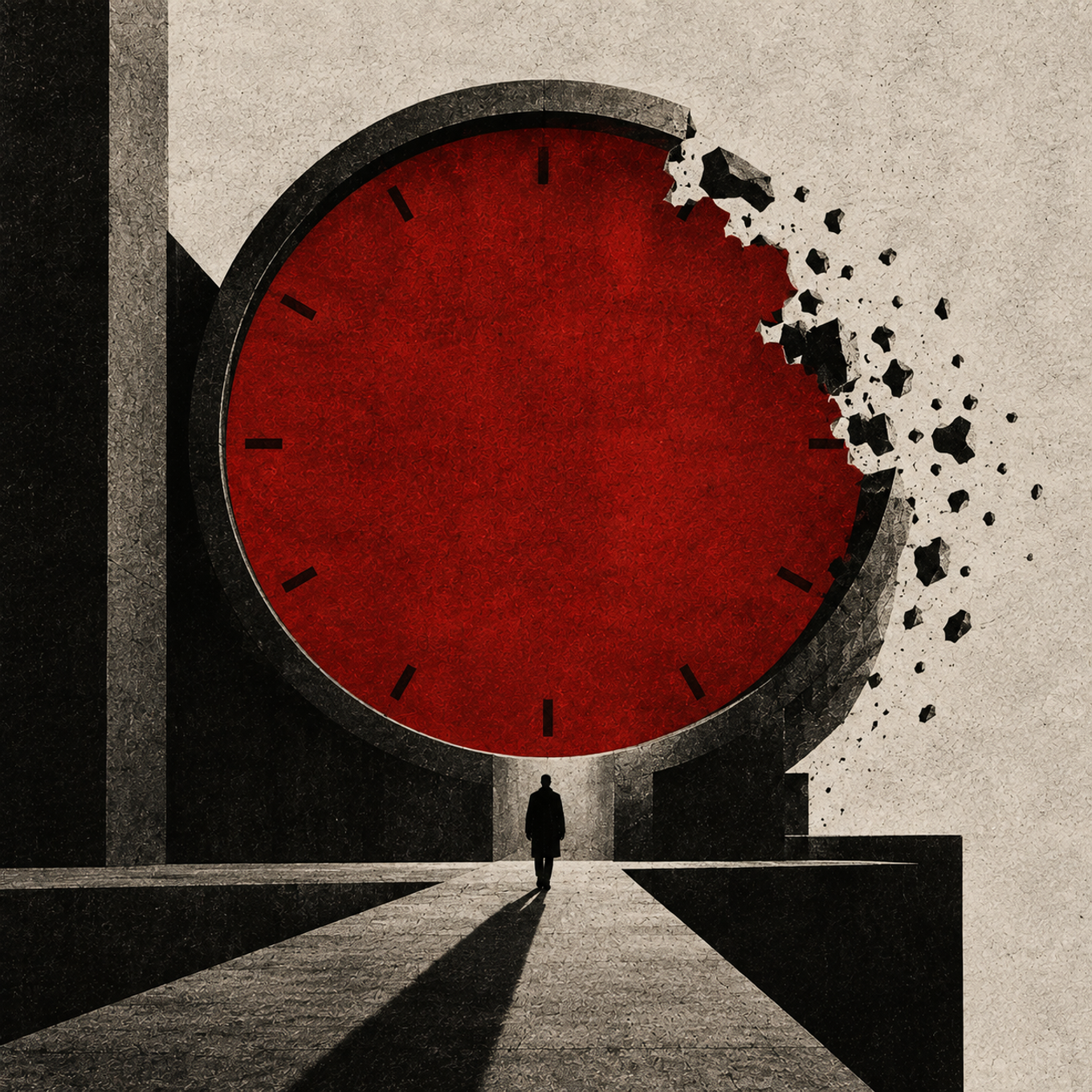
It is not death that a man should fear, but he should fear never beginning to live."
That's what Marcus Aurelius was getting at, writing to himself nearly two thousand years ago. It’s not the fear of how it ends, but the fear of never having started. Most people spend their lives worrying about death while forgetting to live the life they have.
You don’t know how much time you have left in this life, and neither does anyone else. So there's no good reason to keep waiting for the right moment to start living the way you actually want to. The moment is now, because it's the only one you're sure of.
It's Not That Life Is Short
Around 49 AD, the Roman philosopher Seneca wrote a short treatise to his father-in-law Paulinus, a man worn down by the demands of his public career and convinced he'd never have enough time left for what mattered. Seneca argued that the man's premise was wrong from the start, and told him it wasn't that life was too short. It was that he was wasting it.
Let's get this straight: yes, in the grand scheme of things, life is short. A human lifespan is nothing against the age of the universe, barely a blink against the history of the species. But at the same time it's also plenty long — the average person lives to around 73 globally, and that's roughly 26,000 days. That's plenty of time, long enough, if you use it right.
If you actually spend it, rather than losing it in pieces to distraction, ambition, other people's demands, and the endless deferral of the one life you were given for the sake of some future life you keep promising yourself instead, then you have all the time you need.
It is not that we have a short time to live, but that we waste a great deal of it.
Seneca wasn't going after laziness, he was going after busyness mistaken for living. The constantly occupied man, he argued, is usually the one who has least examined what any of it is for. The constantly occupied man isn’t sitting still long enough to check — he's in meetings, running errands, answering emails at 11pm, chasing the next promotion, the next deal, the next thing on the list.
All of it feels like proof he's doing something with his life. A full calendar gets mistaken for a full life. And underneath it all, the same postponement: I'll really start living once this next thing is finished.
The ways a life gets spent without being lived
Attention going out in small pieces, all day, without you noticing
"Once things settle down." They do not settle down. There is always a next thing.
Doing a lot, never stopping to ask what it's for.
The moment it adds up and by then, most of the time is already gone.
“You act like mortals in all that you fear, and like immortals in all that you desire."
Seneca's specific complaint was about people who kept deferring their own life in service of some future point at which they would finally begin living: after the promotion, after the kids are grown, after the house is paid off, after retirement, after I make a certain amount of money. He watched men plan lavishly for a stretch of life they were not guaranteed to reach, while the stretch they were guaranteed to have, right now, went un-lived.
We treat small, survivable risks like they could kill us — the awkward conversation, the career change, the public failure, the honest confession. Genuine fear spent on things that can't actually hurt us. Meanwhile, we put off the ambitions, the reconciliations, the 'someday' projects like we've got all the time in the world to get to them. Scared of the wrong things. Careless with the one thing we don't have much of.
The Man Who Did Everything Right
In 1886, Leo Tolstoy published a short novel about a mid-ranking judge named Ivan Ilyich. Ivan's life is, by every external measure available to him, a success. He climbs the right ladder. He marries appropriately. He furnishes his home with the correct taste of his social class. People like him, the way you like someone who's never given you a reason not to. Nothing about his life would strike anyone as a mistake.
Then he falls — hanging a curtain, of all things — and the injury doesn't heal. The doctors can't agree on anything. His wife, his colleagues, act concerned while wanting him to just get on with it, wishing he'd get better or die so the house could go back to normal.
And somewhere in the final weeks, lying in a room full of people whose love felt more like an obligation than something they actually meant, Ivan Ilyich gets stuck on a thought: maybe the entire correct, respectable, socially approved shape of his life was wrong from the start. Not scandalously wrong, just wrong in a way that never once looked like a mistake — a life spent optimizing for the approval of people who weren't really watching that closely, and definitely weren't going to be in the room at the end.
The most correct life, lived entirely on schedule, in the right order, with everyone's approval, can still turn out, at the very last, to have been the wrong one.
Tolstoy does not let Ivan off with a clean redemption. There is a flicker of something at the very end, a moment where the fear seems to loosen, but the novel makes that moment matter by first making you sit with the story for pages, in a man's dawning terror that he spent decades climbing carefully in a direction nobody had actually checked was up.
What People Actually Regret
A palliative nurse named Bronnie Ware spent years caring for patients in the final weeks of their lives and started writing down the regrets she heard most. For her patients, the realization that they were almost out of time forced them to reflect on their lives in a way nothing before it had. The list Bronnie compiled is short. Here's what's on it:
I wish I'd had the courage to live a life true to myself, not the life others expected of me.
I wish I hadn't worked so hard.
I wish I'd had the courage to express my feelings.
I wish I had stayed in touch with my friends.
I wish that I had let myself be happier.
None of the five are about achievement. They're about time spent on the wrong things — other people's expectations, work that ate the years, feelings never said. It’s the same idea Seneca wrote about and the same story Tolstoy told in Ivan Ilyich.
The Difference Between Knowing and Believing
Everyone will tell you, if asked directly, that they know they are mortal and eventually going to perish from this world. Of course. But there is a difference between knowing a fact and metabolizing it.
A person who had truly, viscerally internalized that their remaining time is finite and unknown in quantity would not spend a decade in a job that drains them while telling themselves "someday."
They would not let a friendship go quiet for three years over a disagreement neither party can now clearly remember. They would not keep the good china in the cabinet for an occasion that keeps never arrives. These are not the choices of someone who believes they are going to die.
Psychologists have a name for the mechanism: terror management. The theory holds that an enormous amount of human culture, ambition, and daily distraction exists specifically to keep the awareness of death at arm's length — to keep people from thinking about the fact that they're going to die. A species that sat with that thought constantly would find it very hard to function.
Yes, this whole topic is about the fact that you're going to die. I want you aware of it. I don't want you sitting with that thought every second, nobody could function like that. I just want it close enough that it shapes what you actually do with your time.
You Won't Know It's the Last Time
Here is the part that is easier to avoid than the big abstract fact of mortality itself: somewhere in your life, you have already had a last ordinary conversation with someone you loved, and you did not know, at the time, that it was the last one.
A phone call with a grandparent that ended with 'talk soon,' and there wasn't a soon. The last time you hung out with a college roommate before everyone scattered to different cities, and you haven't seen them since, because life got to busy. A quick 'see you at Thanksgiving' to a sibling you were sure you'd see at Thanksgiving.
The lastness is only visible afterward, and by then there is nothing left to do with the knowledge except carry it.
Somewhere ahead of you, there is a final time you will see your parents, if they are still living, and you will not be told in advance which visit it is. A final time your children will be small enough to want to be carried.
You are going to die and so is everybody else. There is a year that will be your last year. Somewhere in it, a month. Inside that month, a day, and it will be an ordinary day, because almost all days are, right up until they are not.
Nobody believes in their own death. We can only picture it as spectators, watching from outside, which is exactly the one position we will never actually occupy.
Sigmund Freud noticed this while working with soldiers during the First World War: people who had seen death constantly still could not picture their own. The mind, he observed, simply refuses the assignment. You can rehearse the funeral, the eulogy, the people crying. You cannot rehearse the actual absence of you, because the thing doing the rehearsing is the thing that would have to stop.
It may be structurally impossible to fully believe you will end, in the same way it is structurally impossible to see your own eyes without a mirror.
You've Already Not Existed Once
The Roman poet Lucretius made an argument in the first century BC that is, on paper, almost impossible to refute.
You did not exist for an infinite stretch of time before you were born, he pointed out, and that non-existence caused you no suffering whatsoever.
There was no you there to suffer it. Death is simply the same condition, arriving from the other direction. If the first absence of you was nothing to fear, the second should be nothing to fear either. The two darknesses are symmetrical.
Before you existed
Billions of years of a universe running fine without you in it, and you felt precisely none of it. No dread. No absence. Nothing.
After you die
By Lucretius's logic, structurally identical. The same nothing, arrived at from the other side of a brief interruption called a life.
In 1942, Albert Camus opened a philosophical essay with a sentence that has unsettled readers ever since: there is only one truly serious philosophical problem, and it is suicide — whether or not life is worth living in the first place.
He was following the logic of mortality all the way to its most uncomfortable conclusion. If you will die, and everything you build, love, and become will eventually be erased along with you, on what grounds do you get up tomorrow and keep going?
Camus called this collision the absurd: the gap between a mind that demands meaning and a universe that offers none. And his answer, which is easy to miss if you only remember the opening line, was not despair. It was revolt.
He argued that the correct response to a meaningless, finite existence is not to end it and not to fake your way into some borrowed meaning you do not actually believe.
It is to keep living anyway, with full awareness of the absurdity, and to find that the living itself, done with your eyes open, is enough.
I’ve sat with the question of what the meaning of life is for months, and ultimately, I’ve come to the conclusion that there is no inherent meaning assigned to a single life — unless you believe in something like a God-given purpose or predetermined life purpose.
That being said, I do believe it’s up to us to believe that there is meaning in our lives, because without that belief, I think it can be a dangerous state to live in.
At the same time, I do believe when you zoom out from the individual to humanity as a whole: the collective has meaning. We build, discover, create, preserve, teach, and pass things on to the people who come after us.
Maybe the meaning of an individual life isn't something that is given to us. Maybe it's something we create for ourselves, and something that becomes part of a larger meaning when we connect our lives to other people and to something beyond ourselves.
Every Yes Is a Thousand No's
This isn't really about how long you live. What matters more is what you spend it on. Every year you spend in one city is a year you did not spend in another. Every relationship you commit to is every other relationship you will not have. Every skill you master to depth is a hundred other skills you will only ever touch at the surface, if at all.
This is true even if you live to be a hundred and ten. The ending is the obvious part. The less obvious part is that finitude, the plain fact that your time runs out, is baked into every choice you make before it.
The person who tries to keep every option open forever, who refuses to commit to a place, a partner, a path, in order to preserve maximum future flexibility, does not end up living every life. They end up, very often, having lived none of them fully, arriving at the end having sampled everything and completed almost nothing.
Even a perfectly lived life involves grieving thousands of lives you will never live. The version of you who moved to that other country. Who married that other person. Who took the risk instead of the safe option, or the safe option instead of the risk.
You don't get to avoid this. Choosing anything means not choosing everything else. The only real decision is whether you make those choices on purpose, or let them get made for you by default.
Protecting the Maybe
Most people who say they are afraid of failing are not, on close inspection, afraid of the failure itself. They are afraid of what the failure would prove.
Now let me say that again…They are afraid of what the failure would prove.
That they were never actually talented, just lucky up to that point. That the people who doubted them were right the whole time. That they wasted the years they put into it. That they're not the exception they always assumed they were.
As long as you never actually go for the thing, you get to keep the fantasy of the version of you who would have been great at it, fully intact, forever unfalsified. The second you try, and it goes badly, that fantasy is gone. You now have a data point instead of a maybe, and the data point is real, and it might say something you don't want to hear.
So people protect the maybe. They call it patience. They call it waiting for the right moment. They call it being realistic. What it actually is, underneath the language, is a trade: you give up the chance at the real thing in exchange for keeping the comfortable illusion of what you might have been able to do, safe from ever being tested against reality.
That trade only makes sense if you get infinite chances to eventually find out. If you had unlimited time, protecting the fantasy a little longer wouldn't cost you anything. You'd get around to testing it eventually.
But you don't have unlimited time. You have one run, running down right now, and every year spent protecting the maybe instead of testing it is a year gone for good, out of the only stretch of time you're actually given.
What's Left to Do With It
Friedrich Nietzsche, who did not believe in an afterlife, proposed a thought experiment: imagine a demon appeared to you and told you that this life, exactly as you are living it right now — the same way you spent your morning, afternoon, and evening — would repeat, exactly like this, forever. Would this week, repeated forever, feel like heaven or hell?
If your actions compounded, day after day, would they actually get you anywhere?
Friedrich Nietzsche called the ideal response amor fati, love of fate, a love of your own fate specific enough that you would be willing to run it back exactly as it happened, with nothing changed.
Going Further
The Death of Ivan Ilyich, Leo Tolstoy
Short novel, under 100 pages, about a man who lived a completely respectable life and realizes on his deathbed that none of it was actually his. Read it in one sitting if you can.
Amor fati
Search "Nietzsche amor fati" and "eternal recurrence." Amor fati means love of fate, the idea of wanting your exact life back, including the parts that went wrong, not just tolerating it.
The Top Five Regrets of the Dying, Bronnie Ware
Written by a palliative care nurse who spent years listening to patients in their final weeks and started writing down the regrets she heard most. The same five kept coming up.
Terror Management Theory
Search "terror management theory" and "mortality salience." The psychology behind why so much of what people do, culture, ambition, distraction, exists to keep them from sitting with the fact that they're going to die.
I can't tell you how to live your life, but all I can leave you with is, stop waiting for the version of your life that starts once things settle down. Things don't settle down. There's no calmer year waiting up ahead where real living finally starts. Just this one, running out either way whether you're paying attention or not.
You were the least likely thing that has ever happened. Not likely to be born at all, let alone you, out of every version of a person who never got the chance to exist. So stop guarding the maybe. Stop guarding your dreams. Stop guarding what you actually want in life.
And the failure you're so busy protecting yourself from…let it happen. Go find out what you actually are, instead of guarding the myth of what you might have been. Go find out what you’re actually made of, instead of protecting the myth of what you might have been.