The Substance Of Things Hoped For
A widow with one pot of oil and a house full of borrowed jars shows what faith really is, how it shows up in everyday life, why it always does something, and how to hold on to it when you can't see how things will turn out.
A Pot Of Oil And Borrowed Jars
The woman in this story doesn't even have a name in the Bible. She was the widow of one of the prophets who had followed Elisha, and after her husband died, she was left with his debts. Under the law of the time, a creditor could take a debtor's children as servants to work off what was owed, and that's what was about to happen. The creditor was coming to take her two sons.
She went to Elisha and told him. He asked what she had in the house. Her answer was close to nothing: "Thine handmaid hath not any thing in the house, save a pot of oil."
Elisha gave her strange instructions. She was to go around to all her neighbors and borrow their empty jars, and he added, "borrow not a few." Then she and her sons were to go inside, shut the door, and pour the oil from her one small pot into the borrowed jars, setting each one aside when it was full.
She did it. She gathered the jars, shut the door, and started pouring. The oil kept coming. Her sons kept bringing her jars, and she kept filling them, until she asked for another one and her son told her there were none left. At that moment, the Bible says, "the oil stayed." It stopped. Elisha told her to sell the oil, pay the debt, and live on what was left with her sons.
Read it again and notice when the oil stopped. It stopped at the exact moment the jars ran out. How much she received depended on how many jars she had gathered, and she gathered them before she had seen a single drop flow. If she had borrowed three, she would have had three jars of oil. She borrowed as many as she could find, on the strength of a promise she couldn't yet see.
Most of us know something about waiting for what we can't see. You might be hoping for a job, a recovered relationship, a healing, a child, or a business to finally work. You might be holding on to something you believe God has promised, or simply to the hope that your life will turn out better than it looks right now. And most of us have wondered what faith actually is. Is it a feeling you either have or don't? Is it believing hard enough? What do you actually do while you're waiting for something you can't see?
The widow didn't sit in her house trying to feel more faith. She went door to door collecting empty jars. This article is about what faith really is, how it shows up in everyday life for everyone, why it always leads to action, how it lives alongside doubt, and what to do with it when things don't turn out the way you hoped.
What The Verse Means
The Bible's best-known definition of faith is a single sentence in the letter to the Hebrews:
Hebrews 11:1 (KJV)
Now faith is the substance of things hoped for, the evidence of things not seen.
Two words in that sentence carry most of its meaning. The Greek word translated "substance" is hypostasis, which means something like the foundation that stands under a thing, the reality that gives it weight.
The word translated "evidence" is elenchos, which means proof or conviction. So faith gives real weight to what you hope for, and it's a kind of proof, an inner conviction, about what you can't yet see. Put simply, faith is being confident enough in what you hope for, and sure enough of what you can't see, to live as though it's true.
The rest of Hebrews 11 shows what that looks like in actual lives. It's a long list of people, and almost every one of them is described by what they did. Noah, "warned of God of things not seen as yet," built an ark. Abraham was called to leave his home for a land he would receive later, and "he went out, not knowing whither he went." He didn't have a map. He had a promise and a first step.
There's one more detail in that chapter that explains why faith isn't the same as wishful thinking. When it describes Sarah, who believed she would have a child long after she was too old, it gives the reason: she "judged him faithful who had promised."
Her faith rested on something. She trusted the promise because she trusted the one who made it. Faith in the Bible always rests on someone or something you have reason to trust.
Faith In Everyday Life
You don't have to be religious to live by faith. Everyone does it, every day, usually without noticing.
When you drive through a green light, you're trusting that the drivers on the cross street will stop at their red light, even though you can't control them. When a farmer plants seeds in the spring, he's acting on a harvest he can't see yet. When you put money into a retirement account, you're investing in a future version of yourself you've never met.
When two people get married, they're making a promise about a whole lifetime neither of them can see. When someone starts a business, moves to a new city, or goes back to school at 40, they're acting on a hope with no guarantee. In every one of these, people are doing what Hebrews 11:1 describes: acting on what they hope for before they have proof.
That kind of faith takes a few forms. There's faith in other people, like trusting a friend, a spouse, or a doctor. There's faith in yourself, the belief that you can learn something hard or get through something painful. And there's faith in the future, the belief that things can get better and that what you do today will matter later.
What research says about hope
Psychologists have studied something close to this under the name of hope. The psychologist C. R. Snyder spent much of his career on it, and he described hope as having three parts: a goal you care about, the ability to see ways of reaching it, which he called pathways, and the belief that you can actually follow those ways, which he called agency.
That isn't the same as religious faith, but it's close to the everyday kind. It's confidence about a future you can't see yet, combined with the willingness to act on it.
Snyder's research found that this kind of hope makes a real difference. In a six-year study of college students, students with higher hope when they started college had higher grades years later, even after the researchers accounted for their earlier grades and entrance exam scores, and they were more likely to graduate.
In another study, among women who ran cross-country, higher hope predicted how well they performed in races, beyond what their training, self-esteem, confidence, and mood could explain. People who believe a good future is possible, and act like it, tend to get further than people who don't.
When faith is misplaced
What you put your faith in matters as much as having it. Someone who hands their savings to a get-rich-quick scheme is acting on faith too, and so is someone who keeps trusting a person who has lied to them over and over. Proverbs warns about this: "The simple believeth every word: but the prudent man looketh well to his going.”
That's why Sarah's reason matters. She "judged him faithful who had promised." Well-placed faith rests on something that has earned it: a person with a track record of keeping their word, a plan built on real evidence, a God the believer has reason to trust. Part of living by faith is asking, before you lean your full weight on something, whether it can hold you.
Faith Always Does Something
The letter of James makes the point more bluntly than anywhere else in the Bible. James describes someone who sees a brother or sister without clothes or food and says to them, "Depart in peace, be ye warmed and filled," but gives them nothing. "What doth it profit?" he asks. Then he draws the conclusion:
James 2:17 (KJV)
Even so faith, if it hath not works, is dead, being alone.
A few verses later he says it again: "For as the body without the spirit is dead, so faith without works is dead also." Faith that never changes what you do is what James calls dead. The widow's faith looked like walking door to door asking for jars. Noah's looked like building a boat. Abraham's looked like packing up and leaving.
The same idea shows up far outside the Bible. In a well-known hadith, a saying of the Prophet Muhammad recorded in the collection of al-Tirmidhi, a man asked whether he should tie up his camel and trust in God, or leave it untied and trust in God. The answer was: "Tie it and rely upon Allah."
The medieval scholar Ibn Rajab explained that it means a person should use wisdom and make every reasonable effort, and then place their trust in God after making that effort, and that relying on God doesn't contradict doing your part. The point is the same as James's and the same as the widow's. Trust is what you rest on after you've done what you can.
In everyday life, this is the difference between hoping for a better job and hoping for a better job while you update your résumé, apply every week, and learn the skills the job requires. It's the difference between believing your marriage can heal and believing it while you go to counseling and change how you talk to each other. Faith is what keeps you gathering jars before you see the oil.
Faith And Doubt
Many people think faith means having no doubts, so when doubts come, they decide they don't have faith at all. The Gospel of Mark tells a story that shows otherwise.
A father brought his son to Jesus. The boy had suffered from terrible seizures since he was a child, and Jesus' disciples had already tried and failed to help him. The father was desperate and worn out, and his request was cautious: "if thou canst do any thing, have compassion on us, and help us."
Jesus answered, "If thou canst believe, all things are possible to him that believeth." And the father's reply is one of the most human lines in the Bible:
Mark 9:24 (KJV)
And straightway the father of the child cried out, and said with tears, Lord, I believe; help thou mine unbelief.
He believed, and he doubted, at the same time, and he said both out loud. Jesus didn't send him away for doubting. He healed the boy.
That's what faith usually looks like in real life: choosing to act on what you hope for while the doubt is still there. The widow probably wondered, as she knocked on door after door, whether she'd look foolish with a house full of empty jars. She gathered them anyway. What matters is whether you let the doubt stop you from acting.
Faith the size of a mustard seed
Matthew's Gospel tells the same story about the father and his son, and adds what happened afterward. When the disciples asked Jesus privately why they hadn't been able to help the boy, he told them it was because of their unbelief, and then said:
Matthew 17:20 (KJV)
If ye have faith as a grain of mustard seed, ye shall say unto this mountain, Remove hence to yonder place; and it shall remove; and nothing shall be impossible unto you.
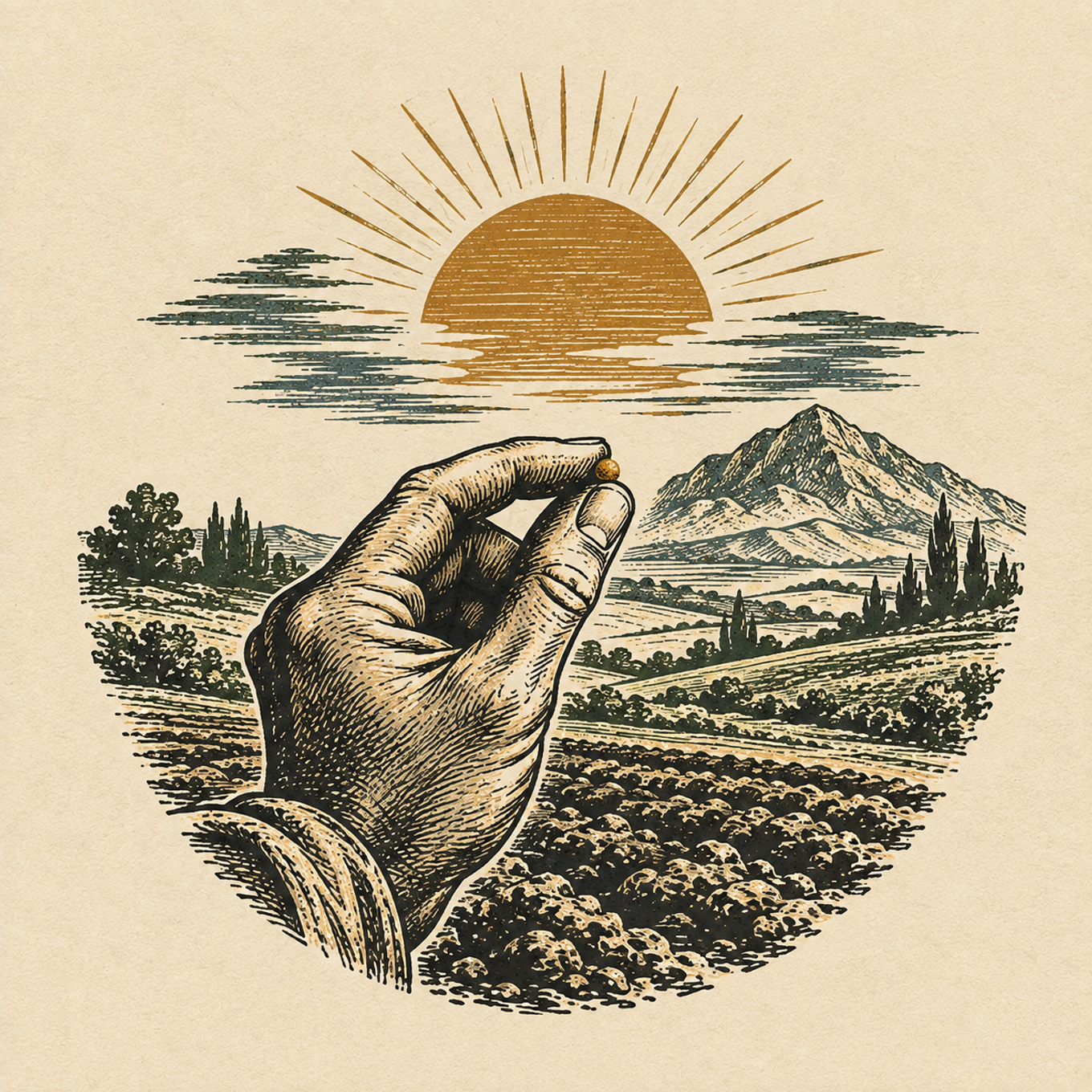
A mustard seed is one of the smallest seeds a farmer in Jesus' time would have planted. The point is that even a very small amount of faith, as long as it's real, is enough to start with. That's good news for anyone who reads the father's words and thinks, "That's me. My faith is mostly doubt." A small faith that you actually act on matters more than a large faith you only talk about.
Where It's Not A Guarantee
Some people teach faith as a formula: believe hard enough, and you'll get what you're asking for. The Bible itself doesn't support that, and the clearest proof is in the same chapter that defines faith.
After listing all those people of faith, Hebrews 11 says something surprising about them: "These all died in faith, not having received the promises, but having seen them afar off."
Near the end of the chapter, it describes others who were mocked, beaten, imprisoned, and killed for their faith, and it says they too "received not the promise."
These are the Bible's heroes of faith, and many of them never saw in their lifetimes what they hoped for.
The prophet Habakkuk wrote one of the most powerful descriptions of faith that doesn't depend on results:
Habakkuk 3:17–18 (KJV)
Although the fig tree shall not blossom, neither shall fruit be in the vines; the labour of the olive shall fail, and the fields shall yield no meat; the flock shall be cut off from the fold, and there shall be no herd in the stalls: Yet I will rejoice in the LORD, I will joy in the God of my salvation.
Faith isn't a guarantee that every prayer will be answered the way you want, or that every risk will pay off. Some businesses fail even when their founders believed in them. Some people don't recover.
Some hopes take far longer than you expected, or come in a different form than you pictured. Faith is what lets you keep going, keep trusting, and keep doing what's right, even when the fields are empty.
People who treat faith as a formula often lose it the first time the formula doesn't work. People who understand it the way Hebrews and Habakkuk describe it can hold on through disappointment.
How Faith Grows
Many people read about faith and think, "That's great, but mine is weak." The Bible doesn't treat faith as a fixed amount you're born with. It describes it as something that grows, and it says where that growth comes from.
From hearing
Paul wrote to the Romans: "So then faith cometh by hearing, and hearing by the word of God." Faith grows when you keep hearing what you're trusting in.
For a believer, that means spending time in Scripture, and in the promises and stories of people who trusted God before you. The widow had heard Elisha's word before she went looking for jars. What you fill your mind with shapes what you're able to believe.
From remembering
The Bible also tells its readers, over and over, to remember. In one psalm, the writer is going through a dark time and feels as if God has forgotten him.
Then he turns his thoughts: "I will remember the works of the LORD: surely I will remember thy wonders of old." Looking back at what God had already done gave him a reason to keep trusting for what he couldn't see yet.
When the Israelites finally crossed the Jordan River into the promised land, Joshua had one man from each of the twelve tribes carry a stone from the middle of the riverbed, and they set the stones up as a memorial.
The reason, Joshua said, was that one day their children would ask, "What mean ye by these stones?" and they would tell them how God had brought them across. The stones were there so they wouldn't forget.
David did the same thing before he faced Goliath. When King Saul told him he was too young to fight, David pointed to his own track record. He had protected his father's sheep from a lion and a bear.
"The LORD that delivered me out of the paw of the lion, and out of the paw of the bear, he will deliver me out of the hand of this Philistine." His faith for the giant came from remembering the lion and the bear.
The same is true in everyday life
Trust between people grows the same way. You trust a friend more after they've kept their word a hundred times. You trust yourself more after you've done something hard and come through it.
Every time someone or something proves faithful, it gives you a reason to trust it a little more next time. That's Sarah's reasoning again: she "judged him faithful who had promised," and faithfulness shown in the past is what made that judgment possible.
So if your faith feels weak, you don't need to force yourself to feel more of it. Keep hearing what you're putting your trust in. Look back and remember the times it was rewarded. And take small steps of faith now, so that you build your own lions and bears to remember the next time a giant shows up.
Jesus described faith's growth with the same seed. In one of his parables, he said the kingdom of heaven is like a grain of mustard seed, "which indeed is the least of all seeds: but when it is grown, it is the greatest among herbs, and becometh a tree, so that the birds of the air come and lodge in the branches thereof."
Faith that starts as small as a seed doesn't have to stay that size. Fed by hearing and strengthened by remembering, it grows into something others can rest in too.
How To Apply It
Putting it all together, faith in daily life comes down to a few things.
Gather your jars. Prepare for what you're hoping for, as if it's coming. If you're believing for a new job, get your résumé ready and learn the skills. If you're hoping to start a family, prepare your finances and your home. The widow received as much oil as she had jars, and much of what we receive depends on how ready we are to receive it.
Take the next step without the whole map. Abraham went out "not knowing whither he went." You'll rarely see how everything turns out before you have to move. Faith usually asks you for the next step while the rest of the road is still out of sight.
Check what your faith rests on. Like Sarah, judge whether the one who promised is faithful. Before you put your full weight on a person, a plan, or a belief, ask whether it has earned that trust.
Bring your doubts with you. You don't have to get rid of every doubt before you act. Say both, the way the father did: I believe, and I'm struggling to believe. Then act anyway.
Hold on when you don't see it yet. Results may come late, or differently than you expected, or not in the way you hoped. Faith that only lasts while things go well isn't the kind Hebrews 11 describes.
Feed it and remember. Keep hearing what you're trusting in, and keep a record of the times your trust was rewarded, the way Joshua's stones and David's lion and bear did.
Practices
Name what you're trusting for
Write down one thing you're hoping for right now that you can't yet see, in a sentence. Then write down what your hope rests on: a promise, a person, evidence, or simply a desire. Be specific about both.
Gather three jars
List three things you can do this week to prepare for what you're hoping for, as if it's coming. Then do them. Each one is a jar.
Take one step without the full picture
Find the next step you've been waiting to take until you were sure of the outcome, and take it this week, even though you can't see how it all ends.
Pray or speak both your belief and your doubt
Whether you pray or simply write it in a journal, put both into words, the way the father in Mark 9 did: what you believe, and where you're struggling to believe. Saying both is more truthful than pretending one of them away.
Set up your memorial stones
Write down at least five times in your life when trust was rewarded: a prayer answered, a person who came through for you, a hard season you got through, a step of faith that worked out. Keep the list somewhere you'll see it, and add to it as new ones happen. Read it when your faith feels weak.
Write your "yet I will" sentence
Following Habakkuk, finish this sentence: "Even if this doesn't turn out the way I hope, I will still..." Decide now what you'll hold on to and keep doing, whatever happens.
Go Further
2 Kings 4:1–7
The full story of the widow, the pot of oil, and the borrowed jars.
Hebrews 11
The definition of faith, and the long list of people who lived by it, including those who never saw what they hoped for.
James 2:14–26
James's full argument that faith without works is dead.
The Psychology of Hope, by C. R. Snyder
Snyder's explanation of hope as goals, pathways, and agency, and how people can build more of it.
The widow had one pot of oil, two sons she was about to lose, and a promise she couldn't see. She could have stayed home and tried to feel more faith.
Instead, she knocked on her neighbors' doors and asked for empty jars, and then asked for more, until there were no more to find.
When she finally began to pour, the oil filled every single one. It stopped only when she ran out of jars.
Whatever you're hoping for right now, faith means being confident enough in what you hope for to start gathering jars before you see any oil.
Rest your faith on something that deserves it, bring your doubts along, take the next step without the whole map, and keep going even when the fields are empty.
And when you gather your jars, take Elisha's advice: borrow not a few.