There Is No Secret Ingredient: It's Just You
A panda who opened a blank scroll, a farmer who sold a diamond mine to go looking for diamonds, and a scientist who learned how her own mind works show why there's no universal secret to success, and how to find the ingredient you're missing.
There Is No Secret Ingredient
In Kung Fu Panda, Po is an overweight, accident-prone panda who works in his father's noodle shop and dreams about kung fu. He knows every legend about the Furious Five, the greatest warriors in the Valley of Peace. He has never trained a day in his life.
Then Master Oogway, the wise old tortoise and grand master of the Jade Palace, holds a ceremony to choose the Dragon Warrior, the one who will be trusted with the Dragon Scroll. Everyone expects him to pick Tigress or one of the other Five.
Instead, Po crashes into the middle of the arena on a chair strapped to fireworks, and Oogway points at him. Nobody believes it, including Po. Master Shifu, who trained the Five, spends the next stretch of the movie trying to get Po to quit.
What struck me most is that almost everyone in the story is searching for something outside themselves that will make them complete.
Po believes the Dragon Scroll holds the secret to limitless power, and that once he reads it, he'll finally become what everyone says he isn't. Tai Lung, the snow leopard who was raised and trained by Shifu, has all the skill in the world, but Oogway refused to make him Dragon Warrior because he saw darkness in his heart.
Tai Lung spends twenty years in prison believing the scroll is what was stolen from him. And Shifu's pride was wrapped up in Tai Lung, the student he raised and believed would be the Dragon Warrior. Later he admits to Tai Lung that his love blinded him to what Tai Lung was becoming. For years, his own peace depended on a student turning out the way he hoped.
Each of them is looking for the answer somewhere else: in a scroll, a title, a student.
Shifu's breakthrough
For most of the movie, Shifu fails with Po because he trains him the same way he trained the Five, through brutal drills built for bodies and minds nothing like Po's. Po gets knocked around, embarrassed, and discouraged.
Then Shifu notices something. Po, who can barely do a single drill, climbs to a high shelf and does a perfect split to reach a jar of cookies. When food is involved, he can do things nobody thought he could do.
So Shifu stops forcing Po into the Five's training and builds a new one around what actually drives him. They train with dumplings, and Po fights Shifu for a bowl of them, getting faster, stronger, and more skilled than in all the weeks before.
It's worth noticing that the Five each fight in their own style too. Tigress fights like a tiger, Monkey like a monkey, Mantis like a mantis, Viper like a viper, and Crane like a crane. Each style is built around the body and nature of the one who uses it.
Po was failing because he was trying to fight in someone else's style.
When Tai Lung finally comes for the scroll, Po wins in part because of the body everyone had mocked. Tai Lung's nerve strikes, which can paralyze an opponent, don't work through all that padding, and Po just laughs because it tickles.
The secret ingredient
Before the fight, when Po opens the Dragon Scroll for the first time, it's blank. Just a shiny golden surface. He's crushed.
Then his father, Mr. Ping, tells him a secret he's kept for years: the secret ingredient in his famous Secret Ingredient Soup is nothing. People believe it's special, so it is.
The secret ingredient is... nothing! You heard me. Nothing! There is no secret ingredient. ... To make something special, you just have to believe it's special.
Po looks at the scroll again and sees his own reflection in it. That's when he understands. There is no secret ingredient. It's just you.
That's the whole idea of this article. People are always asking for the secret to success, as if there were one ingredient that works for everyone. But the answer was never on the scroll. It was in what Po saw when he looked at it.
The Diamonds Under His Own Farm
In the late 1800s and early 1900s, a minister and lawyer from Philadelphia named Russell Conwell traveled the country giving the same speech, over and over. By the time he died in 1925, he had delivered it more than 6,000 times.
He used the money it earned to help build a night school that grew into Temple University. The speech was called "Acres of Diamonds," and it began with a story Conwell said he heard from an old Arab guide while traveling down the Tigris and Euphrates rivers.
The story goes like this. There was once a farmer in ancient Persia named Ali Hafed. He owned a large farm with orchards, grain fields, and gardens. He had money and was content with his life.
One day an old priest visited him and told him about diamonds. He said that if Ali Hafed had one diamond the size of his thumb, he could buy the whole county, and if he had a mine of diamonds, he could put his children on thrones.
Ali Hafed went to bed that night a poor man. Nothing about his farm had changed, but he wasn't content anymore. He lay awake all night thinking, "I want a mine of diamonds."
The next morning he asked the priest where to find them. The priest told him to look for a river running over white sand between high mountains, because diamonds could be found in those sands. So Ali Hafed sold his farm, collected his money, left his family with a neighbor, and set off.
He searched for years across the world. He never found a single diamond. Finally, ragged, broke, and in despair, he threw himself into the sea off the coast of Spain and died…
Back home, the man who had bought Ali Hafed's farm led his camel into the garden one day to drink from the shallow stream. As the camel put its nose in the water, he noticed a flash of light from the white sand at the bottom.
He reached in and pulled out a black stone with an eye of light in it that reflected all the colors of the rainbow. He took it inside and set it on his mantel.
Some time later, the same old priest came to visit. He saw the stone and cried out that it was a diamond. They ran out to the garden, stirred up the sand with their fingers, and found more stones, even more beautiful than the first.
According to the story, that was the discovery of the diamond mines of Golconda, some of the richest diamond mines in history.
Conwell put the moral plainly. If Ali Hafed had stayed home and dug in his own garden, he would have had acres of diamonds.
But the story has lasted for well over a century because people recognize themselves in it. Ali Hafed wasn't foolish for wanting more.
His mistake was believing that what he needed had to be somewhere far away, in someone else's land, so he never looked closely at what he already had.
Po made the same mistake with the scroll. He thought the power was written somewhere outside him, and he'd find it once he finally read it.
Both of them went looking far away for something that was under their own feet the whole time.
The Words Carved At Delphi
In ancient Greece, the most important place to go for answers about your future was the Temple of Apollo at Delphi.
Kings, generals, and ordinary people traveled there from all over the Greek world to ask questions of the priestess known as the oracle. Carved into the temple, where every visitor would see it, was a short line of advice: Know thyself.
It's easy to read those words as a nice saying. But think about where they were placed. People came to Delphi because they wanted an answer from outside themselves, a message from the god about what to do next. And before they ever got that answer, the temple told them to look inward.
The philosopher Socrates took those words more seriously than anyone. In one of Plato's dialogues, a friend asks Socrates what he thinks about an old myth, and Socrates says he doesn't have time for questions like that, and explains why:
I must first know myself, as the Delphian inscription says; to be curious about that which is not my concern, while I am still in ignorance of my own self, would be ridiculous.
Socrates was one of the smartest people in Athens, and he believed he hadn't yet finished the first task, understanding himself. To him, everything else came after that.
About a generation before Socrates, the Greek poet Pindar wrote a line that takes the idea one step further. In a poem for a king named Hieron, he wrote: "Become such as you are, having learned what that is." First you learn who you are. Then you become it.
That's Po's whole journey in one sentence. He spent most of the movie trying to become someone else: a lean, fast warrior like Tigress, the kind of hero in the legends he loved. He only became the Dragon Warrior once he learned who he actually was and stopped fighting it.
Why There's No Universal Secret Ingredient
The scarcest nutrient
In the 1800s, scientists studying how crops grow found something that changed farming. A plant needs many different nutrients, like nitrogen, phosphorus, potassium, and water. You might expect that adding more of any of them would help it grow, well it doesn't work that way.
A plant's growth is limited by whichever nutrient is scarcest. If a field is short on phosphorus, you can pour on all the nitrogen you want and the crop won't grow any better. The idea was first described by the German scientist Carl Sprengel and made famous by the chemist Justus von Liebig, and it's known as Liebig's law of the minimum.
People often picture it as a wooden barrel made of staves of different lengths. The barrel can only hold water up to the height of its shortest stave. Make the tall staves taller and you won't hold one more drop. The only way to hold more is to fix the short one.
People work much the same way. Most of us are trying to grow in some area of life, and we have some things going for us and some things holding us back.
Someone who already knows a lot about business but doesn't believe they can succeed won't be helped by reading ten more business books. Someone with plenty of confidence but no real skill won't be helped by more motivational speeches.
Each person's growth is limited by their own short stave. That's why there can't be one secret ingredient for everyone. The missing ingredient is different for each person.
When the missing ingredient is belief
For a lot of capable people, the short stave is belief.
In 1977, the psychologist Albert Bandura introduced the idea of self-efficacy: your belief that you can succeed at a specific task.
He argued that this belief shapes whether people start something, how much effort they put in, and how long they keep going when it gets hard. Two people with the same skills can get very different results, because one believes they can do it and the other doesn't.
The research has backed him up. In 1998, Alexander Stajkovic and Fred Luthans combined 114 studies on self-efficacy and work performance, and found a strong link between the two. They translated that link into about a 28 percent gain in performance.
Bandura also found where that belief comes from, and the most powerful source was what he called mastery experiences: actually doing something hard and succeeding at it. Belief mostly comes from evidence, built a step at a time.
That's exactly what happened to Po. Po's confidence didn't come from a speech. It grew once he actually won the dumpling fight against Shifu and saw with his own eyes what he could do.
When the missing ingredient is using what you're good at
Other research looks at what happens when people work with their own strengths instead of against them.
In a 2005 study, Martin Seligman and his colleagues asked people to identify their top personal strengths, things like curiosity, kindness, or perseverance, and to use one of them in a new way every day for a week.
Compared with a placebo group, those people were happier and less depressed, and the effects lasted for up to six months.
In a 2010 study of 240 college students followed over three months, Alex Linley and his colleagues found that students who used their strengths more made better progress toward their goals, and that progress was linked to greater well-being.
That's Shifu's breakthrough in research form. Po got further in a few days of training built around what drove him than in weeks of training built for someone else.
The common missing ingredients
Every person's short stave is different, but most of them fall into a handful of kinds:
Belief. You have the skill and knowledge, but you don't really believe you can do it, so you hold back or never start.
Knowledge. You're willing and motivated, but you don't yet know how to do what you're trying to do.
Skill. You know what to do in theory, but you haven't practiced it enough to do it well.
Consistency. You can do it, and you do, but only in bursts, so it never adds up.
Environment. The people, place, or situation around you makes it hard, no matter how much you want it.
Energy and health. You know what to do and want to, but you're too exhausted or unwell to do it.
Support. You're trying to do something alone that needs help, teaching, or encouragement from others.
Clarity. You're working hard, but you're not sure what you actually want, so the effort scatters.
Most advice is written by someone who solved their own missing ingredient and assumes it's yours too. A person who struggled with belief writes a book about confidence. A person who struggled with discipline writes a book about habits. Both may be right about themselves, and both may be wrong about you.
Stop Borrowing Other People's Recipes
I hear people asking for the secret to success all the time, as if there's one universal answer and some people found it and others didn't. Books promise it. Podcasts promise it. Morning routines of famous people get shared like recipes, as if waking up at 5 a.m. and taking a cold shower is what made them who they are.
The truth is the secret ingredient to success is you.
Let me explain what I mean. I don't mean you're special in some vague way, or that all you need is to believe in yourself.
I mean success depends on understanding yourself: what you already have, what you're missing, what drives you, and what holds you back.
Take someone who is capable, who has the character, the skills, and the knowledge. Their missing ingredient might simply be believing in themselves. Another person's missing ingredient might be learning new information and actually applying it.
A third person might have both and still be stuck because they're surrounded by people who pull them down. Same goal, three different missing ingredients. And if each of them follows the same advice, at most one of them will be helped.
Two people, same advice
Here's what that looks like in real life. Picture two coworkers who both want to start a side business. Both of them read the same popular book about productivity, the kind that tells you to wake up early, plan every hour, and push through your to-do list every day. They both follow it exactly.
The first one has been stuck for a year because she's disorganized. She has the skills and the confidence, but her days slip away and the business never gets her attention. The book's system is exactly what she needed. Within a few months she has a website, her first clients, and a schedule she can keep.
The second one already plans his days down to the hour. His problem is something else entirely. Deep down, he doesn't believe anyone will pay for what he offers, so he keeps "getting ready" and never puts himself out there.
The book gives him an even more detailed schedule to fill with more preparation. He wakes up at 5 a.m., works through his list, gets exhausted, and burns out in a month, without ever having asked a single person to buy anything. The advice was good, but it fixed the wrong stave.
Neither of them was weak or lazy. One of them happened to pick up a recipe that matched her missing ingredient, and the other didn't. That's what happens when people borrow recipes without understanding themselves first.
Temple Grandin
Temple Grandin is an animal scientist and a longtime professor at Colorado State University, and she changed the way livestock are handled across North America. Her life was also the subject of the 2010 HBO film Temple Grandin, starring Claire Danes. Grandin is autistic, and she thinks in pictures.
When somebody speaks to her, the words are instantly translated into pictures in her mind. For most of her early life, she didn't know that was unusual. As a child and a teenager, she assumed everybody thought in pictures.
Only later, in college, did she realize her mind worked differently from most people's, and she went on to study exactly how.
In the 1970s, she was watching cattle being moved through chutes at feedlots. Some animals walked right in. Others balked and refused, and the cowboys yelled, pushed, and shoved them, which only made it worse.
Grandin did something nobody else had thought to do. She got down into the chute to see what the cattle were seeing. She took pictures through the chute from a cow's eye level, and with those photos she figured out what was scaring them: shadows, bright spots of sunlight, a reflection off a truck's bumper, people standing up ahead.
In one case, cattle walked easily through one facility and balked in another identical one, and the only difference was which way each faced the sun.
Grandin has said her autism played a key role in her work, because it tunes her in to visual details that upset animals but go unnoticed by most people. She used that understanding to design curved chutes with solid sides that keep animals calm, and her designs changed the industry.
By many estimates, about half the cattle in North America are now handled in equipment she designed. Everyone else was yelling and pushing. Grandin succeeded by understanding exactly how her own mind worked and building her work around it. Her secret ingredient was already in her. She just had to learn what it was.
Finding Your Missing Ingredient
Knowing there's no universal secret ingredient doesn't help much unless you go find yours. Here's a simple way to start.
Look at where you keep getting stuck.
Think of the goal you care about most and the point where you keep stalling. Do you never start? Start and stop? Work hard without getting anywhere? Get close and then pull back?
Where you get stuck usually points to the missing ingredient. Never starting often means belief. Starting and stopping often means consistency or energy. Working hard without results often means knowledge, skill, or clarity.
Go through the list from section 04.
For each ingredient, ask yourself whether it's what's really holding you back right now: belief, knowledge, skill, consistency, environment, energy and health, support, or clarity. Most people find one or two that stand out once they look at it straight. That's your short stave.
Ask someone who knows you.
We're often the last to see our own short staves. Ask a friend, a mentor, or someone who's watched you work: "What do you think is holding me back?" Then listen without arguing.
Work on that one first.
Once you know your missing ingredient, put most of your effort there, and stop adding more of what you already have. If it's belief, give yourself small wins that prove you can do it, the way Po built belief by actually winning.
If it's knowledge, find someone who already knows and learn from them. If it's environment, change who you spend time with or where you work. Fixing the short stave is what raises the whole barrel.
When you're missing more than one
Some people go through the list and feel like they're missing almost everything: belief, knowledge, skill, consistency, all of it. That can feel overwhelming, like the barrel has more short staves than tall ones. But the barrel picture also shows how to handle it.
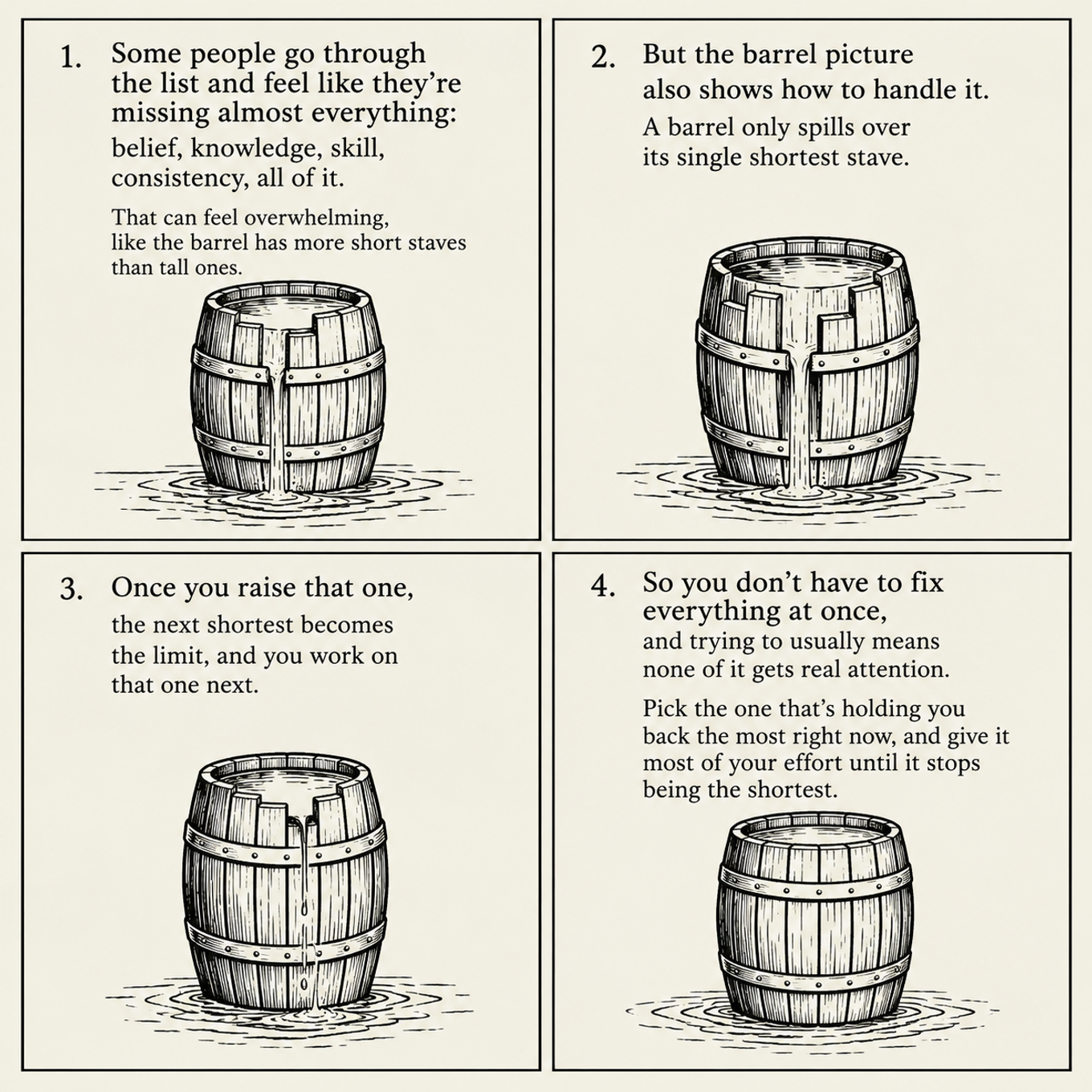
A barrel only spills over its single shortest stave. Once you raise that one, the next shortest becomes the limit, and you work on that one next. So you don't have to fix everything at once, and trying to usually means none of it gets real attention.
Pick the one that's holding you back the most right now, and give it most of your effort until it stops being the shortest.
It also helps to know that the ingredients feed each other, so fixing one often raises others along with it. Remember what Bandura found: the strongest source of belief is mastery experiences, actually doing something hard and succeeding at it.
That means knowledge and skill, built through practice, usually raise belief on their own. And doing something regularly is how skill gets built in the first place. So if you're missing several, a good order is usually this.
First get clear on what you actually want, because the other ingredients depend on knowing where you're going. Then learn the basics you need, and start practicing them in small, regular doses. The skill you build that way gives you the wins that grow your belief.
That's what happened to Po. At the start, he was missing almost everything a Dragon Warrior needs: the skill, the training, and the belief that he belonged there. Shifu didn't try to fix all of it at once. He found the one thing that would get Po working, training built around what drove him, and the rest followed.
As Po's skill grew, so did his belief, and by the end the panda who couldn't climb the stairs to the Jade Palace was the one standing between the valley and Tai Lung.
Notice what drives you.
Shifu found Po's dumplings. Grandin found her pictures. Ask what reliably gets you working when nothing else does, whether it's competition, helping someone, a deadline, a clear picture of the result, or something you love. Build your effort around that instead of around somebody else's routine.
Here are five questions to sit with:
- Whose recipe for success have I been following, and was it ever written for someone like me?
- What is the one thing that's really holding me back right now?
- When have I done my best work, and what was true about me and my situation at that time?
- What do I keep adding more of, even though it isn't what I'm missing?
- What would change if I stopped trying to become someone else and started building on who I already am?
You don't need to answer these right away. Think about them on a walk, before you fall asleep, or the next time you catch yourself reaching for someone else's recipe.
Go Further
Kung Fu Panda (2008)
A panda nobody believes in, a teacher who has to learn how to teach him, and a scroll that turns out to be a mirror.
Acres of Diamonds, by Russell Conwell
The full lecture Conwell gave more than 6,000 times, about the opportunities people overlook in their own lives. It's free online through Project Gutenberg.
Thinking in Pictures, by Temple Grandin
Grandin's own account of how her mind works, and how understanding it shaped her life and her work.
Self-efficacy
Search "Albert Bandura self-efficacy" to learn more about where belief in yourself comes from and how to build it.
You'll leave this article and go back to your normal life, and somewhere out there someone will still be selling the secret to success: a new routine, a new system, a new formula that worked for them. Some of it might even help you, if it happens to match what you're missing.
But the scroll was always going to be blank. Po didn't need to find a secret written by someone else.
He needed to look at himself clearly, see what was already there and what was missing, and build from that.
That's harder than following a recipe, but it's the way that actually fits, because the person you're trying to change is you.