Through Wisdom Is A House Built
The craftsman God chose to build the tabernacle was given three gifts: wisdom, understanding, and knowledge. Proverbs 24:3–4 shows what each one does, and how to use all three to build a house that stands.
The Man Who Built God's House
After the Israelites left Egypt, God gave Moses detailed instructions for building a tabernacle, a portable house of worship they would carry through the wilderness.
It had to be made of gold, silver, bronze, fine linen, carved wood, and precious stones, and every measurement was spelled out. Moses was a leader and a prophet, and this job needed a craftsman. Someone had to actually build it.
So God named a man most people have never heard of. "See, I have called by name Bezaleel the son of Uri, the son of Hur, of the tribe of Judah," God told Moses. Then He described what He had given him:
Exodus 31:3–5 (KJV)
And I have filled him with the spirit of God, in wisdom, and in understanding, and in knowledge, and in all manner of workmanship, to devise cunning works, to work in gold, and in silver, and in brass, and in cutting of stones, to set them, and in carving of timber, to work in all manner of workmanship.
Wisdom, understanding, and knowledge. God gave Bezalel all three, and then He gave him one more thing. A few chapters later, the Bible says God put it in his heart to teach, so he could train the other craftsmen working with him.
The people brought so many materials for the work that the craftsmen finally went to Moses and told him the people were bringing much more than enough. Moses had to send word through the camp telling everyone to stop giving.
Bezalel and his workers built the tabernacle, and when it was finished, the Bible says a cloud covered it, and the glory of the Lord filled it. Hundreds of years later, a verse in Proverbs lists the same three gifts in the same order, and ties them to the same kind of work:
Proverbs 24:3–4 (KJV)
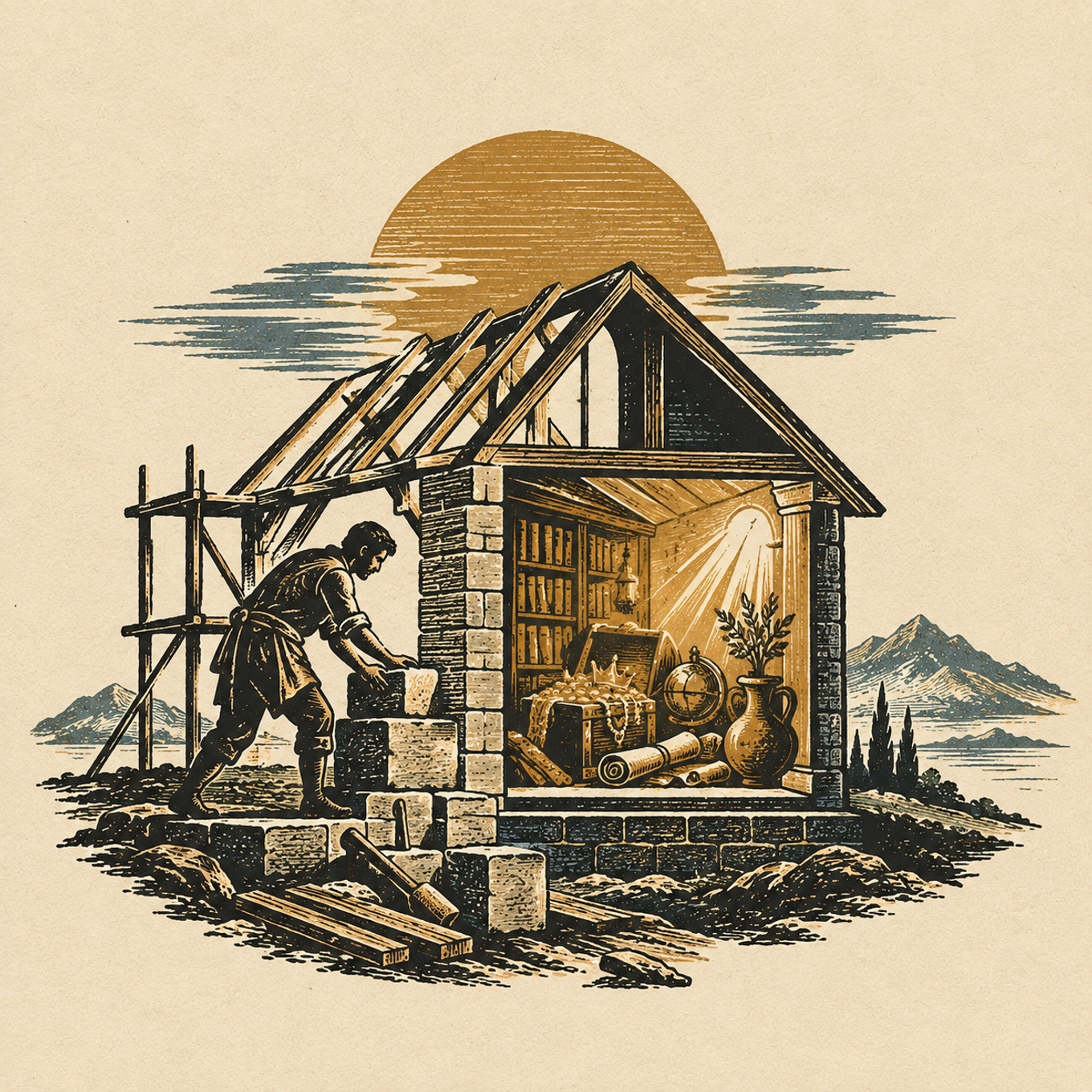
Through wisdom is an house builded; and by understanding it is established: And by knowledge shall the chambers be filled with all precious and pleasant riches.
Bezalel built a literal house. But everyone reading this is building a house of some kind. You're building a family, or a marriage, or a business, or a career, or simply a life and the kind of person you are.
Some of those houses feel solid. Some feel like they're one bad month away from coming down. And some are standing but feel empty inside, as if the walls went up but nothing good ever filled the rooms.
Most people use the words wisdom, understanding, and knowledge as if they mean the same thing. This verse treats them as three different tools with three different jobs.
If your house feels unsteady or empty, it often means one of them is missing. This article looks at what each one is, what it does, and how to get more of all three.
What The Verse Says
It helps to read the two verses right before it. Proverbs 24 opens with a warning: "Be not thou envious against evil men, neither desire to be with them. For their heart studieth destruction, and their lips talk of mischief.
The chapter starts with people whose minds are set on tearing things down, and then turns straight to what it takes to build. Then it lays out three steps. Wisdom builds the house. Understanding establishes it, which means it makes the house stand firm and last. Knowledge fills its rooms with "all precious and pleasant riches."
That can mean real wealth, and it can also mean everything that makes a home worth living in: good relationships, good memories, useful skills, peace. The same three appear together in another place in Proverbs, this time describing how God made the world:
Proverbs 3:19–20 (KJV)
The LORD by wisdom hath founded the earth; by understanding hath he established the heavens. By his knowledge the depths are broken up, and the clouds drop down the dew.
God founds the earth by wisdom, establishes the heavens by understanding, and by knowledge the waters break open and the dew falls. It's the same pattern: wisdom lays the foundation, understanding makes it stand, and knowledge fills it with what brings life. The builder of the universe and the builder of a household use the same three tools.
Three Words, Three Jobs
Wisdom builds
The Hebrew word for wisdom is chokmah. In the Bible, it doesn't only mean being smart or having good ideas. It's also the word used for skill. When God tells Moses to have garments made for the priests, He says to speak to "all that are wise hearted," meaning the skilled workers.
Bezalel's wisdom showed up in his hands, in gold and wood and stone. So wisdom is the skill of living well: knowing what to do and doing it. It's the ability to make good decisions and put them into action.
That's why wisdom is what builds. A house doesn't go up because someone knows a lot about houses. It goes up because someone makes a series of good decisions and follows through on them, one board at a time.
Understanding establishes
The Hebrew word for understanding, tevunah, comes from a root that means to discern or tell things apart. Understanding is the ability to see how things fit together and why: why a person reacts the way they do, why a plan works or doesn't, what's really going on underneath what you can see.
That's what keeps a house standing. You can make a good decision, but if you don't understand the people and the situation around it, things start to crack. Understanding sees where the weak spots are, what might give way, and what will hold.
Proverbs uses the same word, "established," about getting good advice: "Without counsel purposes are disappointed: but in the multitude of counsellors they are established."
Plans stand firm when you understand them well enough, and other people help you see what you would have missed.
Knowledge fills
The Hebrew word for knowledge is da'at, from a verb that means to know, including knowing something by experience and not only from a book.
Knowledge is the facts, skills, and experience you gather over time: how to fix something, what your spouse needs when they're stressed, how money works, what the Bible actually says.
Knowledge is what fills the rooms. A house can be well built and standing firm but still empty. Knowledge is what furnishes it, and the more you gather, the richer the house becomes to live in.
Confucius, the Chinese teacher, made a point about knowledge that fits here. He told a student that when you know something, you should admit that you know it, and when you don't know something, you should admit that you don't.
"This is knowledge," he said. Part of filling your rooms is being truthful with yourself about which ones are still empty.
Why the order matters
The verse starts with wisdom, and knowledge comes last. Proverbs says it directly in another place: "Wisdom is the principal thing; therefore get wisdom: and with all thy getting get understanding."
Knowledge is valuable, but it's the last step. A person who gathers a lot of knowledge but lacks wisdom is filling rooms in a house that was never built right. Everything they know is sitting in a structure that won't hold it.
Proverbs also says where all three come from: "For the LORD giveth wisdom: out of his mouth cometh knowledge and understanding."
Bezalel's skill came from God filling him. The book of Proverbs treats all three as gifts from God that a person also has to seek.
What "House" Means
In the Bible, the word for house can mean a building, but it very often means a household: a family, and everyone and everything that belongs to it. When Proverbs says "Every wise woman buildeth her house: but the foolish plucketh it down with her hands," the house it means is a family.
So Proverbs 24:3–4 applies to any house you're building. Here's what that can look like:
- A Marriage
Wisdom is choosing to be patient, keep your word, and put the other person first. Understanding is knowing your spouse well enough to see what's really behind a hard day. Knowledge is everything you've learned about them over the years, which fills the marriage with shared memories and good habits.
For example, picture a husband whose wife goes quiet and short with him every Sunday night. Over the years he's learned that she has her hardest meeting of the week every Monday morning. That's knowledge.
When he stops and thinks about it, he understands that her mood on Sundays is dread about the week, not anger at him. That's understanding.
So instead of snapping back or sulking, he decides to handle the kids' bedtime on Sunday nights and ask her how she's feeling about Monday. That's wisdom, and over time it's the kind of choice that keeps a marriage standing.
- A Business
Wisdom is deciding what to build and making sound choices about money and people. Understanding is seeing how your customers think and where the business is weak. Knowledge is the skills and experience that fill the business with value.
For example, picture a woman who runs a small bakery that keeps losing money during the week. She starts writing down what sells and when, and after a month she knows most of her weekday sales happen before 8 a.m. That's knowledge.
Looking closer, she understands why: her weekday customers are people on their way to work who want something quick, and hardly anyone comes in during the afternoon. That's understanding.
So she decides to open an hour earlier, add grab-and-go breakfast items, and close early on weekday afternoons, and she sticks with the plan long enough to see if it works. That's wisdom.
- Your own life
Wisdom is choosing what kind of person to become and acting on it. Understanding is knowing yourself: your weaknesses, your patterns, and what sets you off. Knowledge is everything you learn along the way that makes your life fuller.
For example, picture a young man who keeps losing his temper at work and regrets it every time. He starts paying attention and learns that it almost always happens in long afternoon meetings. That's knowledge.
When he thinks about why, he understands that on those days he usually skipped lunch, and that he gets angry when he feels like no one is listening to him. That's understanding.
So he decides to eat before those meetings and to speak up calmly early on, instead of holding it in until it comes out wrong. That's wisdom, and it's how a person slowly builds the kind of character others can trust.
Jesus used the same picture at the end of the Sermon on the Mount. He said whoever hears His words and does them is like "a wise man, which built his house upon a rock."
When the rain came, the floods rose, and the winds beat on it, it didn't fall. The man who heard the same words and didn't do them built on sand, and when the storm hit, his house fell, "and great was the fall of it."
Both men heard the words, so both had the same knowledge. What made the difference was whether they acted on it. That's wisdom.
When One Is Missing
Because each of the three has its own job, you can usually tell which one is missing by what's going wrong.
Knowledge without wisdom
This is the person who knows a lot and still makes poor choices. They've read every book on money and are still in debt. They know exactly what a healthy marriage looks like and still say the thing they know will start a fight.
The rooms are full, but the house was never built right, so the knowledge has nowhere to go. It's the man in Jesus' story who heard the words and didn't do them.
Wisdom without understanding
This is the person who makes a decision that's good in general but doesn't fit the situation. The Bible has a clear example. When King Solomon died, his son Rehoboam became king, and the people came to him asking for relief from the heavy labor and taxes his father had put on them.
The older men who had advised Solomon told him to listen to the people and speak kindly to them, and they would serve him forever. Rehoboam ignored them. He took advice from the young men he had grown up with, and told the people he would make their burden even heavier. Ten of Israel's twelve tribes walked away, and the kingdom split in two.
Rehoboam may have thought he was being strong and decisive. What he lacked was the understanding to see what his people actually needed, and to listen to the counsellors who could see it. The house his father built didn't stay established.
The Bible also says the split fulfilled what God had already told the prophet Ahijah, as judgment for Solomon turning to other gods late in his life. Both things are true in the story: God's word came to pass, and it came to pass through a king who wouldn't listen.
Understanding and wisdom without knowledge
This is the person with good judgment and good sense whose rooms are still empty. They make good decisions and understand people, but they've stopped learning. They lack the skills or experience their house now needs, whether that's a new skill for their job, a better way to handle money, or a deeper knowledge of Scripture. The house stands, but it isn't as full as it could be.
How To Grow Each One
Wisdom starts with asking for it and then acting. James wrote, "If any of you lack wisdom, let him ask of God, that giveth to all men liberally, and upbraideth not; and it shall be given him."
Proverbs adds that "the fear of the LORD is the beginning of wisdom."
So wisdom begins with humility, with admitting you don't know the right way on your own. After that, it grows the way any skill does, by doing it. Each time you make a good decision and follow through, you get better at the next one.
Understanding grows by asking why and by listening. Ask why things happen the way they do: why the argument keeps coming back, why the business keeps losing customers, why you keep making the same mistake.
Listen to people who see things you don't, especially the ones who have been there before. Rehoboam had counsellors who understood what was needed, and he didn't listen. The multitude of counsellors is how plans get established.
Knowledge grows by learning on purpose. Read, study, ask questions, and learn from experience. Keep learning about the people in your house, about your work, and about God. Knowledge is the part you can add to every day, and the rooms only fill if you keep bringing things in.
How To Apply It
Pick the house you're building
Choose one house to focus on right now: your marriage, your family, your business, your career, or your own character. Write it down.
Check all three
Ask three questions about that house. Is it being built with wisdom, meaning am I making good decisions and following through? Is it established by understanding, meaning do I really understand the people and the situation? Are its rooms being filled with knowledge, meaning am I still learning what it needs? Circle the one that's weakest.
Ask for wisdom about one decision
Take the biggest decision in front of you in that house and pray about it specifically, the way James says to. Then write down what you believe the wise choice is, and take one step on it this week.
Get one piece of counsel
Find one person who has built the kind of house you're building, whether that's a long, happy marriage, a successful business, or a strong faith, and ask them what they understand that you might not. Listen more than you talk.
Fill one room
Choose one thing to learn this month that your house needs, like a book, a skill, a conversation, or a part of Scripture, and set aside a specific time each week to learn it.
Go Further
Exodus 31:1–11 and 35:30–36:7
The story of Bezalel, the builder God filled with wisdom, understanding, and knowledge, and the people who gave more than enough.
Matthew 7:24–27
Jesus' story of the wise and foolish builders, and what made one house stand when the storm came.
1 Kings 12:1–20
Rehoboam's choice between the older and younger counsellors, and how it split a kingdom.
Proverbs 2 and 3
Two chapters on where wisdom, understanding, and knowledge come from and what they do for the people who find them.
Bezalel didn't build the tabernacle alone, and he didn't build it from his own ability. God filled him with wisdom, understanding, and knowledge, gave him the heart to teach others, and the people brought more than enough to finish it.
When it was done, God's glory filled the house he had built. That's the picture Proverbs 24 paints for every house: wisdom to build it, understanding to make it stand, and knowledge to fill it with what's precious.
Whatever house you're building right now, look at which of the three it needs most, and start there. Ask God for wisdom and act on it. Listen until you understand.
Keep learning, and keep bringing good things into the rooms. A house built that way can take the rain, the floods, and the wind, and still be standing, and full, when they've passed.