What Are You Afraid Of?
A class that squirmed at Maslow's question, a prophet who bought a ticket the other way, and a servant who buried what he was given show how fear hides behind busyness, planning, and good reasons, and how to find yours and face it.
"If Not You, Then Who?"
The psychologist Abraham Maslow, best known for his hierarchy of needs, had a habit of asking his students a set of questions. Which of you in this class hopes to write the great American novel?
Who wants to be a senator, or a governor, or president? Who wants to be a great composer? Who among you will be a great leader?
He said the same thing happened almost every time. The students started giggling, blushing, and squirming in their seats. Nobody raised a hand. Then he asked one more question: "If not you, then who else?"
What Maslow saw in the room was something he came to believe almost everyone carries: a fear of our own highest possibilities.
He wrote that we enjoy and even thrill to the great things we can see ourselves becoming, and at the same time we shiver with weakness, awe, and fear in front of those very same possibilities. A friend of his, the historian Frank Manuel, suggested a name for it, and Maslow used it: the Jonah complex.
The name comes from the Bible. God told the prophet Jonah to go to the great city of Nineveh and preach against it. Jonah got up and went the other way.
He went down to the port of Joppa, found a ship headed to Tarshish, paid the fare, and sailed off "from the presence of the LORD." He didn't say he was afraid. He just went somewhere else.
Fear doesn't always feel like fear. Jonah didn't sit in Joppa trembling. He bought a ticket. Maslow's students didn't feel terrified. They laughed and looked at the floor.
Maybe someone has asked you what you're afraid of, and you really couldn't think of anything. You don't lie awake scared. You don't feel panic when you think about your goals. But there's something you've wanted to start for a long time, and you haven't started it.
Or you've started it a few times and stopped. You keep planning, researching, getting ready, telling yourself next month. And when the person asking pushed back and said, "If you weren't afraid, you would have started already and kept going," part of you knew they had a point, even if you couldn't say what the fear was.
That's what this article is about. It's about the fears you don't feel, the ones that show up in what you do and don't do rather than in how you feel.
You'll see how fear hides, what the most common hidden fears are, what Scripture and the philosophers noticed about them long before psychology had names for them, and, most importantly, how to find your own and face them, so they stop deciding what you do.
Why You Have To Look For It
In 399 BC, the philosopher Socrates stood trial in Athens. He was accused of corrupting the young and not honoring the city's gods, and he was facing a death sentence.
He told the jury that even if they offered to let him go on the condition that he stop questioning people, he would refuse. Later in his defense he said one of the most famous lines in philosophy: "the life which is unexamined is not worth living."
Socrates spent his life asking people what they believed and why, and he found over and over that people didn't really know. They were living by assumptions they had never looked at.
That's exactly how hidden fear works. It doesn't announce itself. It sits under your choices, and unless you go looking for it, you'll keep explaining your behavior with every reason except the real one.
So the first thing to understand is where to look. If you look at your feelings, you may not find much, because hidden fear is good at keeping you from feeling it.
You find it by looking at your behavior: what you avoid, what you put off, what you start and drop, and what reasons you give. The rest of this article will show you why that works and how to do it.
What Fear Actually Is
Psychologists usually separate fear from anxiety. Fear is your response to a threat that's here right now, like a car swerving toward you or a dog lunging at you. Anxiety is your response to a threat that might happen in the future, like a presentation next week or the chance that your business fails.
When people talk about being afraid to start something, they're usually talking about anxiety. Nothing is attacking you. Your mind is predicting that something bad might happen if you move forward.
Both work the same basic way. When your brain senses a threat, it prepares your body to protect you: your heart speeds up, your muscles tense, and your attention narrows onto the danger.
And it pushes you toward one thing above all: getting away from whatever is causing it. That system kept human beings alive for a very long time. The trouble is that it can't always tell the difference between a threat to your body and a threat to your pride, your reputation, or your place with other people.
There's research showing how close those two are. In 2003, the psychologists Naomi Eisenberger, Matthew Lieberman, and Kipling Williams scanned people's brains while they played a simple computer game of catch with what they believed were two other players, who then stopped throwing them the ball.
Being left out activated a part of the brain that also responds to physical pain. Being rejected isn't the same as being hurt, but to parts of your brain, it's closer than you'd think.
That's why the thought of launching something and having nobody care, or trying and looking foolish, or aiming high and falling short, can trigger the same drive to escape as a real danger. Your body treats a threat to your image as something to get away from. And the easiest way to get away from it is to never start.
How Fear Hides From You
Here's the key idea of this whole article. When you avoid what you're afraid of, you usually don't feel the fear at all. That's because avoiding it works, at least in the short term. You never get close enough to the thing for the fear to kick in.
In the 1940s, the psychologist O. Hobart Mowrer described how this becomes a loop. First, something becomes linked with fear. Then you avoid it, and avoiding it brings a feeling of relief. That relief rewards the avoidance, so you avoid it again next time.
And because you keep avoiding it, you never get the chance to learn that it wasn't as dangerous as you thought.6 Researchers who study fear today still describe avoidance this way: it keeps the fear alive by stopping you from ever testing it. So hidden fear doesn't look like fear. It looks like other things. These are the most common disguises.
Procrastination
Most people think procrastination is a time management problem. The psychologists Fuschia Sirois and Timothy Pychyl, who have spent years studying it, argue that it's mostly about managing feelings. In a 2013 paper, they described procrastination as putting short-term mood repair ahead of the things you actually intend to do.
The task makes you feel something unpleasant, like self-doubt, anxiety, or insecurity, and putting it off makes that feeling go away for now. Pychyl has put it simply: procrastination is an emotion regulation problem, not a time management problem. If you keep putting off the same important thing, the question to ask is what feeling you're avoiding.
Staying busy
"I don't have time" is one of the most common reasons people give for not starting. Sometimes it's true. But busyness is also one of the best hiding places fear has, because being busy feels productive and responsible. It's easy to fill every hour with work that feels urgent and safe, so there's never time left for the thing that scares you.
Endless preparing
Researching, planning, taking another course, redesigning the logo, waiting until you're ready. Preparation is good, and some of it is necessary. But when the preparing never ends, it's usually because preparing feels like progress without the risk of being judged. You can't fail at something you haven't released.
Holding back your effort
This one is harder to see. In 1978, the psychologists Steven Berglas and Edward Jones gave college students problems to solve. Some got problems they could solve. Others got problems that were nearly impossible, but everyone was told they had done well.
Then the students were told they'd take a second test, and before it they could choose between a drug that would supposedly help their performance and one that would supposedly hurt it. The men who had been told they succeeded on the impossible problems, who privately knew their success was mostly luck, were the only group who tended to choose the drug that would hurt them.
Why would anyone do that? Because it gave them an excuse. If they failed the second test, they could blame the drug instead of their ability. Psychologists call this self-handicapping, and it shows up everywhere: the student who parties the night before an exam, the person who starts a project half-heartedly, the athlete who doesn't train hard before a big competition.
If you never give something your full effort, failing never has to mean you weren't good enough. Starting and stopping, never quite committing, is one of the most common ways people protect themselves from finding out.
Good reasons
The last disguise is the best one: reasons that sound completely sensible. The timing isn't right. The market is saturated. I need more money first. I'll start after this busy season. Some of these may even be true. But fear is very good at finding true-sounding reasons, and as long as you have a good reason, you never have to look at what's underneath it.
If any of these describe you, it doesn't mean you're weak. It means your mind is doing exactly what it was built to do: steering you away from something it thinks is a threat. The goal is to find out what that threat is.
The Fears People Don't Admit
Under the procrastination, the busyness, and the good reasons, there's usually one of a handful of fears. Most people have more than one. As you read these, pay attention to which ones make you want to skip ahead, because that reaction is often a clue.
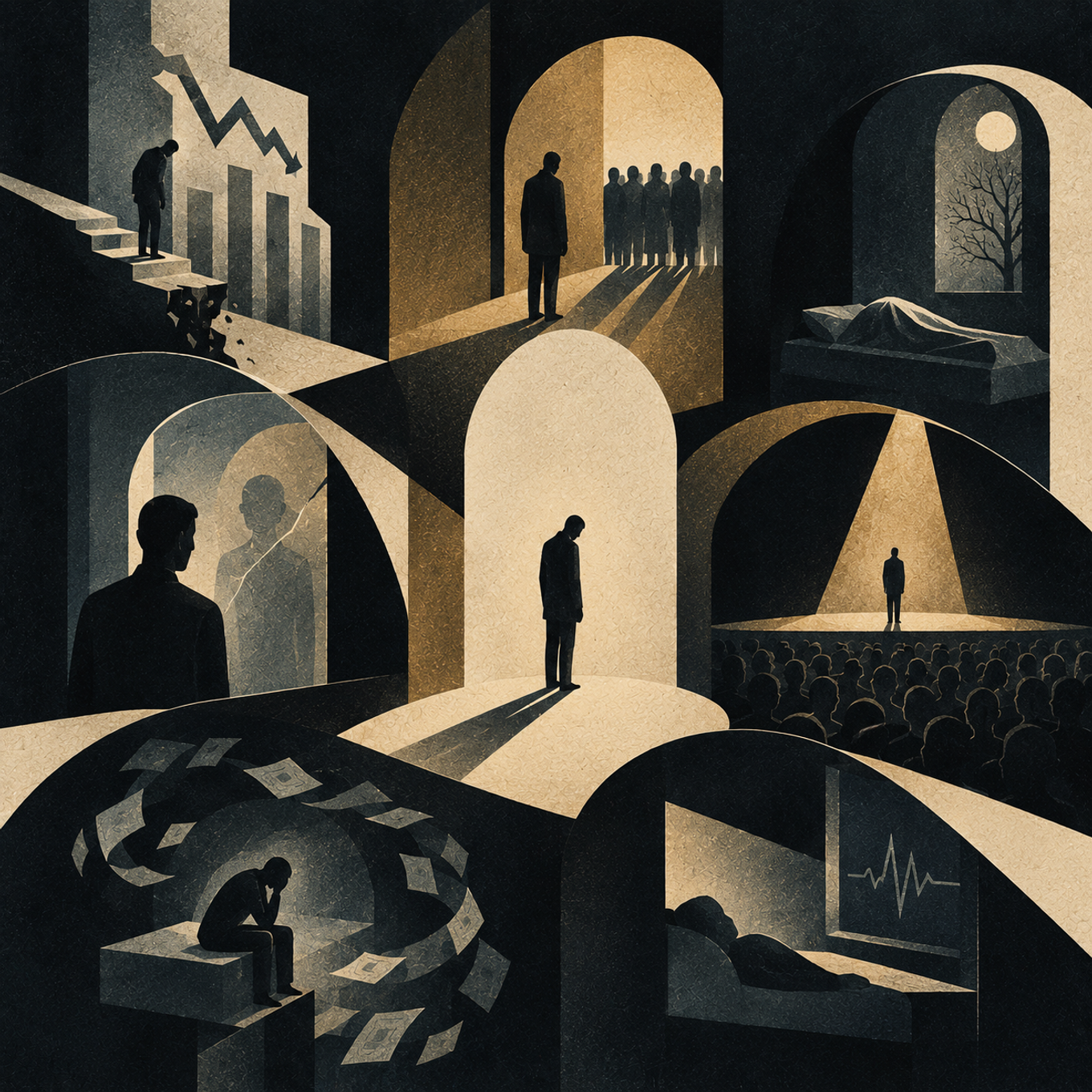
Fear of failing
This is the obvious one, but it goes deeper than most people think. Failing isn't only about losing money or time. For many people, failing would mean something about who they are: that they aren't smart enough, talented enough, or good enough.
As long as you haven't really tried, you can keep believing you could do it if you wanted to. Trying for real puts that belief on the line. That's exactly what the students in Berglas and Jones's study were protecting.
The way through is to separate what you do from what you're worth, and the way you treat yourself after a failure matters a lot.
In a 2012 set of experiments, the psychologists Juliana Breines and Serena Chen gave students a hard vocabulary test they were bound to do poorly on. Afterward, some were encouraged to be kind and understanding toward themselves about it, and others weren't.
When the students were given a chance to study for a second test, the ones who had been kind to themselves studied longer. Beating yourself up over a failure makes the next attempt scarier, which makes you more likely to avoid it. Treating a failure as something that happened, rather than proof of who you are, makes it easier to try again.
A good way to practice this is to fail on purpose at small things with low stakes, like pitching an idea you're not sure about or trying a skill you're bad at in front of a friend, and notice that you come through it fine.
Fear of being judged
Most people are less afraid of failing in private than of failing in front of others. What will people think if you post something and nobody likes it? What will your family say if the business doesn't work? What will your coworkers think if they see you trying to be something more?
Remember that to your brain, social rejection sits close to physical pain. The fear of being seen trying, and then being seen fall short, keeps a lot of people from ever showing their work.
It helps to know that people notice you far less than you think. In a well-known 2000 study, Thomas Gilovich and his colleagues at Cornell had college students put on a T-shirt with a picture of Barry Manilow on it, a singer the students had rated as embarrassing to wear, and walk into a room of other students.
Afterward, the students wearing the shirt guessed that about half the people in the room had noticed it. The real number was about a quarter. Researchers call this the spotlight effect: we feel like a spotlight is on us, when most people are busy thinking about themselves.
The step for this fear is to let people see your work in small doses, then compare what they actually said with what you predicted they'd say. Most people find the judgment they feared mostly never showed up.
Fear of finding out you're ordinary
This is closely tied to the fear of failing, but it's worth naming on its own. Many people carry a private belief that they're meant for something bigger. Starting something real means finding out whether that's true.
If you never start, the dream stays safe. If you start and it goes badly, you might have to live without the dream. For some people that loss is scarier than any actual failure.
The only way to settle this fear is to find out, and the way to find out is to give one thing your full effort. Holding back keeps the dream safe, but it also guarantees you'll never learn what you could do. It also helps to know what the prediction behind this fear usually is: "If I'm not great right away, I never will be."
The research on skill says otherwise. Almost everyone who gets good at something starts out ordinary and improves through a long stretch of practice. An early result tells you where you're starting from. Where you end up depends on the practice that comes after.
So commit fully to one project for a set period, like three months, and judge yourself by how much you improved over that time.
Fear of succeeding
This is the one Maslow noticed in his students, and it's the hardest for most people to believe about themselves. Why would anyone be afraid of succeeding? Because success changes things. It brings more responsibility and more pressure to keep it up.
It makes people expect more from you. It can change how your friends and family see you, and it can separate you from people you're close to. Maslow wrote that we fear our highest possibilities as much as we want them.
As you'll see in the next section, Jonah didn't run because he thought he'd fail in Nineveh. He ran because he didn't want what would happen if he succeeded.
This fear is about what changes after you succeed, so the step is to look at those changes directly instead of letting them stay vague. Write down exactly what you think success would cost you: more responsibility, less free time, pressure to keep it up, or distance from certain people.
Seeing it on paper usually shows that some of it is real and worth planning for, and some of it is a worry that won't happen. For the parts that are real, make a plan now. If you're afraid success will take all your time, decide in advance what you'll protect.
If you're afraid people will expect more from you, remember that you can grow into responsibility the same way you grow into anything else, a step at a time.
Fear of losing who you are
Every real change asks you to become a slightly different person. If you've always been "the one who talks about starting a business," actually starting it means giving up that identity.
If your friends all know you as someone who parties, getting serious about something can feel like leaving them behind. People often hold on to a life they don't want because it's the one they know how to live, and the person they'd have to become feels like a stranger.
The step here is to bring the people involved into the change instead of hiding it from them. Most people who fear losing others by changing have never actually told those people what they're working on. Tell one or two of the people who matter most, before they find out on their own.
You'll often find that the people who really care about you are glad for you, and if someone isn't, that tells you something useful too. It also helps to see the change as adding to who you are rather than replacing it. You can take on something new and still be loyal to the people and the places you came from.
Fear of the unknown, and of freedom itself
The Danish philosopher Søren Kierkegaard wrote in 1844 that anxiety is the dizziness of freedom. He meant the feeling you get when you realize that you really could choose, that nothing is stopping you, and that what happens next is up to you.
That can be more frightening than being stuck. When you're stuck, it isn't your fault. When you're free to choose, the result is on you. Many people stay where they are because the open road in front of them feels more dangerous than the wall they're used to.
Uncertainty feels worse than almost anything, so the step for this fear is to shrink the unknown with small experiments. Instead of deciding whether to change your whole life, try one version of the new thing for a week or a month.
Take one freelance project before quitting your job. Post ten articles before building a whole website. Spend a weekend in the city you're thinking of moving to. Each small experiment turns part of the unknown into something you've actually seen, and it's much easier to make a big choice once most of it is no longer a mystery.
What The Bible Shows About Hidden Fear
The Bible is full of people who were called to do something and found reasons not to. Read closely, their stories show how fear hides behind reasons, and how God answered it.
Moses and his reasons
When God spoke to Moses from the burning bush and told him to go to Pharaoh and lead Israel out of Egypt, Moses didn't say he was scared. He gave reasons, one after another.
First: "Who am I, that I should go unto Pharaoh?" Then: what if the people ask who sent me? Then: "behold, they will not believe me." Then: "I am not eloquent... I am slow of speech, and of a slow tongue." God answered each one.
And finally, out of reasons, Moses said what he really meant: "O my Lord, send, I pray thee, by the hand of him whom thou wilt send." In other words, send someone else.
Each of Moses' reasons was reasonable on its own. He really wasn't a great speaker. The people really might not believe him. But the reasons weren't the real issue. When God took them away one by one, what was left was the thing underneath: he didn't want to go.
Gideon in the winepress
When the angel of the Lord came to Gideon, Gideon was threshing wheat inside a winepress, a pit in the ground, "to hide it from the Midianites," who had been raiding Israel. The angel's first words to him were, "The LORD is with thee, thou mighty man of valour." Gideon, hiding in a hole, didn't see himself that way.
When he was told he would save Israel, he answered, "my family is poor in Manasseh, and I am the least in my father's house." God called him what he could become before he believed it. Gideon's fear told him who he was, and God told him something different.
Jonah's real reason
Jonah ran from Nineveh, and for most of the book we don't know why. The real reason only comes out at the end. After Jonah finally preaches, the people of Nineveh repent, and God spares the city.
Jonah is furious, and he finally says what had been driving him all along: "for I knew that thou art a gracious God, and merciful, slow to anger, and of great kindness, and repentest thee of the evil."
Jonah hadn't run because he thought he'd fail. He ran because he knew he'd succeed, and he didn't want the result. His reason stayed hidden until the last chapter, and it was the last thing anyone would have guessed.
The servant who buried it
In Jesus' parable of the talents, a master gives three servants money to manage while he travels. Two of them put it to work and double it. The third digs a hole and buries his. When the master returns and asks what happened, the servant explains: "I was afraid, and went and hid thy talent in the earth."
He didn't lose the money. He didn't waste it. He just never used it, because he was afraid. The master's response is one of the hardest in the Gospels, because in the story, doing nothing out of fear was treated as seriously as doing something wrong.
What God says about fear
Paul wrote to his young student Timothy: "For God hath not given us the spirit of fear; but of power, and of love, and of a sound mind."
When God sent Joshua to lead Israel into the promised land after Moses died, He told him: "Be strong and of a good courage; be not afraid, neither be thou dismayed: for the LORD thy God is with thee whithersoever thou goest." And John wrote that "perfect love casteth out fear."
None of these verses say that faithful people never feel afraid. Moses, Gideon, and Joshua all did. What they say is that fear doesn't have to be what decides. Every one of these stories ends with a person moving forward while still afraid, because someone greater was with them.
The Roman philosopher Seneca wrote hundreds of letters to his friend Lucilius about how to live well, and fear comes up again and again. In one letter he wrote:
There are more things, Lucilius, likely to frighten us than there are to crush us; we suffer more often in imagination than in reality.
Seneca's point was that most of what scares us never actually happens, and much of what does happen is less terrible than what we imagined. Nearly two thousand years later, research would test that idea directly, as you'll see in section 09.
Seneca also gave Lucilius a practice for dealing with a fear head-on. If you're afraid of losing everything, he said, set aside a few days to live as if you already had. Eat the cheapest, plainest food. Wear rough clothes. And while you do it, ask yourself:
Is this the condition that I feared?
Instead of running from the fear, Seneca walked straight into a small version of it, on purpose, to find out what it was really like. That's the same idea behind the most effective modern treatments for fear.
And the American writer Mark Twain put the point about courage well in 1894: "Courage is resistance to fear, mastery of fear—not absence of fear."
Courageous people are the ones who feel afraid and move anyway. If you're waiting for the fear to go away before you start, you'll wait forever, because in most cases the fear only shrinks after you start.
How to find your hidden fears
You can't face a fear you haven't found. Because hidden fear hides in behavior, finding it means working backward from what you do to what's driving it. Here are four ways to do that, and they work best together.
Look at what you avoid
Start with your behavior, not your feelings. Make a list of the things you've said you want to do for a long time but haven't done, or have started and stopped. Next to each, write the reason you usually give. Then look for patterns.
Do you keep avoiding the part where other people see your work? The part where you have to ask for money? The part where you commit fully? The thing you avoid most consistently is usually the closest to the fear.
Follow the arrow down
The psychiatrist David Burns, in his book Feeling Good, described what he called the vertical arrow technique, which is often called the downward arrow. You take a situation you're avoiding and ask yourself, "If that happened, what would it mean?" Then you take the answer and ask the same question again, and keep going until you hit something that feels heavy.
Here's what it can look like. I haven't launched my newsletter. What would happen if I did? Maybe only a few people would sign up. And if that happened, what would it mean? That people aren't interested in what I have to say.
And if that were true? That I'm not as good a writer as I thought. And if that were true? That I've been fooling myself about who I am.
That last answer is the real fear. It has nothing to do with the newsletter's signup form. It's about identity. And once you can see it, you can deal with it directly.
Name it
Once you find it, say it plainly, out loud or on paper. "I'm afraid that if I really try, I'll find out I'm not good enough." It sounds simple, but there's research behind it. In a 2007 study, Matthew Lieberman and his colleagues at UCLA scanned people's brains while they looked at pictures of angry and frightened faces.
When people put a label on the emotion in the picture, activity in the amygdala, a part of the brain involved in fear, went down.19 Putting a feeling into words seems to take some of its power away. A fear you can name is smaller than one you can only sense.
Ask Maslow's question
Finally, ask yourself the question Maslow asked his students, and don't laugh it off.
What would you do if you weren't afraid? What would you start, say, or commit to?
Write the first answer that comes to mind, even if it feels embarrassing. Then ask the second question: if not you, then who?
Whatever made you squirm is probably pointing right at the thing you're afraid of.
How To Face What You Find
Finding a hidden fear takes away some of its power. But the fear only really shrinks when you move toward it. Remember Mowrer's loop: avoidance keeps fear alive because it stops you from ever finding out the danger isn't what you thought. The way out of the loop is the opposite of avoiding. You approach the thing, a little at a time, and let your mind learn from what actually happens.
Approach it in small steps
This is the basic idea behind exposure therapy, one of the most effective treatments psychology has for fear and anxiety. People face what they fear on purpose, starting with a version small enough to handle and working up from there. Each time they do it and the disaster doesn't happen, their brain learns something new.
Researchers like Michelle Craske at UCLA describe this as new learning that competes with the old fear: the old link between the situation and danger doesn't disappear, but a new, stronger link forms between the situation and safety.
Therapists often use what's called a fear ladder. You list the situations connected to your fear, from the least scary to the most, and start at the bottom. If you're afraid to launch a newsletter, the bottom rung might be showing one article to one friend.
The next might be posting one idea on LinkedIn. Then sending it to ten people. Then announcing it to your business club. You stay on each rung until it stops feeling like a big deal, then move up.
This approach works remarkably well, and fast. In 1989, the Swedish psychologist Lars-Göran Öst introduced what's now called one-session treatment for specific phobias, like fear of spiders, dogs, needles, or flying.
The whole treatment is a single guided session of gradual exposure lasting three hours or less. Across different phobias, studies of this treatment have found that roughly 80 to 90 percent of adults improve clinically.
The fears you're dealing with are probably less specific than a fear of spiders, and you won't have a therapist guiding you through a ladder in one afternoon. But the principle is the same, and it's one of the best-supported findings in psychology: fear that has been kept alive for years by avoidance can shrink, sometimes surprisingly fast, once a person starts moving toward it.
Name it while you face it
The two tools work even better together. In a 2012 study, Katharina Kircanski, Matthew Lieberman, and Michelle Craske had people who were afraid of spiders move closer and closer to a live tarantula. Some of them were asked to describe their feelings out loud as they did it, with sentences like "I feel anxious that the tarantula will jump on me."
A week later, when they faced a different spider in a different room, the people who had put their feelings into words showed a smaller physical fear response than those who had tried to talk themselves out of the fear, distracted themselves, or simply been exposed without saying anything.
They still said they felt about as afraid as everyone else, but their bodies reacted less, and the more fear words they had used, the more their fear response dropped. You don't have to pretend you aren't scared. Saying it plainly while you move forward seems to help your body's fear response settle faster.
Check whether your fears come true
Seneca said we suffer more in imagination than in reality. In 2020, Lucas LaFreniere and Michelle Newman at Penn State tested something close to that. They asked 29 people with generalized anxiety disorder, a condition marked by constant worry, to write down their worries for ten days and then track whether each one actually happened over the following month.
About 91 percent of the worries didn't come true. And the people who saw most clearly that their worries weren't coming true improved the most over the course of treatment.
These were people who worry far more than most, so the exact number won't apply to everyone. But the lesson does. Your fears are predictions, and most predictions made by fear are wrong. Writing them down and checking them is one of the fastest ways to stop believing them.
Move while you're still afraid
Most people wait until they feel ready. In exposure work, though, the feeling of being ready usually shows up after people act. Twain's point was that courage means acting with fear still there. Joshua was told to be strong and courageous because God was going with him, and the land ahead of him was still full of danger. You don't need the fear to leave first. You need to take one step while it's still standing next to you.
Expect it to come back sometimes
Fear often returns after you've made progress, especially under stress or in a new situation. Researchers who study exposure call this the return of fear, and it's a normal part of the process. It doesn't mean the work failed.
This is also where consistency comes in. For many people who start and stop, the stopping happens right when the next step brings the fear back, and they quit without noticing why. When you feel the old pull to take a break, change direction, or wait until next month, ask whether the next step is near the fear. If it is, that's the step to take.
When you catch yourself avoiding again
At some point, you'll realize you've done it again. A week or a month has gone by, and you haven't touched the thing you decided to face. What happens next matters a lot, and most people handle it badly.
They get angry at themselves, call themselves lazy or weak, and feel so bad about it that the whole subject becomes even more painful to think about. That extra pain gives them one more reason to avoid it.
There's research on a better way. In 2010, Michael Wohl, Timothy Pychyl, and Shannon Bennett followed first-year university students through two midterm exams. Before the first exam, the students reported how much they had put off studying and how much they had forgiven themselves for it.
Among the students who had procrastinated the most, the ones who forgave themselves procrastinated less before the second exam. The researchers found that forgiving themselves reduced the negative feelings they carried about the first exam, and with less of those feelings attached to studying, they were less likely to avoid it the second time.
It was a single study that measured students rather than assigning them to forgive themselves, so it doesn't prove forgiveness causes the change. But it fits everything else in this article. Avoidance runs on bad feelings, and piling shame on top of the fear gives your mind even more reason to stay away.
Forgiving yourself still means admitting what happened and deciding what you'll do differently. What you let go of is the anger, so you can move again. So when you catch yourself avoiding, try this. Say plainly what happened: "I've avoided this for three weeks."
Name the fear underneath it, the same way you did before. Forgive yourself for it. Then pick the smallest rung on your ladder, even one lower than where you were, and do it today. The goal is to get moving toward the fear again before the avoidance has time to settle back in.
One Person, Start To Finish
Here's what all of this can look like in one person's life. Picture a man named Jordan. He's 26 and has wanted to start a podcast about personal finance for three years. He's bought a microphone, recorded a dozen practice episodes, and redesigned the logo four times.
None of it has ever been published. When a friend asks what he's afraid of, he says nothing, really. He's just been busy, and he wants it to be good before he puts it out.
He maps his avoidance. When Jordan lists what he's started and stopped over the past few years, a pattern jumps out. He does fine with every part of a project that happens in private: the research, the recording, the editing. He stalls every single time right before other people would see it.
He follows the arrow down. If he published an episode, what would happen? People he knows might hear it. And if they did? The guys he grew up with might think he's acting like he's better than them, talking about money and investing. And if they thought that?
He'd lose them. That's the fear. It was never about the audio quality or the logo. It was about losing the people who've known him his whole life.
He names it. He writes it in one sentence: "I'm afraid that if I put myself out there, my old friends will think I've changed and I'll lose them." Then he tells his friend who asked the question in the first place. Saying it out loud feels strange, and a little embarrassing, but the fear seems smaller once it's in words.
He rehearses the worst case. The worst realistic outcome is that a couple of old friends make fun of him in the group chat. To prevent it, he could tell his closest friends about the podcast himself before they stumble on it. If it happened anyway, he'd have a conversation with the ones who matter and let the rest go.
Then he writes what it costs him never to try: three more years of recordings sitting on his laptop, and the same question from his friend a year from now. Looking at it on paper, the thing he's been afraid of is unpleasant to think about, but small. The cost of never trying is much bigger.
He builds a ladder and climbs it. Bottom rung: send one episode to his closest friend. Next: post a clip on his own social media. Next: publish the first episode publicly. Next: tell his old friends in the group chat. He starts at the bottom that week.
He uses the tools in the moment. The night before he's supposed to publish, he catches himself opening the editing software to fix the intro one more time. He recognizes it as the old pattern.
He says out loud, "I'm afraid the guys back home will laugh at this," the way the people in the spider study named their fear while facing it. Then he does the one thing on the next rung: he clicks publish.
He checks his predictions. He keeps a worry log for the month. He had predicted mockery, silence, and embarrassment. What actually happened: two old friends sent supportive messages, one asked him for advice about a credit card, and nobody laughed at him. Almost none of what he predicted came true.
He avoids again, and comes back. After episode five gets hardly any listens, Jordan stops posting for two weeks without really deciding to. When he notices, he's tempted to call himself a quitter.
Instead, he says what happened, names the fear underneath it, this time a fear that nobody cares, forgives himself for the two weeks, and records a short episode the next morning.
Six months later, Jordan still feels a flicker of fear every time he hits publish. The fear hasn't disappeared, but it no longer decides what he does. He has 25 episodes out, a small audience that grows every month, and the friendships he was afraid of losing are still there.
Practices
Map your avoidance
Write down three things you've wanted to do for a long time and haven't done, or have started and stopped. Next to each, write the reason you usually give. Then circle the part of each one you avoid most, like being seen, asking for money, or committing fully. Look for what the three have in common.
Follow the arrow to the bottom
Take the thing you avoid most and ask, "If this happened, what would it mean?" Keep asking the same question about each answer until you reach something that feels heavy. Write that last answer down. That's the fear you're working with.
Name it
Write your fear as one plain sentence: "I'm afraid that..." Say it out loud. Then tell one person you trust, like a mentor, a friend, or a pastor. A fear you've said out loud to someone else has much less room to hide.
Rehearse the worst case
Follow Seneca's lead. Write down the worst thing that could realistically happen if you did the thing you've been avoiding. Then write what you could do to prevent it, and what you would do to recover if it happened anyway. Finally, write what it will cost you if you never try at all, one year, five years, and ten years from now. Ask Seneca's question: is this the condition that I feared?
Build a fear ladder and climb one rung
List five to ten steps toward the thing you fear, from the least scary to the most. Do the bottom step this week. Stay on it until it feels like no big deal, then move to the next. Say how you feel out loud while you do it.
Keep a worry log for 30 days
Every time a fearful prediction comes up, write it down with the date. At the end of 30 days, go back and mark which ones actually happened. Most people are surprised by how few did, and seeing it on paper is what weakens the fear.
Forgive yourself and restart
When you notice you've been avoiding, say plainly how long it's been, name the fear underneath it, and forgive yourself for it. Then do the smallest rung on your ladder that same day, even if it's lower than where you left off.
Take one step a day near the fear
Each day, do one small thing that moves you toward what you've been avoiding, even if it's five minutes of work. When you notice the urge to wait, change plans, or take a break, check whether the next step is close to the fear. If it is, take it anyway.
Go Further
The Farther Reaches of Human Nature, by Abraham Maslow
Includes Maslow's writing on the Jonah complex and why people run from their own best possibilities.
Feeling Good, by David Burns
A practical guide to the thinking patterns behind fear and discouragement, including the vertical arrow technique.
Exodus 3–4, Judges 6, and the book of Jonah
Moses' reasons at the burning bush, Gideon in the winepress, and Jonah's flight and his real reason at the end.
Letters 13 and 18, by Seneca
Two short letters on why we suffer more in imagination than in reality, and how to practice facing what you fear.
Jonah did eventually go to Nineveh. It took a storm, a ship full of frightened sailors, and three days inside a great fish, but he went, and a whole city changed because of it.
Moses went to Pharaoh with his slow tongue. Gideon came up out of the winepress. The servant who buried his talent is the only one in these stories who never moved, and the talent sat in the ground the whole time, doing nothing for anyone.
Your fear may not feel like fear. It may feel like being busy, or getting ready, or waiting for the right time. But now you know where to look. Look at what you avoid, follow it down until you find what's underneath, and say it out loud. Then take one small step toward it while it's still there, and another one tomorrow.
You'll find that most of what you feared never happens, and the parts that do are smaller than you imagined. And when you catch yourself squirming at the thought of what you could become, ask yourself Maslow's question and give it a real answer: if not you, then who?