Business Lab - Vol. 01
What People Pay For: Understanding Value in Business
A man who sold a million rocks, an engineer who turned YouTube videos into a toy company, a football player tired of wet shirts, and two cousins who weren't bakers show the different kinds of value people pay for, the different ways they pay, and the different paths to starting a business.
A Rock In A Box
In 1975, Gary Dahl was a freelance advertising copywriter in Los Gatos, California, and he was having a hard time paying his bills. One night at a bar, his friends started complaining about their pets.
Dogs chewed the furniture. Cats had to be fed. Everything had to be walked, cleaned up after, and taken to the vet. Dahl said he didn't have any of those problems, because his pet was a rock.
It was a joke, and it got a laugh. But Dahl kept thinking about it. He went home and wrote a 36-page manual called "The Care and Training of Your Pet Rock," full of jokes about how to teach your rock to sit, stay, and play dead.
He designed a cardboard box with air holes, like the ones pet stores used, and put a bed of straw inside. He got two friends to invest, and he bought smooth stones from a beach in Mexico for about a penny each.
He started selling them in August for $3.95. By the holidays, stores were selling them as fast as they could get them. Dahl sold an estimated 1.3 to 1.5 million rocks, went on The Tonight Show twice, and became a millionaire.
You've probably heard that businesses make money by solving problems. It's good advice, and a lot of this article is about it. But the Pet Rock didn't solve anyone's problem. Nobody needed a rock.
People bought it because it was funny, because it made a great gift, and because everyone was talking about it. Dahl put it this way in an interview that year: "You might say we've packaged a sense of humor.”
So if a business can make a million dollars selling rocks, what is it that people are actually paying for? And why can someone on YouTube earn a living when viewers never pay them anything at all?
If you're thinking about starting something, or you already have and it isn't working, this is the first thing to get clear on. Almost every business idea people come up with starts with the product: "I'll make an app," "I'll start a channel," "I'll open a shop." But the product is only the container.
What people pay for is what the product gives them. Once you understand the different kinds of value people want, and the different ways they pay for it, you'll see more ways to start a business than you probably see right now, and you'll be able to tell much earlier whether an idea has a real chance. That's what this issue covers.
What Money Is
Before we talk about value, it helps to be clear on what money is. Money is how people trade what they have for what they want, without having to trade goods directly. It stands for work someone did and things someone can buy. When you hand someone $20, you're giving up everything else that $20 could have bought.
To see why money exists at all, picture life without it. Say you raise chickens and you need a new pair of shoes. You'd have to find a shoemaker who happens to want eggs, right now, in the amount you have. If the shoemaker wants firewood instead, you're stuck, unless you can find someone who'll trade you firewood for eggs first.
The economist William Stanley Jevons called this problem the "double coincidence of wants": for a direct trade to happen, each person has to want exactly what the other one has, at the same time. Money fixes that. You sell your eggs to anyone who wants eggs, and you use the money to buy shoes from anyone who sells them.
That's why economists usually describe money as doing three jobs. It's a way to pay for things. It's a way to measure what things are worth, so you can compare a pair of shoes with a month of eggs. And it's a way to store what you've earned, so you can spend it later instead of right away. A dollar bill is just paper. It works because nearly everyone trusts that other people will accept it too.
This also shows where your customers' money comes from. Almost everyone who pays you earned that money by giving value to someone else first, usually an employer who paid them for their time and skill. So when a customer hands you $20, they're trading you a piece of the work they did. That's why people are careful with it, and why they only part with it for something they want more. That leads to the most important rule in business:
If a sandwich costs $10 and you buy it, it's because at that moment you'd rather have the sandwich than the $10. The shop, meanwhile, would rather have the $10 than the sandwich, since it cost them less than that to make. Both sides walk away better off. That's why people keep coming back.
It's worth more than $10 to you and less than $10 to the shop, at the same moment. That's possible because value isn't a fixed number stamped on a thing. It depends on who's looking at it and what situation they're in. The same sandwich is worth a lot to you at 1 p.m. when you're starving, and almost nothing at 1:30 after you've eaten.
In 1871, the Austrian economist Carl Menger built much of modern economics on this idea: things are worth what they're worth to a particular person, based on what that person needs.
Adam Smith noticed a puzzle about this that economists still teach. Water is one of the most useful things in the world, since you'll die without it, yet it's cheap. Diamonds are nearly useless for survival, yet they're very expensive. He described it this way:
Nothing is more useful than water: but it will purchase scarce any thing; scarce any thing can be had in exchange for it. A diamond, on the contrary, has scarce any value in use; but a very great quantity of other goods may frequently be had in exchange for it.
The answer came later, from economists like Menger. Water is cheap because in most places there's plenty of it, so one more glass doesn't matter much to anyone. Diamonds are rare, so one more matters a lot to the people who want them.
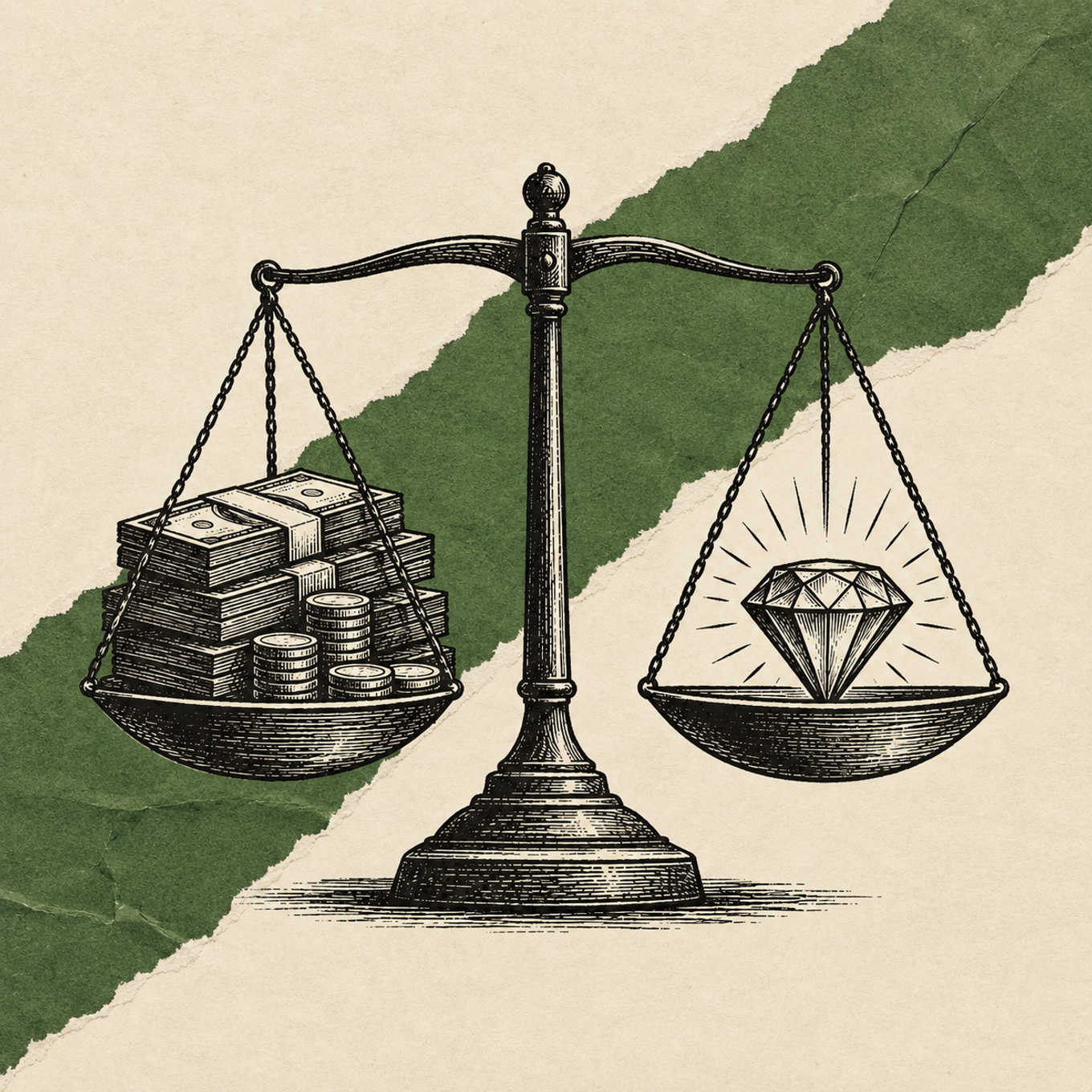
But put someone in the middle of a desert for two days and everything changes. They'd trade a diamond for a jug of water without thinking twice. What people will pay depends on how badly they want the thing and how hard it is to get anywhere else. Every business works this way.
Adam Smith, one of the first people to write about how economies work, made the point in 1776 with a line that's still quoted today:
It is not from the benevolence of the butcher, the brewer, or the baker that we expect our dinner, but from their regard to their own interest.
The baker isn't doing you a favor, and you're not doing the baker one either. Each of you gets something you want more than what you gave up. A business is simply a way of doing that over and over: making something other people want more than their money, for less than they pay for it.
The gap between what something costs you to make and what people pay for it is called profit. If the sandwich costs the shop $6 to make and sells for $10, the $4 left over is profit. Profit is what lets a business pay its owner, grow, and survive bad months. It's also a signal.
When people keep paying more than it costs you to deliver something, they're telling you that what you make is worth it to them. When they stop, they're telling you it isn't, or that someone else is doing it better.
So the question every business has to answer is this: what are you giving people that they want more than what they're giving up to get it? That thing is what we call value.
What People Actually Pay For
Value is whatever makes someone's life better in a way they care about. It comes in more forms than most people think about. Here are six of the biggest ones.
Relief from pain
This is the one everyone talks about: solving a problem. It includes big problems, like a medical treatment, and small ones, like a shirt that doesn't stay soaked with sweat. It also covers saving time, removing a hassle, and lowering a risk. A locksmith who comes at 2 a.m. when you're locked out of your house is selling relief, and that's why people pay a lot for it without arguing.
You can see this kind of value almost everywhere once you look for it. Uber started, according to the company, after its founders couldn't get a cab on a snowy night in Paris in 2008, and the whole business grew out of that one frustration. AAA has sold roadside help to stranded drivers since 1902. Tax software sells relief from a job most people dread every spring. Even a bottle of pain reliever is exactly what it sounds like. In each case, the customer isn't buying a thing so much as buying their way out of something they don't want to deal with.
There's a reason pain is such a strong driver of spending. In 1979, the psychologists Daniel Kahneman and Amos Tversky showed that people feel losses more strongly than gains of the same size. Later estimates put the difference at roughly two to one: losing $100 feels about as bad as winning $200 feels good.
That's why people will pay quickly to stop a problem, like a leak, a broken car, or a pain in their back, when they might hesitate to pay the same amount for something that would simply be nice to have.
Pleasure and entertainment
People pay to enjoy themselves: movies, games, concerts, good food, a funny gift. The Pet Rock sold this. So does every streaming service and theme park. Nothing is broken that needs fixing. People just want to feel good, laugh, or be taken somewhere else for a while.
Look at how much people spend on things they don't need at all. Taylor Swift's Eras Tour became the highest-grossing concert tour in history, bringing in more than $2 billion in ticket sales. Disney's theme parks charge well over a hundred dollars a day just to get in, and families save for years to go. Video games, streaming services, sports tickets, candy, and fireworks are all big businesses built on nothing more than people wanting to enjoy themselves.
This isn't a small slice of the economy. In 2024, according to the U.S. Bureau of Labor Statistics, the average American household spent $3,609 on entertainment. That's more than the same household spent on clothing ($2,001) and more than twice what it spent on education ($1,569). People treat enjoyment as a real need, and they pay for it the same way they pay for anything else they need.
Status
People pay to look successful or to be seen a certain way. In 1899, the economist Thorstein Veblen called this "conspicuous consumption," meaning buying things partly so other people can see you have them. A luxury watch tells time about as well as a cheap one. What people pay extra for is what it says about them.
You can see status value in how some companies sell on purpose. Hermès is famous for making its Birkin handbags hard to get, which is part of what makes owning one mean something. People pay extra for first-class seats that land at the same time as economy, for a car badge, or for a table at the restaurant everyone is talking about. None of these fix a problem. What the buyer gets is a signal to other people about who they are.
In a set of experiments published in 2011, the psychologists Rob Nelissen and Marijn Meijers at Tilburg University found that people wearing a shirt with a visible designer logo were rated as wealthier and higher in status than people wearing the same shirt without the logo.
In one test, far more strangers agreed to take a survey when the person asking wore a designer label. In another, viewers who watched a job interview recommended a salary about 9 percent higher for the same candidate when his shirt had a designer logo. When people pay for status, they're paying for how others will treat them.
Belonging
People pay to be part of a group. In 1983, Harley-Davidson started the Harley Owners Group, a club that gives owners rides, events, and people to ride with. Owning a Harley became a way to join a community. Gym classes, church retreats, fan clubs, and paid online communities all sell a version of this.
Look at what people will pay just to be part of something. CrossFit gyms often charge more than a regular gym, and a big part of what members get is a group that knows their name and notices when they don't show up. Sports fans spend money on jerseys that say they belong to a team. Online communities charge monthly fees to let people into a room with others who share their interests or goals. In each case, the product includes other people.
This works because belonging is one of the strongest human needs. In 1995, the psychologists Roy Baumeister and Mark Leary reviewed the research and argued that the need to belong is a basic human drive, not a nice extra.
Later research showed how deep it goes. In 2010, Julianne Holt-Lunstad and her colleagues combined 148 studies covering more than 300,000 people and found that people with stronger social relationships had about a 50 percent higher chance of survival over the course of the studies. Something that important to people is something they'll pay for.
Hope
People pay for the chance at a better future. A fitness program, a course on starting a business, a language app, and a book about getting out of debt all sell hope. The buyer is paying for who they believe they could become.
Some of the most successful businesses in history sell hope. Jean Nidetch started Weight Watchers in 1963 by inviting friends to her apartment to talk about losing weight together, and it grew into a company that millions of people have paid to join, many of them more than once. Gyms sign up a flood of new members every January. Self-help books and online courses are bought by people picturing the life they'll have once they've read or finished them.
The clearest proof of how much people will pay for hope is the lottery. Americans spend more than $100 billion a year on lottery tickets, according to the North American Association of State and Provincial Lotteries, even though almost every ticket loses.
What they're really buying is a few days of imagining a different life. That doesn't mean selling hope is always good. A business that sells hope has a special duty to deliver on it, or it slides toward the kind of taking this article warns about in section 08. But it shows how strong the pull is.
Information
People pay to know things that are useful to them: how to fix something, what's happening in their industry, which option to choose. Newspapers, how-to videos, and newsletters sell information.
Consumer Reports has sold information about which products are worth buying since 1936, and it doesn't take advertising, so its only product is the information itself. Industry newsletters charge hundreds of dollars a year because knowing something first helps readers do their jobs better. A cookbook, a map, a repair manual, and a how-to course are all information packaged so people can use it.
How much information is worth depends on what it helps people do. A Bloomberg Terminal, the computer system that traders and bankers use for financial news and data, costs about $30,000 a year per user. Firms pay it without blinking, because a single piece of information that arrives a little sooner or is a little more accurate can be worth far more than that in a trade. The more money or risk a decision involves, the more people will pay to know what they need to make it.
Most products deliver more than one of these at the same time. A good restaurant sells pleasure, but also status if it's hard to get into, and belonging if it's the place your friends go. When you look at your own idea, it's worth asking which of these you're really offering, because that tells you who will want it and how to talk about it.
Money isn't the only way people pay
The second thing that confuses people about business is payment. Most of us picture someone handing over cash. But there are several ways people pay for value, and some of the biggest companies in the world are built on the ones that don't look like payment at all.
Money
This is the simplest. Someone buys your product, service, or subscription. Dahl's customers paid $3.95. The person who uses the value is the one who pays.
How you charge changes a lot. Some businesses charge once, the way Dahl did: you pay $3.95 and the rock is yours. Some charge a subscription, like Netflix or CrunchLabs, where you pay every month for as long as you keep getting value. Some charge per use, like a taxi ride or a car wash.
A one-time sale means you have to keep finding new customers. A subscription means one customer can pay you for years, but you have to keep earning it every month or they'll cancel. Picking how you charge is one of the first real decisions in a business.
Attention
When you watch a YouTube video, you don't pay the creator anything. What you give is your time and attention. Advertisers want your attention, because it's how they reach you, so they pay YouTube to show you their ads.
YouTube then shares that money with the creator. For long-form videos, creators in YouTube's Partner Program get 55 percent of the ad revenue from their videos.
So there are really three sides to the trade: the viewer gets entertainment or information, the advertiser gets the viewer's attention, and the creator gets paid for bringing them together. Radio, television, magazines, and podcasts have all worked this way for decades.
Advertisers usually price attention by the thousand. The industry term is CPM, which means cost per thousand views. What they'll pay depends heavily on who is watching.
Industry data on YouTube shows finance channels commonly earning several times more per thousand views than gaming or entertainment channels. The reason is simple: banks, investment apps, and credit card companies want to reach people who are making money decisions, because one new customer can be worth thousands of dollars to them.
So attention isn't all worth the same. A smaller audience of the right people can earn more than a huge audience that advertisers don't care much about.
Data
Google Search, most social media apps, and many free apps cost nothing to use. You pay partly with information about yourself: what you search for, what you click, what you like. That information lets these companies show you ads that are more likely to work, which advertisers pay more for. Most of Google's revenue comes from advertising.
Here's what that looks like day to day. A free map app knows where you drive and which stores you stop at, so a coffee shop can pay to show its ad to people who are nearby right now. A free social app knows you've been looking at running videos, so a shoe company pays to show you its new running shoes instead of showing them to everyone.
You never hand over money, but the information you give makes you worth more to advertisers, and that's what pays for the free service.
Trust and word of mouth
People also pay in a way that doesn't show up right away: they tell other people. When someone recommends your product to a friend, shares your video, or forwards your newsletter, they're giving you something valuable, because new customers who come from a friend's recommendation already trust you a little.
Under Armour, which you'll read about in section 06, grew in its early years as football players passed the shirts around locker rooms and told each other about them.
Dropbox turned this into a system. In 2008, it was paying so much for online ads that each new paying customer cost more than that customer would pay in a year. So instead, it offered free extra storage to anyone who invited a friend, and to the friend too.
Its users went from about 100,000 in September 2008 to about 4 million by December 2009, and founder Drew Houston said the referral program permanently raised signups by 60 percent.
The users paid nothing in money for that growth. They paid with their recommendations, and that was worth more to Dropbox than the ads it had been buying.
When someone else pays
Sometimes the person who uses the value doesn't pay at all, and it isn't about attention or data either. Someone else pays for them. A company pays for the software its workers use every day.
Insurance pays for most of a visit to the doctor. Parents pay for their kid's toys, and schools pay for students' textbooks. This matters when you're building something, because the person you need to convince to pay may not be the person who uses the product.
Rober's build boxes are made for kids, but it's usually a parent who pays, so the box has to make sense to the parent too.
Once you see all of these, a lot of businesses make more sense. The question is never only "Will people pay for this?" It's also "Who pays, and how?"
Building On Attention
Mark Rober spent nine years as an engineer at NASA's Jet Propulsion Laboratory, where he worked on the Curiosity rover that landed on Mars. In 2011 he started a YouTube channel, and for years he made videos in his spare time, mostly fun science experiments and engineering builds.
His videos didn't solve anyone's problem. They were entertaining, and people learned something from them.
In December 2018, he posted a video about a package he built to catch people stealing deliveries off porches. When a thief opened it, it sprayed glitter and a fart smell, and cameras inside recorded the whole thing. The video went viral, and Rober left his job to work on YouTube full time.
Today his channel has tens of millions of subscribers. A channel that size can earn money from YouTube's share of ad revenue and from sponsors. Then, in 2022, Rober launched CrunchLabs, a monthly subscription box that sends kids a toy to build each month, along with a video from Rober explaining how it works. It costs about $30 a month and is aimed at kids 8 to 12.
The first run sold out in less than a week. Look at how the value changed form along the way. Rober created entertainment and information. Viewers paid with attention. Advertisers and brands paid him to reach that attention. And because his audience trusted him after years of videos, many of them were happy to pay money directly once he had something to sell them. The attention came first, and the product came later.
This is the path open to anyone who can make something people enjoy or learn from, whether that's videos, writing, a podcast, or social media posts. The ways to turn attention into money are fairly standard:
Ad revenue from the platform, like YouTube's share.
Brand deals and sponsorships, where a company pays you to mention or feature its product.
Your own products, like merchandise, courses, books, or a product like CrunchLabs.
Memberships and fan support, where your audience pays you directly for extra content.
Affiliate links, where you earn a cut when people buy something you recommend.
The trade-off is time. Rober had been posting videos for about seven years before he went full time. An audience takes a long time to build, and most of the money comes after people already trust you.
Solving A Pain
In the mid-1990s, Kevin Plank was a special teams captain on the University of Maryland football team, and he called himself the sweatiest guy on the field. During practice, the cotton T-shirt under his jersey would get soaked and heavy, and he had to keep changing it.
He noticed that his compression shorts, made of synthetic fabric, stayed dry. So he wondered why nobody made a shirt out of something like that.
After he graduated in 1996, he tried different fabrics until he found one that pulled sweat away from the body. He started the company from his grandmother's basement in Washington, D.C., with his own cash, credit cards, and a small business loan.
He drove up and down the East Coast with shirts in his trunk and gave them to former teammates who had gone on to play in the NFL. His first team sale came at the end of 1996, for $17,000.
The company was Under Armour, and it grew into one of the biggest sportswear brands in the world.
This is the path most people mean when they say "solve a problem." Plank had a pain himself, noticed that thousands of other athletes had the same pain, and found a better answer than what was out there.
Athletes paid money for it because the value, not being weighed down by a soaked shirt, was worth more to them than what the shirt cost.
To find a pain worth solving, look for these signs:
People complain about it. Plank's teammates all dealt with the same wet shirts.
People have homemade workarounds. Changing your shirt three times during practice is a workaround. So is a spreadsheet someone built because no software does what they need.
People already pay for something that doesn't work well. Athletes were already buying cotton T-shirts. They just weren't good ones for the job.
You have the pain yourself, or you know the people who do. Plank understood the problem because he lived with it, and he knew exactly who to sell to.
This path can bring in money much faster than building an audience, because people who have a pain are often ready to pay to get rid of it. The hard part is finding a pain that enough people have, that hasn't already been solved well, and that you can actually solve.
The Other Paths
Attention and pain are the two most common ways to start, but they aren't the only ones. Each of the other kinds of value from section 03 can be the starting point of a business too. Here are three.
Selling pleasure directly
In 2017, two cousins in Logan, Utah, Sawyer Hemsley and Jason McGowan, set out to make the best chocolate chip cookie they could. Neither of them was a baker. They baked batch after batch, took them to grocery stores and gas stations, and asked strangers which one tasted better until they had a recipe people kept picking.
Then they opened a cookie shop, Crumbl, with a menu that changed every week, so there was always a reason to come back and try something new. By the end of 2024 it had more than 1,000 stores.
Nobody needs a cookie. Crumbl sells pleasure, the same way the Pet Rock sold a laugh, and it skipped the years of building an audience that Mark Rober needed. The product itself was the reason people came, and the rotating menu gave them a reason to keep coming. If you can make something people enjoy enough to buy again, this path can work from the first sale.
Selling belonging
In the early 2000s, Greg Glassman was posting daily workouts online from a small gym in Santa Cruz, California. People who did the workouts wanted to train together, and in 2002 the first gym affiliated with his program opened in Seattle.
Gym owners paid CrossFit a yearly fee to use the name. There were 13 of these gyms in 2005 and, by 2018, around 15,000 in more than 160 countries.
A CrossFit gym often costs more than a regular gym, and what members pay extra for is the group: the same people at the same class time, who notice when you're missing. That's belonging, and it's a strong thing to build a business on.
It also shows how much that kind of business depends on trust. After a series of scandals starting in 2020, thousands of gyms left, and by 2025 the number of affiliates had fallen to around 10,000. When people are paying to belong, they leave when they no longer want to belong to you.
In April 2014, Ben Thompson, a former Microsoft employee writing a blog about the business of technology, started charging $100 a year for a daily email with his analysis. He wasn't famous.
Within about six months, more than 1,000 people had signed up, which was enough to make it a living. By 2020, Fortune estimated his newsletter, Stratechery, was bringing in more than $3 million a year.
Thompson's readers pay money directly for what he knows and how he explains it. He argued that a niche is best served by earning more from people who really care, rather than trying to reach everyone and collect a little from each through ads.
This path works when you know something useful that a specific group of people will pay to understand better, and you can keep delivering it on a regular schedule.
How big it can get
Whichever path you take, four things decide how much money a business can make.
How many people want it. A pain or desire that millions of people share can support a much bigger business than one only a few hundred people have.
How badly they want it. Someone locked out of their house at 2 a.m. will pay a lot. Someone mildly curious will pay little or nothing.
How well you deliver it. The better your answer compared with what people already have, the more they'll pay and the more they'll tell others.
How much of the value you collect. You can create a lot of value and keep very little of it.
That last one surprises people. Wikipedia is used by hundreds of millions of people and saves them enormous amounts of time. But it's run by a nonprofit, the Wikimedia Foundation, and it's funded mostly by donations, so it collects very little of the value it creates.
That's a choice, and a good one for what Wikipedia is trying to do. But it shows that creating value and making money from it are two separate steps. You need a clear way to collect.
The Pet Rock also shows a limit. It created real value, since people enjoyed it and paid for it. But the joke wore off. Within about a year the craze was over. Value that lasts, like a shirt that keeps working every practice, can keep a business going for decades. Value that depends on novelty usually doesn't.
What doesn't count
There's another way money moves from one person to another: someone takes it through lies or fraud. It's worth saying clearly, because it can look like business from the outside.
Theranos, a blood-testing company, claimed it could run hundreds of tests from a few drops of blood. It raised hundreds of millions of dollars from investors on that promise.
The technology didn't work the way the company said. In 2022, its founder, Elizabeth Holmes, was convicted of defrauding investors and later sentenced to more than eleven years in prison.
Investors gave Theranos money because they thought they were getting something worth more than what they paid. They weren't. That's the difference. In a real business, both sides come out ahead, and people come back because they got what they paid for. When one side is being deceived, money moves, but no value is created, and it usually ends badly for everyone involved.
Test Your Idea
Use these questions on any idea you have, or on a business that isn't working the way you want. Write your answers down.
What value am I creating?
Relief from pain, pleasure, status, belonging, hope, or information? If it's more than one, which matters most to the people you're serving?
For whom, exactly?
Describe the person in one sentence, like "college football players who hate wet cotton shirts," or "parents who want their kids to learn engineering without screens."
How badly do they want it?
Do they complain about the problem, build workarounds, or already pay for something that doesn't work well? Or would it just be nice to have?
Who pays, and how?
Do the users pay money? Do they pay with attention, which you'll turn into money through ads, sponsors, or products? Or does someone else pay?
How many people want it?
Make a rough guess. Hundreds, thousands, millions?
How will I collect?
What's the specific way money reaches you: a price, a subscription, ad revenue, sponsorships? If you can't answer this, you might be building something valuable that doesn't pay you.
If you can answer all six clearly, you have the start of a business. If you get stuck on one, that's the part to work on first.
Go Further
The Personal MBA, by Josh Kaufman
A plain-language guide to how businesses work, with chapters on creating value, marketing, sales, and delivering what you promise.
The Wealth of Nations, Book I, Chapter 2, by Adam Smith
The chapter with the butcher, the brewer, and the baker, and why trade makes both sides better off.
This Is Marketing, by Seth Godin
A short book on finding the smallest group of people you can truly serve, and building something they'll talk about.
Competing Against Luck, by Clayton Christensen and others
Explains the idea that customers "hire" products to do a job in their lives, which is a useful way to find what people really want.
Gary Dahl sold a million rocks, Mark Rober turned science videos into a toy company, Kevin Plank built a sportswear brand out of a sweaty shirt, and two cousins who weren't bakers built more than a thousand cookie shops.
None of them started with the same idea, and none of them made money the same way. But every one of them gave people something they wanted more than what they paid for it, whether that was a laugh, a dry shirt, a good cookie, a group to belong to, or a clearer way to understand their world.
That's where the money in a business comes from. The product is only the way the value gets to people.
So before you build anything, get clear on the value first. Ask what you're giving people, who wants it, how badly they want it, and how they'll pay you for it, whether that's with money, attention, or a recommendation to a friend.
You don't need a perfect idea to start. You need one group of people who want what you can make enough to give something up for it. Find them, deliver it well, and keep finding ways to deliver it better.