Everything Takes Longer Than You Think It Will
Why You Always Underestimate How Long Things Will Take
A close look at what physics and psychology actually know about time: why it seems to move in only one direction, why a year at seven years old and a year at thirty-five are not the same length, why no amount of effort can compress certain processes, and why we reliably underestimate how long things will take. Most people already suspect their timelines are optimistic. This is just an attempt to show why, and what to actually do about it.
There Is No River of Time, Only Rising Disorder
Imagine filming yourself cracking an egg onto a kitchen floor. You watch the shell hit the ground, it breaks apart, the yolk spreads across the tile. Pieces of shell scatter in every direction.
Now imagine pressing rewind. The shell flies back together, the yolk pulls itself off the floor and rises into the center. The pieces of shell leap upward and lock perfectly back into place. Then the egg jumps off the floor and lands, completely intact, in your hand.
The fundamental laws of physics don't contain a rule that says the egg can break but cannot un-break.
If you could somehow record the position and motion of every particle involved, then reverse those motions exactly, the same physical laws could describe that reversed process just as well as the original one. The equations don't fundamentally care whether you call one direction "forward" and the other "backward."
Yet in the real world, we see eggs break all the time, but we never see the pieces spontaneously fly back together. So why does reality have a direction at all? Why does time seem to move forward when the underlying laws of physics appear to work in both directions?
Newton’s laws, Maxwell’s equations of electromagnetism, even the core equations of quantum mechanics—run them forward or backward, and they still describe a physically consistent world. Physicists call this time-symmetry. Which means that, mathematically at least, an egg unscrambling itself isn't forbidden.
Eggs break; they do not un-break. Ice melts; puddles do not spontaneously refreeze into ice cubes on a warm counter. So why does time only ever seem to move one way in the world you actually live in?
Physicists have an answer, and it's not really about time. It's about entropy, which just means a measure of disorder, and the second law of thermodynamics, which states that in a closed system, entropy tends to increase.
Think of it this way: there are countless ways for things to be messy, but very few ways for them to be perfectly organized.
There are countless ways for a deck of cards to be scattered across a table, but only one way for every card to be neatly arranged in order. Disorder has far more possible arrangements than order does, so systems drift toward disorder simply because there are astronomically more ways to be disordered than to be ordered.
This is sometimes called the Past Hypothesis: the idea, most associated with physicist Sean Carroll and others who study time's arrow, that the universe began in an extraordinarily low-entropy state, and the total entropy of the universe has generally increased ever since. That increase is what gives rise to what we call the arrow of time.
Think about what happens when you light a candle. Watch the smoke from a candle for a few seconds. It starts as a narrow stream, then curls and spreads through the air. Eventually, it is everywhere, mixed in with the room around it. There are countless ways for those smoke particles to spread out, but almost no chance of them all happening to move back together into the same narrow stream they came from.
It may also help explain why your memories point toward the past, rather than the future. Memories are physical records of things that have already happened, stored in your brain, in photographs, in footprints in the sand. We can create records of the past because those events have already left physical traces behind. The future hasn't happened yet, so there is nothing there to leave a record.
That is entropy in action. Systems naturally move from states with fewer possible arrangements to states with many more. The reverse isn't forbidden by the basic laws of physics, it is simply so incredibly unlikely that, in practice, we never see it happen. Maybe that is why time feels like it only moves forward. We live in a universe where things naturally spread out, mix together, and become harder to put back the way they were.
Why Right Now Isn't the Same Moment for Everyone
Entropy helps explain why time seems to have a direction. Einstein's theory of relativity says that two people can disagree about what is happening “right now,” and both can be correct.
According to Einstein's special theory of relativity, whether two events happen at the same time depends on how fast you are moving relative to them. Two events that happen at the same time for you can happen at different times for someone moving at a different speed.
Imagine two lightning bolts striking opposite ends of a moving train. Someone standing on the platform halfway between the strikes might see both flashes arrive at the same time. But someone sitting in the middle of the moving train is moving toward one flash and away from the other, so they see one flash before the other.
If both observers account for the time it takes the light to reach them, they can still disagree about whether the lightning strikes happened at the same time. Neither person is wrong. There is no single, universal clock that tells the entire universe what “right now” is. Each observer's measurement of time is valid within their own frame of reference.
GPS satellites, for example, have to account for differences in how time passes for satellites in orbit compared with clocks on Earth's surface. If those relativistic effects weren't corrected for, GPS positions would become inaccurate.
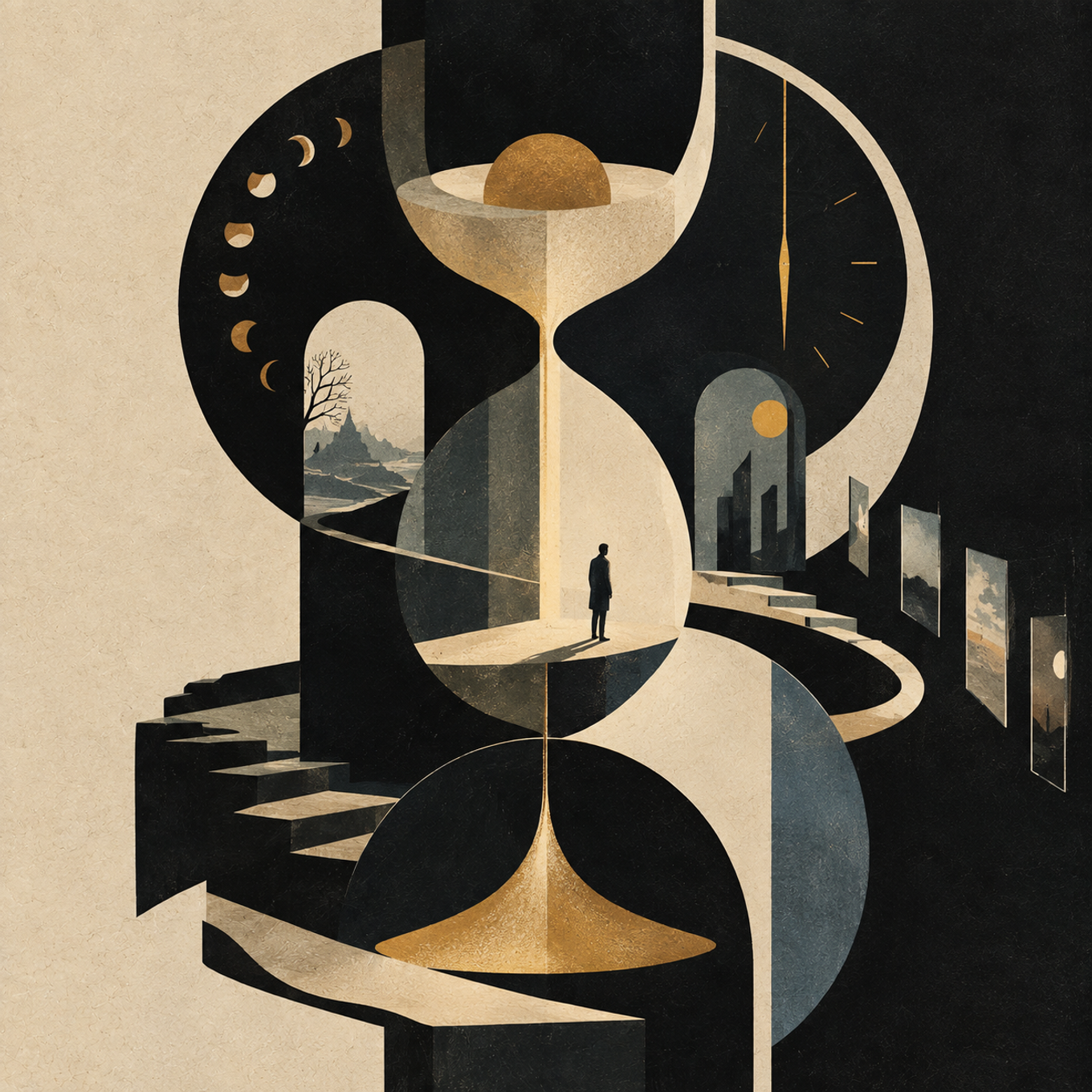
Some philosophers and physicists, known as eternalists, argue that if there is no single objective "now," then the past, present, and future should all be treated as equally real. In this view, time is more like a map: every point exists, even though we experience only one part of it at a time. This is often called the block universe.
Another camp, called presentists, argues that only the present is actually real. The past happened, but it no longer exists, and the future has not happened yet. From this perspective, relativity tells us that people can disagree about what is happening at the same time, but that doesn't necessarily prove that the past and future exist in the same way as the present.
This is still an open question. Relativity gives us a very good description of how time and simultaneity behave, but it does not by itself settle the deeper question of what is really real.
The Time We Actually Experience
Why does five minutes sometimes feel like an hour, while an entire afternoon can disappear without you noticing?
The clock hasn't changed. Five minutes is still five minutes. Yet our experience of those five minutes can feel completely different depending on what we're doing, what we're paying attention to, and even how we remember the experience afterward.
The time measured by a clock and the time we experience in our minds aren't always the same thing.
We all know the feeling when you're sitting somewhere waiting, and five minutes somehow feels like twenty. You check the time on your phone and only two minutes have passed. You check again. Somehow, only three minutes has gone by.
Then there are the opposite moments where you're talking to a friend, working on something you enjoy, or completely lost in a movie, and suddenly you look up and realize hours has gone by. Nothing about the clock changed. What changed was your attention.
When we're watching time, every minute becomes noticeable. When we're absorbed in something else, we stop paying attention to the clock, and the hours can slip by.
The same thing happens when we look back on time. A long, boring afternoon can feel like it lasted forever while you're living through it, yet barely register in your memory. A packed vacation can feel like it flew by while you were there, but seem much longer when you look back on it.
Why Years Seem to Speed Up.
I remember being a kid and thinking summer would never end. Summer felt slow and relaxing. I remember waking up with the whole day ahead of me, with nothing but time to fill.
Now that I’m older, years pass by and I barely feel them happening. One year turns into the next, and sometimes it feels like I was just celebrating the new year a few months ago.
A day is still a day, and a year is still a year. But when you're young, you're constantly experiencing things for the first time. New places, new people, new experiences, new ideas. As you get older, more of your life falls into familiar routines. When Monday looks a lot like Tuesday, and one week looks a lot like the next, there are fewer moments that stand out in memory.
So the years may not actually be moving faster. When you look back, those repeated days can almost blend together. A summer filled with new experiences can feel like it lasted forever, while an ordinary year can feel like it disappeared.
If familiar routines are part of what makes the years blend together while we get older, then maybe the answer is to become more intentional about how we spend them. We can't slow the clock down, but we can give our time more experiences, challenges, and things to remember.
Here are three ways to do that:
#1 - Seek Novelty
One way is to deliberately do things you've never done before. Try a new hobby, visit somewhere you've never been, learn something you've always been curious about, or simply break your normal routine.
A few things I've been doing are having one “big” new experience each month, like going to a symphony or taking a three-hour road trip for the weekend. Then there are smaller things, like getting into photography, learning French, or learning how to play the guitar. And if I have no plans for the upcoming weekend, I'll go to a museum or explore a part of the city I've never been to before or simply just find something new to do.
When you're constantly experiencing new things, you create more distinct memories instead of having months of similar days blend together. You don't need every day to be exciting. You just need enough moments that are different from the ones before them.
#2 - Challenge Yourself - Misogi
The second way is to deliberately put yourself in situations where you don't know if you'll succeed. One idea I really like is the Misogi challenge, a modern practice developed by sports scientist Dr. Marcus Elliott. The idea is to choose one major challenge each year that you have roughly a 50% chance of completing.
It could be running a marathon, climbing a mountain, starting a business, performing on stage, or doing something you've always wanted to do but kept putting off because you weren't sure you could. The point isn't necessarily to succeed. It's to give yourself a challenge where failure is a real possibility.
When you give yourself challenges like this, the year becomes easier to remember. You have a moment you can point back to and say, I did that this year. And even if you fail, you still have an experience that probably wouldn't have happened if you had stayed comfortable.
#3 - Build Something
The third way is to build something that takes time. Start a business, write a book, learn an instrument, create something, or work toward a goal that takes months or even years.
When you're building something, you can look back and see where you started and how far you've come. The months don't feel like a collection of random days anymore. They become part of something.
I think this is one of the biggest differences between simply passing time and actually using it. When you have something you're working toward, you can look back at a year and see what you did with it.
When We Lose Track of Time
I remember back in college, I was hanging out with one of my good friends in her dorm. We started talking about philosophy, psychology, our lives, and pretty much everything else that came up. One conversation turned into another, and somehow we kept talking for hours.
Eventually, we looked at the time and realized it was already 5 a.m. We had completely forgotten to go to bed. So, instead of going to sleep, we decided to go to the gym together.
I don't remember exactly what we talked about that night, but I remember how quickly the time disappeared. We had been sitting there for hours, yet it didn't feel like hours. There was no clock in our heads counting down each minute. We were just there, completely absorbed in the conversation.
That is what it feels like to lose track of time. The clock keeps moving at exactly the same speed, but our attention isn't on it. We aren't thinking about how much time has passed because we're too engaged in what we're doing.
And I think that's part of what makes certain moments in life feel so much more memorable than others.
Why We Can't Control Time
We can experience time in completely different ways, but none of us can escape it. A minute is still a minute, whether it feels like an hour or disappears in an instant. We can't pause time when we're having a good day. We can't save a few extra hours for later when we're busy. And we can't go back and use the time we already spent.
We make plans for next year, next month, or even decades from now without knowing exactly how much time we'll actually get. That is what makes time different from almost everything else we have. We know it is limited, but we don't know the limit.
Lets take a goal for example: Say you know exactly what you want, you know what to do, you do it consistently, with discipline, you put in the work, and you do everything right, and yet, you still find yourself bound by a timeline you cannot compress no matter how hard you push.
Software engineer Fred Brooks described a version of this in 1975 that became known as Brooks's Law: adding more people to a late software project can actually make it later. The reason is that some tasks simply can't be divided up beyond a certain point. More people can help with some parts of the work, but they can't make every part happen simultaneously.
Brooks gave a simple illustration: one woman can have a baby in nine months, but nine women can't have a baby in one month. Pregnancy has a biological timeline that you can't eliminate by adding more resources. The point is bigger than software or pregnancy.
Anything that compounds—savings, a body of skill, an audience, a reputation—produces a curve, not a line. Early effort can look like it is producing almost nothing because, in a genuinely compounding process, most of the total growth happens in a late, steep stretch rather than being spread evenly across the timeline.
People often interpret that flat early section as evidence that the approach isn't working and quit during the exact phase that was always going to look unrewarding, right before the part where the results would have become visible.
Psychologist K. Anders Ericsson's work on expertise was later popularized as the "10,000 hours" idea. The idea is often overstated and you hear it everywhere. Later research, and Ericsson's own writing, pushed back against the idea of a fixed universal threshold.
But the underlying point his research supports remains: developing deep expertise takes an extended period of deliberate practice, and there is no simple shortcut that can replace the time required to develop it.
You can control the quality and consistency of your actions. You cannot fully control how long the underlying process takes to mature, only how well you use the time it requires.
A Story About Time
A 23-year-old wants to build his own business and reach $180,000 in annual profit within three years. To take home that kind of money, he'd need roughly $265,000 in personal income before taxes. Depending on the type of business and its profit margins, that could mean generating somewhere between $500,000 and $1 million or more in annual revenue.
He has a plan, and he intends to follow it consistently. The question is simple: is three years actually enough time, regardless of how well he executes the plan?
Most people would look at the plan itself. Does each step make sense? Is the strategy sound? Those are important questions, but they don't tell us how long the whole thing is likely to take.
A better question is: What happened to other people who tried to build something similar, and how long did it take them?
So, going back to the example, the first step for our 23 year old is to build a reference class.
The JPMorgan Chase Institute tracked about 835,000 small U.S. businesses and found that roughly 9% reached $1 million in annual revenue within their first five years. Nearly half of the businesses that eventually reached $1 million did so in their first year.
The study also found a strong relationship between how much revenue a business generated in its first year and its likelihood of eventually reaching $1 million.
That's revenue, not profit. Our 23-year-old is trying to reach $180,000 in annual profit, which could require somewhere around $500,000 to $1 million or more in annual revenue, depending on the business and its margins. And he's trying to get there in three years rather than five.
But "small business" is still too broad. A consulting firm, an e-commerce company, and a software business can have completely different paths to $1 million.
So the next step is to narrow the reference class: find real businesses with a similar model, industry, starting capital, and team size, and see how long they actually took to reach similar numbers.
This is where the outside view becomes useful. It can't tell him exactly how long his business will take. But it can show him whether his three-year timeline is common or unusual among businesses that started in a similar position.
The point isn't to prove that he can't do it. It's to replace a timeline based entirely on what he hopes will happen with one informed by what has actually happened to people who tried something similar.
Why We Can't Predict the Timeline
Even with a good reference class, we still can't know exactly how long something will take.
Two people can start with similar goals, follow similar plans, and put in similar amounts of work, yet end up on completely different timelines. One person might get an opportunity that changes everything. Another might spend a year working on something that goes nowhere. Some skills click quickly for one person and take years for another.
The problem is that there are too many variables to account for. We can estimate how long something usually takes based on what happened to other people, but we can't know exactly how our own situation will unfold.
Financial researcher Michael Mauboussin offers a useful way to think about this. Real-world outcomes usually fall somewhere between skill and luck. Chess is heavily driven by skill: if two players compete, the better player will usually win. Roulette is almost entirely luck: being more skilled doesn't improve your odds.
Most things in life fall somewhere in between. Business is one of them. Skill, preparation, and hard work matter, but so do timing, competition, market conditions, unexpected opportunities, and plain luck. And the more ambitious the goal, the more luck can matter. Building a business that survives is one thing. Building one that becomes an unusually large success is another.
And the longer the timeline, the more uncertainty there is. A three-year plan isn't just one prediction about where you'll be three years from now. It's hundreds of smaller predictions about what will happen along the way.
That doesn't mean planning is useless. It means a timeline should be treated as an estimate, not a promise.
You can control what you do, but you can't control all the things that affect when the result arrives.
What to Do With Your Time
We've spent a lot of time thinking about what time is, how we experience it, and why some things take longer than we expect. But understanding time doesn't change the fact that it keeps moving.
You can't slow it down when life is going well. You can’t speed it up when things are going rough. You can't save it for later when things are busy. And you can't go back and use the time you already spent.
What you can control is what you do with the time you have. So what do we actually do with all of this?
#1 - Pay Attention to How You Spend It
We tend to think of time as something that happens to us. We have work to do, places to be, and responsibilities to take care of, so the days fill themselves. Before we realize it, another week, month, or year has passed.
But how we spend our time shapes what our life actually becomes. If most of your days are spent doing the same things, surrounded by the same people, and waiting for the weekend, those days can start to blend together.
You don't need to make every moment productive or exciting. Some of the best parts of life are ordinary. But it is worth paying attention to where your time is actually going.
#2 - Accept That Some Things Take Time
We also have to accept that not everything can happen as quickly as we want it to.
We can work harder, learn faster, and make better decisions, but some things still need time to develop. Skills take practice. Relationships take years to build. Businesses take time to grow. Even when you're doing everything right, you may not see the results immediately.
That can be frustrating, especially when we're surrounded by stories of people who seemed to succeed overnight. But most things don't work that way.
The goal isn't to rush everything, It's to understand what deserves your patience and keep moving while you wait.
#3 - Choose What Is Worth Your Time
The hardest part may be deciding what deserves your time in the first place. There will always be more things you could do, more places you could go, more skills you could learn, and more goals you could pursue. You can't do all of them. Choosing one path means giving up the time you could have spent on another.
That doesn't mean you have to make the perfect choice. It means you have to make a choice. Time gives every decision a cost because once you spend it, you can't use it somewhere else.
Go Further
The Order of Time, Carlo Rovelli
A working physicist's case, in plain and often lyrical prose, for why the flow of time may not be a fundamental feature of reality.
Dopaminergic Processes Predict Temporal Distortions in Event Memory, Erin Morrow, Ringo Huang & David Clewett
A 2026 study examining how dopamine-related brain activity affects how we remember the passage of time, offering a deeper look at why our memories can stretch or compress our experience of time.
The Block Universe
The idea that past, present, and future all exist as part of a four-dimensional spacetime, rather than time being something that continually comes into existence moment by moment. It raises the deeper question of whether the past and future are as real as the present.
Arrival, Denis Villeneuve
A science-fiction film that plays with the idea of experiencing time differently, following a linguist whose understanding of an alien language begins to change her perception of past and future. It isn't a scientific depiction of time, but it is a fascinating thought experiment about whether our experience of time is as fixed as it seems.
Time is strange. We experience it differently from one moment to the next, yet the clock keeps moving at the same rate. We can understand how it works, study why it seems to move faster as we get older, and make better estimates about how long things might take. But none of that gives us control over it.
Eventually, every day becomes a day we will never get back.
Maybe the point isn't to find a way to make time slow down. It's to become more aware of where it's going while we're here.
Time is the one thing we are all spending every day, whether we realize it or not. The only question is what we choose to spend it on.