The Will to Dominate
Win or Die Trying: How to Go All In Without Getting Wiped Out
Most people keep a backup plan, keep one foot out the door, and give their goal whatever energy is left over. Xiang Yu sank his own boats and won a battle he had no business winning. Five years later he died on a riverbank because he wouldn’t get in a boat that could have saved him. Here’s how to go all in the right way, using what war, research, and real people’s lives have to say about it.
The General Who Destroyed His Own Food
In 207 BC, the king of Zhao was trapped inside the city of Julu in northern China. By the time help arrived, his forces in Julu were close to starving after a long siege. The Qin dynasty had conquered all of China only fourteen years earlier, and now its best general, Zhang Han, had brought an army north to finish off the rebellion against it. A year earlier, Zhang Han had launched a surprise night attack at Dingtao and killed the rebel leader Xiang Liang.
A rebel army was sent north to break the siege. It was led by a man named Song Yi, and his second in command was Xiang Liang’s nephew, Xiang Yu, who was in his early twenties.
Song Yi got as far as Anyang and stopped. His plan was to wait until the Qin and Zhao armies had worn each other out before he moved. Xiang Yu wanted to cross the river and attack right away, and for 46 days he kept pushing Song Yi to give the order. Song Yi ignored him and kept the army sitting in camp.
On the morning of the 47th day, Xiang Yu walked into Song Yi’s tent, caught him off guard, and killed him. Then he told the army that Song Yi had been plotting with another state against them. The other officers were afraid of Xiang Yu, so they let him take over as commander.
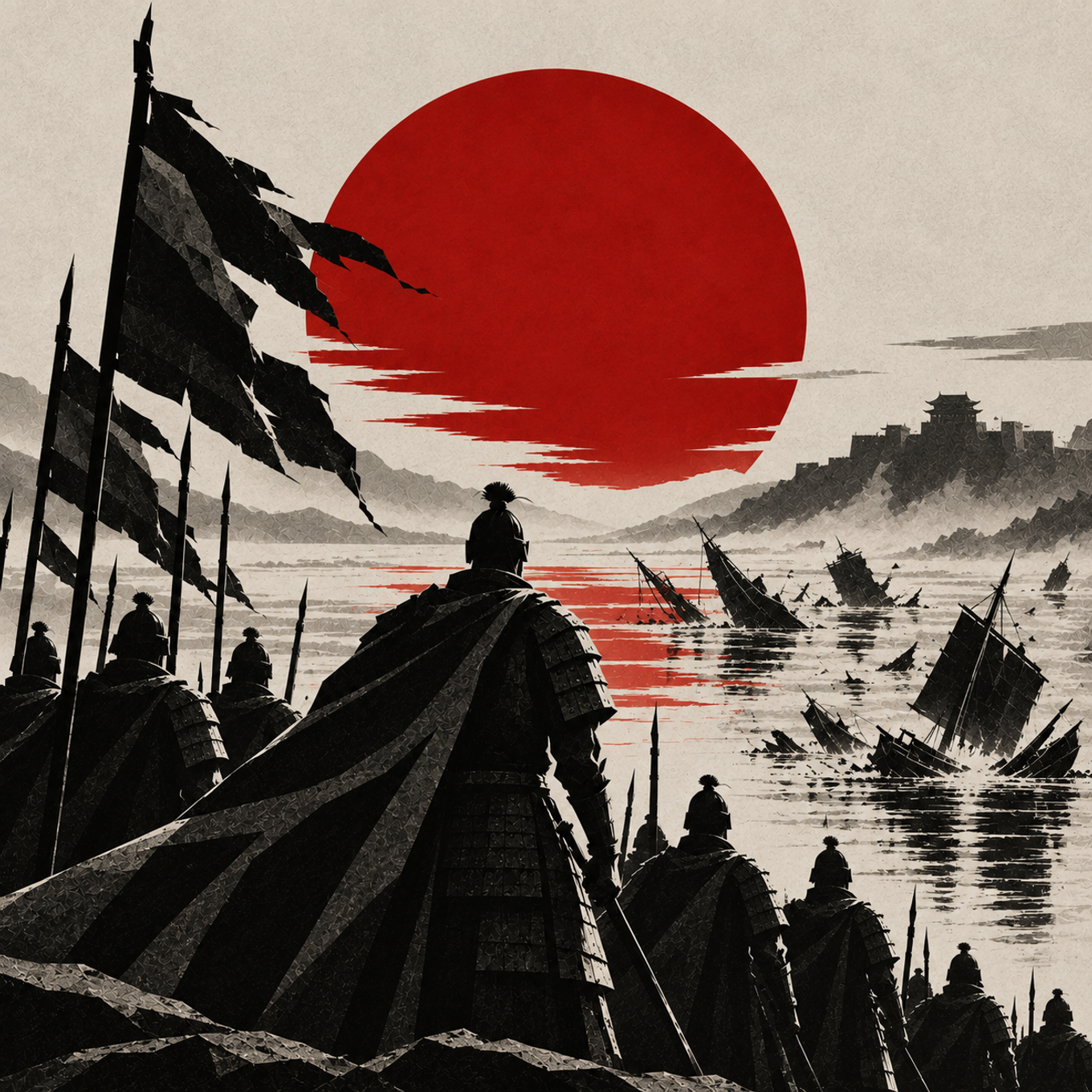
Once the whole army was across the river, Xiang Yu ordered his men to carry three days of food and destroy everything else, including their cauldrons and cooking pots, and to sink the boats they had just used to cross. Now the only way out was through the Qin army. If they didn’t win within three days, they would run out of food with no way to get more.
Why would a commander about to face the strongest army in China destroy his own way home and most of his own food?
Other rebel armies had already come to help the king of Zhao. They camped about ten li, a few miles, from the city and were too afraid of the Qin army to attack. When Xiang Yu went in, they didn’t join him. They watched from their camps.
The Qin general Wang Li was the one keeping Julu surrounded, and Zhang Han had camped his own army to the south to keep a supply road open to Wang Li’s men. Xiang Yu went after that supply road first. The fighting went on through nine separate battles. Sima Qian, the Han historian who wrote the Records of the Grand Historian about a hundred years later, says the Chu soldiers fought so hard that every one of them was taking on ten of the enemy.
Once Wang Li’s supply lines were cut, his army fell apart. Su Jiao, one of the Qin generals, was killed, and Wang Li was taken prisoner. Another Qin general, She Jian, refused to surrender and threw himself into a fire. With his supply lines gone and Wang Li’s army beaten, Zhang Han pulled back. He asked the Qin court for more troops, and when they refused, he gave up. By the summer of 207 BC, he and his 200,000 men had surrendered to Xiang Yu.
When the commanders of those other rebel armies came to Xiang Yu’s camp afterward, they were so afraid of him that they dropped to their knees at the gate and wouldn’t look up at him. Two Chinese sayings came out of that battle. “Break the cauldrons and sink the boats” still means total determination. “Watching from the ramparts” came from those rebel armies, and it means standing by and watching someone else’s fight without helping either side.
If you’re like most people reading this, you’re acting like Song Yi. You want something, you’ve been planning it for a long time, but you still haven’t started because you’re waiting until you’re 100% sure it’ll work. Maybe it’s a business you’ve been thinking about for two years without making a single sale, or a book you started but never finished. You keep telling yourself you just need a little more time. Meanwhile, nothing changes. And while Song Yi waited, the people he was supposed to save were starving.
Then there’s the backup plan. If you’re always thinking about what happens if you fail, part of you is already preparing to quit. You never really give the goal everything you have because you know there’s something to fall back on. Xiang Yu took that option away from his army. Once the boats were gone and the food was down to three days, there was nothing left to fall back on.
If the story ended there, the lesson would be easy: sink the boats, cut off every way out, and you’ll win. But Xiang Yu was dead by around thirty, and the way he died is the other half of the lesson. Five years after Julu, he stood on the bank of the Wu River with enemies closing in, and a boatman with the only boat there urged him to cross quickly because the Han army couldn’t follow. Xiang Yu refused to get in, turned back to fight, and killed himself on that riverbank.
What Going All In Actually Means
When people say “win or die trying,” what are they actually giving up?
Most people who say they’re going all in mean they’re locking in. They’ve decided to put everything they’ve got into one thing until it’s done. For a business owner, that might mean pouring every spare hour and dollar into the business. For a student, it might mean actually studying and showing up to class like it matters. For a starting entrepreneur, that could mean putting all their effort into their goal for three months and not being around friends or family or going out much until it’s done.
You’ve probably done this. You tell a friend you’re locking in for the next three months, or maybe you just tell yourself, and you mean it. Then a week goes by and you’re back on YouTube and playing games like you never said anything.
If you told someone, part of the problem is the telling itself. In 2009, NYU psychologist Peter Gollwitzer and three other researchers ran four experiments on what happens when other people notice a goal you’ve shared with them. The people whose plans got noticed actually put less into them, and in one of the experiments you could see it happen over just one week.
Having someone else hear your plan gives you an early feeling of already being the person you’re trying to become, so you get the reward before you’ve done any of the work. And if you only told yourself, it’s even easier to slide.
So if you’re going to take your goals seriously, you don’t need to announce it to anyone. Just go do the work, get the job done, and let your results talk for you, so when the three months or however long you set is over, you actually have something to show for it.
Telling people can work too, but only once you’ve already done something you can’t take back. Say you tell your friends and family you’re going to run a marathon, and then you actually go sign up and tell everyone the date so they can come out and support you.
Now you’re stuck with three options. You train for it and crush it, you show up with no training and raw dog it, or you don’t show up at all and let down everyone who came out for you. Telling them worked this time because you’d already signed up and there was a day when everyone would see how it went. Saying “I’m locking in” didn’t have any of that.
Some people go the Xiang Yu route and just get rid of whatever they keep running back to. They delete the games off their phone or sell the console, so when the urge hits, the easy option isn’t sitting there anymore.
Whichever way you go, it holds for the same reason: you’ve set things up so quitting isn’t easy anymore. Pick the way that fits you, and then actually do the work.
According to the Greek writer Plutarch, a Spartan mother handed her son his shield before he went to war and told him, “Son, either with this or on this.” The usual reading is that he should come home carrying his shield as a winner or be carried home dead on it, though ancient writers didn’t all agree on what the second half meant. Either way, she was giving her son only two ways to come home: as a winner or dead. The one thing she ruled out was coming back alive without the shield, which is how a man who ran from the fight came home.
Greek soldiers fought shoulder to shoulder in a tight line, and each man’s shield covered his own body and the man standing to his left. The whole line was held together by those overlapping shields. Plutarch also tells how a Spartan king named Demaratos was asked why the Spartans disgraced a man for losing his shield but not his helmet. He said the helmet was for the man’s own protection, while the shield was there for the good of the whole line. A soldier who ran away had to drop his shield to run, and that left the man next to him open. The Greeks even had a name for cowards: they called them “shield throwers.”
So for a Spartan, running away was worse than dying in the line. A soldier who ran left the man beside him exposed, and he came home known as a coward. Xiang Yu set up the same choice at Julu by making sure his men had nothing to run back to.
A backup plan does the opposite, because it makes failing easier to live with. Cutting off your way out means getting rid of that option before you’re tempted to use it.
An American economist named Thomas Schelling explained why this works. In 1960 he published The Strategy of Conflict, where he introduced the idea of a “credible commitment.” That’s a promise the other side believes because you’ve made it impossible to take back.
In 2005 he shared the Nobel Prize in economics for his work on conflict and cooperation. When the Nobel committee explained his ideas, they used the example of a general who burns the bridges behind his troops to show the enemy he won’t retreat. That kind of move only works if it can’t be undone. If it can be undone, then the other side has no reason to believe you, because they know you can still pull back the second things get hard.
Think about the promises you make to yourself. “I’ll start Monday” and “I’m done with junk food” fall apart because you can take them back the second they get hard, and nobody but you would ever know. By Schelling’s definition, those were never commitments in the first place.
At Julu, Xiang Yu’s soldiers knew they had three days to win, and with the boats at the bottom of the river, they knew there was no way back if they lost. An order not to retreat is only as strong as the men’s belief in it. With the boats gone, nobody had to believe anything, because retreat was no longer possible. It was either win or die trying.
Xiang Yu got rid of the boats, the cooking pots, and every bit of food past three days. His men still had their weapons, and they still had enough food to fight for three days straight. He cut off the way back and kept everything he needed to win. That difference decides whether going all in makes you stronger or wipes you out.
A lot of people take “burn the boats” the wrong way. They hear it and think it means quitting the job, emptying the savings account, and betting their rent on the idea working out. Xiang Yu didn’t sink his weapons, and you shouldn’t sink the things you need to keep fighting. Your job, your rent money, and your health are what keep you in the fight, the same way his men’s weapons kept them in theirs, so those stay. What goes is anything that makes it easy to quit, like never setting a real start date or telling yourself you’ll get to it later.
Can just thinking about a plan B make you worse at plan A?
Most people would say no. Having a backup plan is supposed to be the smart, responsible thing to do, and you’ve probably been told your whole life to have something to fall back on.
In a study published in 2016, Jihae Shin of the University of Wisconsin and Katherine Milkman of the Wharton School put that advice to the test. They gave 160 college students ten minutes to unscramble sentences, and the students who did well got a free snack.
Before the task started, half the students were asked to think of other ways they could find free food on campus if they didn’t win. That was the whole difference between the two groups. The students who’d made a backup plan did worse, unscrambling 4.2 sentences on average compared to 4.5 for everyone else. Then Shin and Milkman ran the same idea twice more online and got the same result.
In the later trials, the researchers also asked people how badly they wanted the reward. The ones who’d thought about a backup plan wanted it less, and that’s what pulled their scores down. Just picturing a way out made the goal matter less to them. When a goal really matters to you, you’ll find a way to get it done, even if it means going through pain and suffering to get there.
Say you’re building a business, and every night before bed you scroll job listings “just in case.” Or you walk into a big exam already thinking that if it goes bad, you’ll just retake it next semester. You haven’t failed at anything yet, but in your head you’ve already made failing okay, and you’ll go after the goal a little less hard because of it, the same way the students thinking about free food on campus did.
The effect only showed up for goals you reach through effort. When the outcome comes down to luck or natural talent, a backup plan isn’t expected to hurt, because trying harder wouldn’t change much anyway. In our view, most goals worth going all in on come down to effort. The trouble starts when you spend your head space on how you’ll handle losing instead of how you’re going to win, and that can happen whether you have a job or not.
In The Art of War, written more than two thousand years ago, Sun Tzu describes a kind of battlefield he calls “desperate ground,” where the only way to survive is to fight right away. He tells his generals that on desperate ground, they should fight.
Sun Tzu was writing about soldiers with nowhere to run, and Shin and Milkman were measuring how much students wanted a snack. The two are a long way apart, but both show people pushing harder when there’s nothing to fall back on.
That’s the position Xiang Yu put his men in at Julu. With the food past three days destroyed and the boats at the bottom of the river, there was no plan for getting home to think about, and the only thing left for them to do was win.
You’ve probably got your own boats too. For a lot of us it’s thinking, if this doesn’t work out, I’ll just go back to my old job or move back in with my parents or whatever it is. That thought comes up every time things get hard, and the more you let it sit there, the easier it gets to actually do it. So when it shows up, shut it down and get back to work.
Not every psychologist sees backup plans as all bad. Christopher Napolitano and Alexandra Freund at the University of Zurich have argued that a backup plan can sometimes turn into a second way of reaching the same goal, running alongside the first one.
Our take is that this depends on which way the backup plan points. If you’re trying to become a writer and you take freelance writing jobs to pay the bills, that backup still moves you toward the goal. If your backup is a completely different career you’d settle for, then every hour you spend thinking about it pulls you away from the thing you said you wanted.
Shin’s own advice was to hold off on making a backup plan until you’ve done everything you can for the main goal. In practice, that means the job listings stay closed while you’re building, and retaking the exam isn’t an option in your head while you’re studying. If you go at it for real and it still doesn’t work, that’s when you sit down and plan what’s next.
Why You Hold On to Options That Are Costing You
Why can’t people let go of their backup plans?
Most people think keeping a few options open is just being smart. You’ve got the main thing you’re working on, but you keep a second idea or a side project around just in case. It doesn’t feel like it’s costing you anything, but every option you keep alive takes time and effort away from the one you actually want. You’d get a lot further putting all your time and energy into one thing than spreading yourself thin across three. Yes, it’s a simple idea, and most of us already know it, but we forget to actually live by it.
Jiwoong Shin and Dan Ariely, then at MIT, showed this with a simple computer game. Students sat in front of a screen with three doors, and each door led to a room that paid real money every time they clicked inside it. Each room paid a different amount, and each player got 100 clicks. Moving from one door to another used up a click and paid nothing. The smart play was to check each room quickly, find the one that paid the most, and stay there for the rest of the game.
Then the researchers changed one rule. Any door left alone for 12 clicks would shrink and disappear forever. The players started running back and forth to keep every door from vanishing, even the doors they already knew paid less. All that switching burned up clicks that could have been earning money, and their earnings dropped by about 15 percent. The researchers then tested whether the habit would hold up under different conditions. Players kept doing it when switching cost them money, when they were told exactly what each door paid, and after as much practice as they wanted. It even held when a vanished door could be brought back with a single click.
When Shin and Ariely dug into why, their last experiment gave early evidence that it came from not wanting to lose something, more than from wanting to keep options for later. Watching a door close felt like a loss, even when that door paid less than the one they were already in.
Those students hated the feeling of something being taken from them, and that feeling was strong enough to make them throw away money to avoid it. Most of us do the same thing with our backup plans. Letting go of one feels like losing something, so we keep it around even though it’s eating up time we should be putting into what we actually want.
Daniel Kahneman and Amos Tversky spent years showing that losing something hurts more than getting the same thing feels good. In 1992 they put a number on it, estimating that a loss hits about two and a quarter times harder than a gain of the same size. That number came from only 25 graduate students, so researchers have kept checking it since, and a review of 607 estimates from 150 studies landed at about two times. Kahneman won the Nobel Prize in economics in 2002 partly for this work.
You’re probably doing this right now. Maybe you’ve got three business ideas going at once, and every week you give each one a few hours so none of them dies. It feels productive, and you get to tell yourself you’re working on all three. But you’re doing the same thing those students did, running between doors so nothing closes, and none of the three ever gets enough of you to actually take off, including the one that might have worked if you’d given it everything.
Song Yi’s plan at Anyang was to wait and see whether the Qin or Zhao army came out ahead before he committed to anything, which is the same as keeping every door open. Xiang Yu did the opposite when he crossed the river and sank the boats behind him.
Closing a door is going to hurt, and you should expect it to. If you pick one business idea, you have to watch the other two die, and if you pick one direction, you’ll have to tell some people no. That pain is the loss Kahneman and Tversky measured, and it shows up whether the thing you’re letting go of was worth anything or not. You’ll feel it either way, so let the door close and put everything into the one you picked.
If burning your boats works, why do we only ever hear about the people who did it and won, and never about the ones who did it and lost?
Most people take the famous stories as proof that cutting off your way out is how you win. Cortés burned his ships and conquered an empire, and for most people that’s all they need to hear. It shows up in speeches and motivational videos all the time, but the stories leave out what actually happened, and they leave out everyone who tried the same thing and lost.
The most famous “burn the ships” story isn’t even true the way it’s told.
The myth: Cortés landed in Mexico with his men scared and talking about going home, so he ordered every one of his ships set on fire. With the ships burning behind them and no way back, his men had no choice but to march inland and conquer the Aztecs.
What actually happened: In 1519, Hernán Cortés landed on the Gulf coast of Mexico with eleven ships, and some of his men wanted to sail back to Cuba. Roberto Junco, who heads underwater archaeology at Mexico’s national institute of anthropology and history, says Cortés’s own letters and the account of one of his soldiers, Bernal Díaz del Castillo, show the ships were never burned.
The burning version is a myth that came from stories about ancient Greece. What Cortés actually did was have his men take everything useful off the ships, then knock holes in the hulls and sink them so no one could mutiny and sail home. He sank ten of the eleven and sent the last one back to Spain with news of what he was planning. Junco’s team has been searching the seafloor off Veracruz for those wrecks, and as of the last reports, they haven’t been found.
The story also leaves out how the conquest was actually won. The Tlaxcalans and other peoples who hated Aztec rule joined Cortés and gave him warriors, food, and knowledge of the land. In the summer of 1520 the Aztecs drove the Spanish out of their capital, Tenochtitlan, and they lost heavily on the way out. Then smallpox spread through central Mexico.
The Spanish had been exposed to it for centuries, but the people of Tenochtitlan hadn’t, and the disease killed huge numbers of them, including much of their leadership. When Cortés came back in 1521, he brought his Spanish soldiers along with a much larger force of Indigenous allies. The city fell on August 13, 1521.
Sinking the ships kept Cortés’s men from sailing home in 1519. But the empire fell two years later because of the allies who fought with him and the disease that tore through Tenochtitlan, and you almost never hear that part when someone uses his story to tell you to go all in.
Agathocles, the ruler of the Greek city of Syracuse in Sicily, really did burn his ships, and almost nobody tells his story. In 310 BC a Carthaginian army had beaten him and had Syracuse surrounded, so he slipped a fleet out past their blockade and sailed to Carthage’s own land in North Africa. When he landed, he told his army he’d promised the ships to two goddesses as thanks for getting there safely, and he burned every one of them. Now his men had no way home unless they won. At first it worked. He took Tunis and beat a Carthaginian army in the field. But the war dragged on, and by 307 BC it had turned against him.
After a defeat, afraid his own soldiers would turn on him, Agathocles snuck out of his camp and sailed back to Sicily, leaving his army behind. His soldiers were so angry that they killed his sons, then made peace with Carthage. Nobody puts Agathocles in a motivational speech, because he did exactly what the speech tells you to do and still lost the war and his sons.
During World War II, a mathematician named Abraham Wald worked for the Statistical Research Group at Columbia University, and one of his jobs was helping decide where to add armor to American bombers. Armor is heavy, so you can’t cover the whole plane. The bombers coming back from missions were full of bullet holes, mostly in the wings and the body of the plane, and the military’s first idea was to add armor where the holes were.
Wald said they had it backwards. The bullets were hitting planes all over, and the reason the returning planes had no holes in places like the engines was that the planes hit there never made it back. He told them to put the armor where the holes weren’t. Today that mistake has a name, survivorship bias, which means drawing conclusions only from the ones that made it through.
Stories about burning the boats have the same problem. The people who went all in and won are the ones telling the stories, while most of the people who went all in and lost don’t talk about it. According to the Bureau of Labor Statistics, about one in five new businesses in the U.S. closes within its first year, and from 1994 to 2022 only about 49 percent of new businesses with employees were still open after five years. Those numbers cover every new business, not only the founders who bet everything, but it tells you how many people start something and don’t make it. You just never hear from them.
Think about the founder stories you’ve been scrolling through, like the guy who maxed out his credit cards and quit his job and now runs a company worth millions. He’s one of the bombers that came back. For every one of him, there are people who did the same thing and ended up broke and back at a job they hate, and none of them are making videos about it.
Xiang Yu’s own story gets told the same way. Everyone remembers Julu, the sunk boats and the win nobody thought was possible, and far fewer people know how he died five years later at the Wu River. If you only read the chapter about Julu, you’d think he’d figured out how to win for good.
Sinking the boats can still work, and Julu is proof of that, but a story by itself can’t prove it’ll work for you. Before you copy what someone risked, look at what actually got them the win. For Cortés, it was the allies and the disease, and for a founder it might be family money or years of skill you never saw. Make sure you have that too before you take the same risk.
What to Cut and What to Keep
When you go all in, what should you cut, and what should you keep?
Most people think going all in means cutting everything. You quit the job, drain the savings, stop seeing your friends, and throw every dollar and every hour at the one thing you want. It sounds like what someone serious would do. But the people who actually last are careful about what they cut and what they hold on to.
In 2018, economists Hunt Allcott, Luca Braghieri, Sarah Eichmeyer, and Matthew Gentzkow paid a group of Facebook users to deactivate their accounts for four weeks, and they checked to make sure people actually stayed off. Getting off Facebook gave the average person back about 60 minutes a day. Those people also spent less time on other social media and other stuff online, and more of their time went to things offline, including time with friends and family.
An hour a day is seven hours a week, and that’s from one app. Getting rid of social media was one of the first things I cut, and it’s one of the easiest places to start. If you use it to build something, though, it’s worth keeping. For SynterionAtlas, I’ll probably need a social media account for the brand, but that account is for making things, and the scrolling stays gone. Games and nights out that wreck the next day can go too.
I give myself one weekend a month to go out and hang out with people, and the rest of the month goes to my goals. That doesn’t mean I never get a break, because I believe in working hard and playing hard. Every year I treat myself to a two-week trip anywhere I want to go, and I break the year itself into seasons, where I lock in hard for 90 days and then ease up for the next 90. I’ll break down that four seasons approach in its own article soon.
The things worth keeping are the ones that keep you in the fight, and your paycheck is a big one. In 2014, Joseph Raffiee and Jie Feng at the University of Wisconsin followed more than 6,300 entrepreneurs over 14 years. The businesses started by people who kept their day jobs were 33 percent less likely to fail than the ones started by people who went full time from the start. Keeping the job meant they weren’t betting money they couldn’t lose, and it gave them time to find out whether the idea actually worked before they bet everything on it.
Phil Knight co-founded Blue Ribbon Sports, the company that became Nike, in 1964. For years he worked as an accountant at Price Waterhouse six days a week and ran Blue Ribbon in the early mornings, late nights, and on weekends. When he wanted more time for the business, he took a teaching job at Portland State that paid $700 a month and left him more hours for Blue Ribbon, and he kept it until 1969, when sales were big enough to pay himself $18,000 a year.
Pierre Omidyar built the site that became eBay over a weekend in 1995 while he was working at a tech company called General Magic. He kept that job until June 1996, when the site was bringing in $10,000 a month, and only then did he quit to run it full time.
Neither of them was sitting back. Knight was working six days a week and building a company on top of it. That’s going all in on effort. What they didn’t do was bet the money they needed to live on before the business could pay them.
Also, your landlord doesn’t care about your vision. You can’t lock in on your business while you’re getting evicted, so keep paying rent. If money’s tight, make the rent easier to cover instead of skipping it, whether that’s living with a friend, moving back in with your parents for a while, or cutting what you spend on everything else.
MrBeast goes all in with money, but only with the money the business makes. He told TIME that he puts what he earns back into his content, and he said that in 2022 alone he was spending about $8 million a month on videos. He told The Wall Street Journal he basically doesn’t have money of his own, and that he was borrowing money from his mom to pay for his wedding. He’s betting what the business makes, over and over, and that’s very different from emptying your rent money into an idea nobody has paid you for yet.
John Kelly, a physicist at Bell Labs, worked out a formula for how much of your money you should bet when the odds are in your favor.
In plain words, it says the share of your money to bet equals your edge divided by the odds. Your edge is how much you expect to win on average, and the odds are how much you get paid when you win. Say you had a coin that landed your way 60 times out of 100, and every win paid you the same amount you bet.
Your edge is 60 minus 40, which is 20 percent, and with even odds the formula tells you to bet 20 percent of your money on each flip. Even with the odds on your side, you’d only put a fifth of your money on any one flip. A math professor named Ed Thorp used this formula to beat casinos at blackjack and later to run money on Wall Street. Thorp’s warning was that having the odds on your side isn’t enough, because you can still lose everything by betting too much of your money on it.
If you bet too much, you’ll almost certainly be ruined.
A business works the same way. You can be right about the idea and work harder than anyone, and still go broke if one slow month takes out the money you needed to live on. If someone with a 60 percent edge should only bet a fifth of their money, putting your whole savings on an idea nobody has paid you for yet is way past what even the math says is safe.
At Julu, Xiang Yu sank the boats and burned the extra food, but his men still went into battle with their weapons, and that’s the same line you’re drawing when you delete the apps and keep the paycheck.
When Refusing to Turn Back Gets You Killed
If going all in means never backing down, what happens when backing down is the only way to stay alive?
Most people think never turning back is always strength and turning back is always weakness. They think quitting is for people who didn’t want it bad enough, and that if you really wanted it, you’d push through no matter what it costs you. They see the person who turns around as the one who gave up. But the people who actually win over the long run tend to know ahead of time where they’d turn around, and that’s how they live to come back and fight again.
By 1996, Rob Hall was one of the most respected guides on Mount Everest. The New Zealander had stood on the summit five times, more than any other climber who wasn’t a Sherpa, and he’d guided 39 clients to the top. One of his clients that year was Doug Hansen, an American who had worked two jobs to pay for his Everest trips. Hansen had climbed with Hall in 1995 and turned back just 300 feet short of the summit. Hall had kept calling him and cut his price to talk him into coming back for another try.
Hall gave his team a 2 p.m. turnaround time for summit day. Anyone who wasn’t on top by then was supposed to turn around and head down, because the top of Everest is only halfway, and climbers who are still high on the mountain when the afternoon weather comes in can die up there. On May 10, 1996, Hall reached the summit and waited there for Hansen. Hansen didn’t make it to the top until around 4 p.m., two hours past Hall’s own rule.
On the way down, a storm hit. Hansen ran out of oxygen near the top, and Hall wouldn’t leave him. Hall radioed down that he desperately needed oxygen and couldn’t get Hansen down the Hillary Step, a steep section of rock near the summit. Early the next morning, Hall radioed that he was on the South Summit, and Hansen was no longer with him. Neither man came off the mountain. Eight climbers died in that storm.
Think about that for a second. Hall was one of the best guides on the mountain, and he set the 2 p.m. rule because he knew exactly what happens to people who stay up there too late. But standing up there with a client who had already come so close once before, he stayed and waited. It’s easy to understand why he did it, and it shows how hard it is to stick to your own line when what you’ve worked for is right in front of you.
Nobody can say for sure what was going through Hall’s head that afternoon. Psychologists do have a name for one thing that pulls people past their own line. In 1985, Hal Arkes and Catherine Blumer published a study on what they called the sunk cost effect. People buying theater season tickets were split into groups. Some paid the full $15, and others got a $2 or $7 discount. Since everyone had already paid, the money was gone either way, and it shouldn’t have changed how many plays they went to. But the people who paid full price went to more plays than either discount group, just because they’d paid more for the tickets.
Hansen had already spent two years and a lot of money trying to stand on that summit, and the year before, he’d come within 300 feet of it. After Hall talked him into coming back for another try, turning around that close a second time would have meant walking away from everything they’d both put into it.
You’ve probably felt this. Maybe it’s a business that’s been losing money for a year, and you keep putting more in because you can’t stand the thought of the last year being for nothing. Maybe it’s a degree you’re two years into and hate, and you keep going because quitting now would mean those two years were wasted. Whether you finish or not, you’re never getting those two years back, so the only thing worth asking is whether the next two years get you where you want to go.
Ed Viesturs became the first American to climb all 14 of the world’s 8,000-meter peaks without bottled oxygen, and on one Everest climb he turned back 300 feet from the top, the same distance Hansen was from the summit in 1995. In 1996 he was on Everest too, and he almost went for the summit the day before Hall’s team did but backed out because it didn’t feel right. He kept climbing for years after that and finished all 14 peaks in 2005.
Getting to the top is optional. Getting down is mandatory.
Hall and Viesturs both wanted the top of Everest as bad as anyone alive. Viesturs had a line he wouldn’t cross even 300 feet from the summit, and he lived to keep climbing. Hall let getting Hansen to the top pull him past his line, and he never came down. Xiang Yu had to make the same kind of choice at the end of his life.
In 202 BC, Liu Bang’s armies trapped Xiang Yu at Gaixia, and he broke out with a small group of horsemen. By the time he reached the Wu River, almost all of them were gone. A boatman was waiting there with the only boat on the river, and he urged Xiang Yu to cross quickly, because the Han army had no way to follow. Across the river was Xiang Yu’s homeland, where he could rebuild. According to Sima Qian, Xiang Yu refused. He said he’d crossed that same river years earlier with 8,000 young men from his homeland, and none of them were coming back with him, so how could he face their fathers and brothers? He gave his horse to the boatman, turned around, fought the Han soldiers on foot, and killed himself on the riverbank.
Now look at the man who beat him. Liu Bang lost to Xiang Yu over and over. In 205 BC he took Xiang Yu’s capital at Pengcheng with an army that supposedly numbered 560,000, and Xiang Yu came back with 30,000 men and crushed it. Liu Bang was nearly captured and got away with only a handful of horsemen. The next year Xiang Yu trapped him at Xingyang, and once again Liu Bang escaped with a few men. Every time he lost, he retreated, rebuilt, and came back. Three years after Pengcheng, he beat Xiang Yu at Gaixia, made himself emperor, and founded the Han dynasty, which ruled China for about four hundred years.
Xiang Yu was the better fighter by almost any measure, and he still died at thirty on that riverbank because he treated one lost battle like the end of everything. Liu Bang lost far more often, and he kept treating each loss as one more fight he’d get to come back from, which is why he was the one left standing.
Before any of this matters, though, you have to be starting from solid ground. A complete beginner who decides to climb Everest with no guide and no experience needs a turnaround point a lot sooner than 2 p.m. on summit day, because he’s literally walking to his death. A commander wouldn’t march an untrained army into enemy land and sink the ships behind them either, because that would be suicide. Sinking the boats only makes sense when your army can actually fight.
So first, get on solid ground. Do the research, build the skill, and make sure what you’re going all in on is worth it. Say you’re starting a business, you’ve done your homework, and you’ve got an offer you know is good. Give it time. Stick with that offer and stay consistent for a couple of months, because some things just take a while to work.
If month three comes and you still haven’t made a sale, that’s your turnaround point, but what you turn around is your approach. Maybe it’s how you’re selling, who you’re selling to, or how you’re getting in front of people. Throwing out an offer you know is solid is the wrong move. Fix how you’re getting it out there first, and only rethink the whole plan if you’ve fixed the approach and it still isn’t working.
When is going all in the right move, even when the odds are against you?
Most people think playing it safe is always the low-risk choice. If you don’t take the big swing, you can’t lose big. But when you’re behind and running out of time, playing it safe still ends with you losing, and the only thing it protects is your reputation, because nobody blames you for losing the normal way.
In hockey, each team plays with six players on the ice, and one of them is the goalie. When a team is losing near the end of a game, the coach can pull the goalie off the ice and send out an extra attacker instead. Now they’ve got more players trying to score, but their net is wide open, and the other team can score just by getting the puck down the ice.
Think about what that coach is doing. He’s taking the one player whose whole job is to keep the other team from scoring and sitting him on the bench, all to give his team one more shot at tying it up. If you walked in without knowing the score, it would look crazy.
In 2018, Clifford Asness, who founded the investment firm AQR Capital Management, and Aaron Brown, a math professor at NYU and AQR’s former chief risk officer, built a model to figure out when a coach should actually do it.
Asness and Brown found that pulling the goalie “nearly quadruples the probability of its opponent scoring,” while the team that pulls it doesn’t even double its own chances. On paper that looks like a bad trade, but in the standings, losing by one goal and losing by five goals both get you zero points. If you’re down one late in the game, you’re probably going to lose anyway, so giving up another goal barely changes anything, and the extra attacker gives you a shot at tying it up.
When they ran the model, the best time to pull the goalie when down by one goal came out to about 6 minutes and 10 seconds left. When down by two, it was about 13 minutes left, which is less than halfway through the last period. NHL coaches usually wait until there are only a minute or two left.
Asness and Brown’s explanation is that coaches get rewarded for looking like good coaches more than for winning. A coach who pulls his goalie with 13 minutes left and wins gets called a lucky gambler, and if it fails and his team gets blown out, people call him reckless. A coach who waits until the last minute and loses by one gets no criticism at all, because that’s what every other coach would have done.
A lot of us are stuck in the same spot. The safe move feels safe because if you lose, nobody can say you did something stupid, even though it gives you a worse shot at winning. Think about how much of what you’re not doing comes down to what people would say if the bold move didn’t work out.
Coaches in American football do the same thing. In 2006, UC Berkeley economist David Romer published a study of fourth-down calls in NFL games from 1998 to 2000, looking mostly at the first quarter of each game.
So basically, nine out of ten times, the coaches had a better chance of winning by going for it, meaning running one more play to try to keep the ball, but they kicked it away anyway. That’s a lot of games given up just to make the call that looked safer.
In his paper, Romer said coaches might lean on experience and gut feelings instead of the math. Bill Belichick, who won six Super Bowls with the New England Patriots, admitted he’d read Romer’s paper, and he’s known for going for it on fourth down more than any other coach in the league.
John Maynard Keynes, one of the most famous economists of the last century, wrote about this same pressure.
Worldly wisdom teaches that it is better for reputation to fail conventionally than to succeed unconventionally.
Pulling the goalie only makes sense when you’re actually behind, when time is running out, and when losing by a little counts the same as losing by a lot. If you’re winning, or there’s plenty of time left, pulling the goalie is just a good way to lose. This is also different from Ed Thorp’s warning about betting too much. Thorp’s rule is for when you’ll get to place the same bet over and over for years, so you protect your money to stay in the game. Late in a game, when you’re behind and only have a few minutes left, you don’t get a hundred more tries, so protecting what you have just means running out the clock on a loss.
Julu was one of these moments. The king of Zhao was trapped, and the people inside the city were close to starving. Song Yi sat in camp for 46 days waiting for the Qin and Zhao armies to wear each other out, and every day he waited, Julu got closer to falling. Xiang Yu went all in while there was still time for it to work, and that’s why sinking the boats was the right call there.
Now bring it back to your own life. Say you’ve been building your business a little at a time for five years, playing it safe the whole way, and it still isn’t where it needs to be. Your savings will only cover a few more months, or your lease is about to be up, or you told yourself you’d make it work by 30 and you’re 29. That’s being down a goal late in the game. If you keep doing it the same safe way, you’ll probably just keep losing slowly, and if you wait until the last month to try something bold, there won’t be enough time for it to work. So this is when you make the big move, while there’s still time left on the clock.
You’ve read about sinking the boats, backup plans, and when to turn back. So what do you actually do starting this week?
Most people finish an article like this fired up. They think about their goal for the rest of the night, maybe tell somebody they’re about to lock in, and by Thursday they’re back to scrolling like they never read anything. Reading about going all in feels like progress, but nothing in your life changes until you actually set something up. If you’re about to close this and go back to what you were doing, at least pick one of these and do it today.
1. Get on solid ground first.
Before you sink anything, make sure what you’re going all in on is worth it. Do the research, learn the skill, and test the idea in small ways first. If you’re starting a business, that means knowing who you’re selling to and having an offer you know is good before you bet your time on it.
2. Pick your one thing and let the rest go.
If you’ve got three ideas going and each one gets a few hours a week, none of them is getting enough of you to work. Pick the one you believe in most and stop feeding the other two. It’s going to hurt to watch them go, and you’re going to feel like you’re losing something, but let them go anyway and put that time into the one you picked.
3. Make backing out cost you, in whatever way fits you.
There isn’t one right way to do this. Some people tell nobody, do the work, and let their results talk when the time is up. Others tell people only after they’ve done something they can’t take back, like signing up for the race and telling everyone the date so they’ll be there, and some just get rid of whatever they keep running back to, like the games or the console. Pick the one that fits you, as long as it makes quitting harder than it is right now.
4. Keep your head on plan A.
Close the job listings you’ve been scrolling “just in case” and stop running through what you’ll do if it fails. Every time you rehearse the backup plan, you want the main goal a little less. If you go at plan A for real and it still doesn’t work, that’s when you sit down and plan what’s next.
5. Cut the distractions and keep your weapons.
Delete the apps you scroll and drop the nights out that wreck the next day, but still give yourself breaks. For me, that’s one weekend a month to go out and see people, a two-week trip every year, and 90-day seasons where I lock in hard and then ease up. Keep your paycheck and don’t spend it on some course, keep your rent money, and your health, because those are what keep you in the fight. Never put money you need to live on into an idea nobody has paid you for yet.
6. Find out what really got them there before you copy the risk.
When you see someone who quit everything and made it, look for the part of the story they’re not telling. Maybe it was family money, years of skill you never saw, or the right people helping them. If you don’t have that same thing going for you, think twice before you take the same risk they did.
7. Write down your turnaround point.
Before you start, decide when you’ll stop and look at whether it’s working, and write it down. Give it enough time, because some things take a while. When you hit that point and it’s not working, change your approach first, like how you sell or who you’re talking to. Only throw out the whole plan if you’ve fixed the approach and it still doesn’t work.
8. When you’re behind and the clock is real, go all in early.
If your savings are running low, your lease is about to be up, or a deadline you set is getting close and you’re behind, that’s when playing it safe just means losing slower, so make the big move while there’s still enough time left for it to work.
Xiang Yu had the nerve to sink the boats at Julu, and it won him a battle nobody thought he could win. What he never figured out was when to turn back, and Liu Bang, the man who kept turning back, ended up ruling China. Going all in the right way takes both of those things.
Go Further
Everest (2015)
The movie about the 1996 disaster on Everest, following Rob Hall, Doug Hansen, and the storm that caught them on the way down from the summit. You’ll see what it actually looks like when someone stays up there past their turnaround time.
Shoe Dog by Phil Knight (2016)
Phil Knight’s own story of building Nike, from selling running shoes out of his car to running Blue Ribbon Sports on nights and weekends while working other jobs to pay the bills.
Records of the Grand Historian by Sima Qian
The ancient Chinese history where most of what we know about Xiang Yu comes from, including Julu, the fight with Liu Bang, and the last stand at the Wu River.
Survivorship Bias
The mistake of only looking at the people who made it, like the bombers that came back, and forgetting everyone who didn’t. Once you start noticing it, you’ll see it in almost every success story you scroll past.
Win or die trying is easy to say, and a lot of people say it without thinking about what it actually takes.
It means you stop waiting until you’re sure and stop keeping one foot out the door, and you put everything you have into the thing you said you wanted.
It also means being smart enough to keep what you need to keep fighting, and knowing ahead of time where you’d turn back, so that one bad stretch doesn’t end everything.
Xiang Yu crossed the river at Julu with three days of food and no way home, and he won.
You probably don’t need to sink anything that dramatic.
Most of the time your boats are the job listings, the apps, the three half-started ideas, and the plan B you keep running through in your head at night.
Pick one this week and get rid of it, and then go to work.