Sowing & Reaping
You Reap What You Sow
What a blind father, a goat, and a bloodstained coat show about the harvest you're living in today, and the one you're planting for tomorrow.
A Goat And A Coat
Jacob's father, Isaac, was so old that his eyes had gone dim and he could not see, and he was ready to give his blessing to his firstborn son, Esau. In their world, that blessing mattered.
It passed on the family's future. Jacob's mother, Rebekah, wanted Jacob to have it instead, so she came up with a plan. Jacob's only worry was that his father would touch him, find out, and curse him instead of blessing him. His mother told him to let the curse fall on her, and he went along with it.
She told Jacob to bring two young goats from the flock. She cooked them the way Isaac liked, dressed Jacob in Esau's best clothes, and wrapped the goat skins around his hands and the back of his neck, because Esau was a hairy man and Jacob wasn't. Then Jacob walked in to his blind father and said, "I am Esau thy firstborn."
Isaac wasn't sure. He said the voice was Jacob's voice, but the hands felt like Esau's. He smelled the clothes and they smelled like his older son. In the end, the Bible says, "he discerned him not," and he gave Jacob the blessing.
Jacob had to run for his life after that, because Esau wanted to kill him. He ended up working for his uncle Laban, fell in love with Laban's younger daughter Rachel, and worked seven years to marry her.
That evening, Laban brought his older daughter Leah to Jacob instead. Jacob didn't find out until morning. When he confronted Laban, his uncle answered: "It must not be so done in our country, to give the younger before the firstborn."
The man who had pretended to be the older brother had just been fooled with an older sister put in place of the younger one.
That was only the start. Jacob stayed with Laban for twenty years and raised a large family. His favorite son was Joseph, and he gave Joseph a special coat. Joseph's brothers hated him for it, and one day they sold him to traders headed for Egypt.
Then they had to explain what happened to him. So they killed a goat, dipped Joseph's coat in its blood, and brought it to their father. "This have we found," they said. "Know now whether it be thy son's coat or no." Jacob recognized it and believed an animal had killed his son. He tore his clothes and mourned for many days.
Look at what his sons used to deceive him: a goat and a piece of clothing, the same two things Jacob had used on his own father decades earlier. The Hebrew even uses the same word in both scenes. Isaac "discerned him not." Jacob's sons told him to "discern" whether the coat was Joseph's.
Near the end of his life, standing before Pharaoh, Jacob summed it up this way: "few and evil have the days of the years of my life been.
The Bible doesn't stop to explain the lesson. It just tells you what Jacob did, and then shows you what came back to him, years later, in almost the exact same shape. Jacob sowed deception, and for the rest of his life he kept reaping it.
Most of us aren't deceiving our fathers for an inheritance. But we're all living some version of Jacob's story. The life you have right now, your health, your money, your relationships, your skills, the way people trust you or don't, grew out of things you did years ago, some of which you've probably forgotten.
And the things you're doing this week, the small ones you barely notice, are already growing into the life you'll have five and ten years from now.
That's what this article is about: what you're harvesting today, what you're planting today, and how to start planting what you actually want to harvest.
What The Saying Means
The words come from farming. To sow is to plant seed in the ground. To reap is to harvest what grew from it. For most of history, almost everyone lived close enough to farming that nobody needed this explained. You planted in one season and harvested in another, and what you harvested depended on what you had planted.
The best-known version of the saying comes from Paul's letter to the Galatians:
Galatians 6:7–8 (KJV)
Be not deceived; God is not mocked: for whatsoever a man soweth, that shall he also reap. For he that soweth to his flesh shall of the flesh reap corruption; but he that soweth to the Spirit shall of the Spirit reap life everlasting.
Paul opens with a warning: "Be not deceived." He's talking to people who might think they can live one way and somehow get a different result, as if the rule applies to everyone else. He says it doesn't work like that. What you plant is what grows.
Paul is mainly talking about the spiritual life, about whether a person lives for their own appetites or lives by God's Spirit, and what each kind of life produces in the end. But he makes the point with a rule that every farmer in his audience already knew was true.
The Bible says it in other places too. The prophet Hosea warned Israel, "they have sown the wind, and they shall reap the whirlwind." What they planted was small and empty, and what came back was far bigger and did real damage. Proverbs says, "He that soweth iniquity shall reap vanity."
The idea isn't only biblical. The Roman statesman Cicero, writing in the first century BC, quoted it as a proverb: ut sementem feceris, ita metes, "as you sow, so will you reap."
A common Chinese proverb says, "Plant melons and you get melons; plant beans and you get beans." People in very different places, who never read each other's books, kept arriving at the same observation, because they all watched the same thing happen in their fields every year.
Three Things Every Farmer Knows
If you want to understand the saying, it helps to think like the people who first said it. Every farmer knows at least three things about sowing and reaping.
You reap what you plant
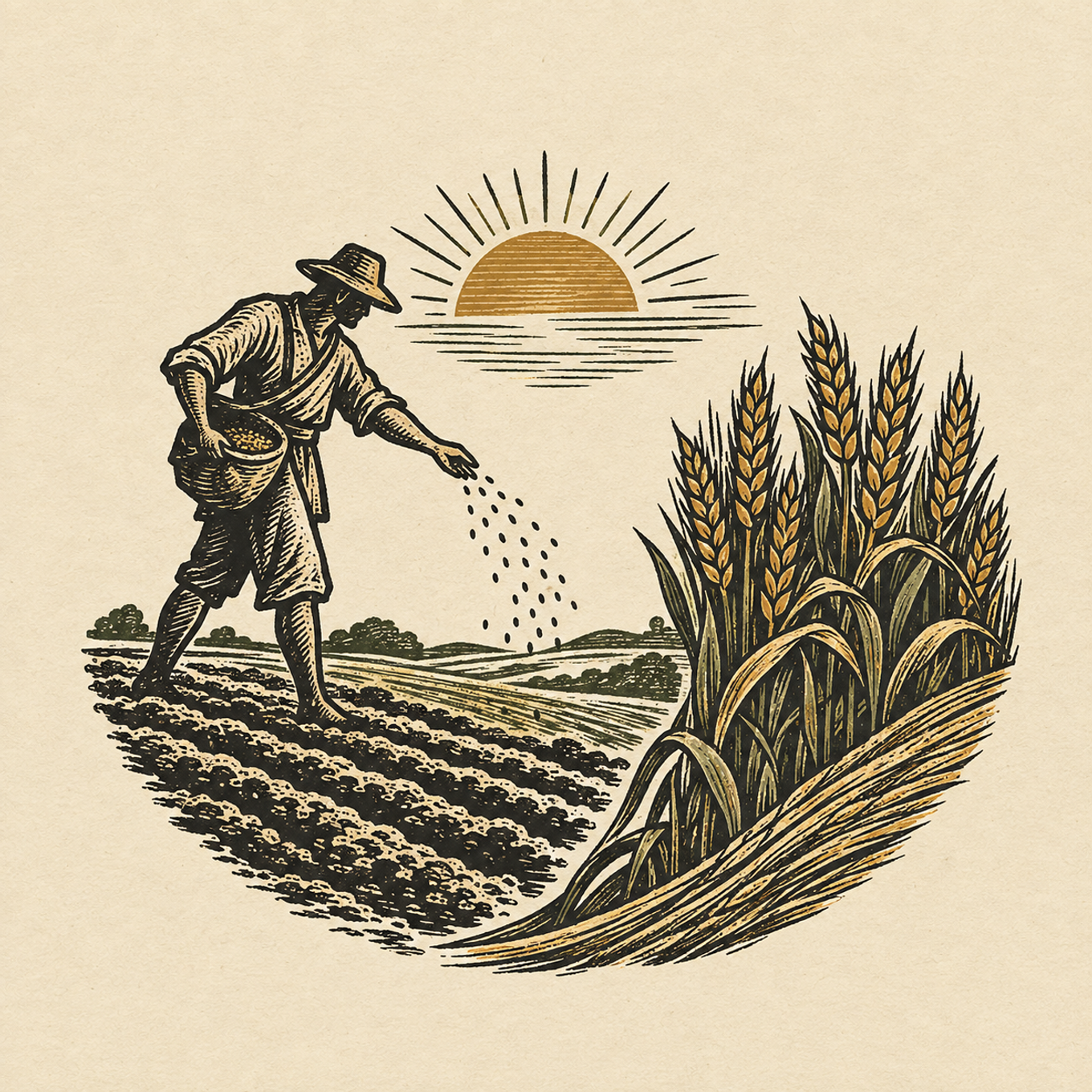
If you plant wheat, you get wheat. You don't plant wheat and hope for grapes. In the creation story, every plant yields seed "after his kind," and that's the rule farmers have always worked by. The Chinese proverb says the same thing: melons give melons and beans give beans.
In life, this means the result you get is the same kind of thing as what you put in. If you plant laziness, you don't harvest a strong career. If you plant criticism in your marriage for ten years, you don't harvest closeness. If you plant twenty minutes of reading a day, you harvest a mind that knows things.
You reap later than you plant
There's always a gap between planting and harvest. James wrote that a farmer "waiteth for the precious fruit of the earth, and hath long patience for it, until he receive the early and latter rain." No farmer plants on Monday and goes out on Tuesday looking for a crop.
This gap is where most people get confused. Because the harvest comes so much later, it's easy to believe that what you're doing today doesn't matter. The cigarette, the skipped workout, the purchase on the credit card, the harsh word to your kid, none of them seem to cost anything today.
And the good seeds seem to do nothing today either. The hour of study, the money put away, the apology, all feel wasted in the moment, because nothing comes up right away.
You reap more than you plant
One seed doesn't give you one seed back. It gives you a plant with many seeds on it. In the book of Genesis, during a famine, Isaac planted crops and "received in the same year an hundredfold."
In Jesus' parable of the sower, the seed that fell on good ground brought back thirty, sixty, and a hundred times what was planted.
Paul told the Corinthians, "He which soweth sparingly shall reap also sparingly; and he which soweth bountifully shall reap also bountifully."
That works in both directions. Good seeds multiply, and so do bad ones. Hosea's people sowed the wind and reaped a whirlwind. Jacob used one goat and one set of clothes on his father, and he spent decades reaping deception from his uncle and his own sons.
You're Harvesting And Planting At The Same Time
This is the part of the saying that matters most for your life right now. It describes today, and it runs in two directions at once.
Everything you have today is a harvest. Your bank account, your health, your skills, your friendships, your reputation, and your walk with God are all, in large part, what grew from what you planted in the past.
Some of those seeds you chose on purpose. Some you planted without thinking, one small day at a time. Either way, today is harvest day for them.
At the same time, today is also planting day. Whatever you do this week goes into the ground and starts growing into the life you'll be living years from now. You can't skip this. Even doing nothing is a kind of planting, because a field you don't plant still grows something, usually weeds.
This is why wanting something badly isn't enough. Think about a 16-year-old who wants to live in France for a year when she's 24. She can picture it clearly: the apartment, the cafés, speaking French with her neighbors. She wants it now. But the year in France gets planted in what she does between 16 and 24, and wanting it doesn't put anything in the ground.
Take just the language. The U.S. Foreign Service Institute, which trains American diplomats, puts French in its easiest group of languages for English speakers, and still estimates it takes about 600 to 750 hours of class time to reach professional working proficiency, for people studying full time.
Twenty minutes a day adds up to about 120 hours a year. At that pace, it takes five or six years just to put in the hours. If she starts at 16, she can do it. If she waits until she's 23 and "gets serious," the harvest won't be ready when she wants it.
The money works the same way. If the year costs, say, $30,000, then saving it over eight years comes to a little over $300 a month. Spread over one year, it's $2,500 a month. Same harvest, very different planting.
Planting is only the start. A seed needs water to sprout, and the young plant needs water again and again as it grows. A farmer who plants a field in spring and never comes back to water it will lose most of that crop, even though the seed was good. That's where a lot of goals die.
The 16-year-old downloads a French app, practices every day for three weeks, and then stops. She planted, but she didn't water, and by the time she's 24 there's almost nothing left of it.
What makes the harvest is the twenty minutes she puts in day after day in her second year, when it isn't exciting anymore and nobody is watching.
Watering works for bad seeds too. A single angry comment doesn't ruin a marriage, and one night of overspending doesn't wreck your finances. What grows is the thing you keep feeding.
The resentment you replay in your head every night gets watered every night. The purchase you tell yourself is "just this once" every weekend gets watered every weekend.
So when you look at your life and ask what you're growing, look at what you keep coming back to, day after day. That's what's being watered, and that's what will still be there at harvest time.
The same thing is true for any goal. If you want to be healthy at 60, you're planting it or not planting it in your thirties and forties. If you want a close relationship with your kids when they're grown, you're planting it now, in the ordinary evenings. If you want to be trusted, you're planting it every time you keep a small promise.
Where It's Not A Guarantee
Sowing and reaping is a principle, a description of how life works most of the time. It isn't a promise that every good seed will grow on schedule, or that every hard thing in someone's life was caused by something they did. The Bible itself makes that clear.
Ecclesiastes says, "the race is not to the swift, nor the battle to the strong, neither yet bread to the wise, nor yet riches to men of understanding, nor yet favour to men of skill; but time and chance happeneth to them all."
A farmer can do everything right and still lose a crop to drought or hail. In the parable of the sower, some of the seed was eaten by birds, some withered on rocky ground, and some was choked by thorns. The seed was good. The conditions weren't.
The book of Job shows what happens when people use sowing and reaping as a weapon. Job loses his children, his wealth, and his health, and his friends come to comfort him. One of them, Eliphaz, tells him, "they that plow iniquity, and sow wickedness, reap the same."
In other words, you must have done something to deserve this. But the book opens by saying Job was a righteous man, and at the end God tells Eliphaz directly, "ye have not spoken of me the thing that is right, as my servant Job hath."
Eliphaz took a true principle and used it to judge a suffering man, and God said he was wrong.
So use this principle on yourself, to look at what you're planting. Be careful using it on other people, to explain why their lives are hard. You usually don't know what they planted, or what storms came through their field.
How To Apply It
Right after Paul tells the Galatians that they'll reap what they sow, he adds a line for the people who are already doing the right thing and don't see results yet:
Galatians 6:9 (KJV)
And let us not be weary in well doing: for in due season we shall reap, if we faint not.
"In due season" means the harvest has its own timing, and it's usually later than you'd like. "If we faint not" means the harvest goes to people who keep planting. The gap before the harvest comes up is where a lot of people give up, because it feels like nothing is happening.
Ecclesiastes adds two pieces of advice that fit well together. The first is a warning: "He that observeth the wind shall not sow; and he that regardeth the clouds shall not reap."
If you wait for perfect conditions, you'll never plant. There will always be a reason to start next month. The second tells you what to do instead:
Ecclesiastes 11:6 (KJV)
In the morning sow thy seed, and in the evening withhold not thine hand: for thou knowest not whether shall prosper, either this or that, or whether they both shall be alike good.
Plant in the morning, plant in the evening, and keep planting, because you don't know which seeds will grow best. You don't need to know which particular day of studying French will be the one that makes it click, or which particular deposit will make the difference. You just keep putting seeds in the ground.
And for anyone who is planting during a hard season, Psalm 126 says: "They that sow in tears shall reap in joy." Sometimes you plant while you're grieving or tired or discouraged. The seed still counts.
Walk your field
Pick one part of your life: money, health, work, a relationship, or your faith. Write down what the harvest looks like right now, without dressing it up. Then ask what you planted, over months or years, that grew into it. Write those seeds down too. You're not doing this to feel guilty. A farmer who doesn't look at the field can't fix it.
Name the harvest you want, and the seed it takes
Write down one thing you want your life to look like in five years. Then work backward, the way we did with French and the year in France, until you reach something small you can plant every week. "Be fluent in French" becomes "20 minutes of French every morning." "Have $30,000 saved" becomes "move $315 to savings on the first of every month."
Plant something today
Don't wait for good weather. Put the first seed in the ground today, even if it's small: the first 20 minutes, the first deposit, the first phone call. Then plant again tomorrow, morning and evening if you can.
Stop planting one bad seed
Look back at the list from your field. Pick the one bad seed you're still planting most often, like the late-night spending, the harsh tone, or the skipped workout, and stop planting it. Every day you don't plant it is one less thing growing in your field years from now.
Judge the planting, not the harvest
For the next 90 days, don't measure yourself by whether you see results. Measure whether you planted. Mark each day you did what you said you'd do. The harvest comes "in due season." Your job right now is to keep planting and not faint.
Go Further
Genesis 27–37: The whole story of Jacob
Read how Jacob took the blessing, how Laban deceived him, and how his sons deceived him with Joseph's coat. Reading it straight through shows how long the harvest took to come in.
Galatians 6:1–10
The full passage around "whatsoever a man soweth." Paul sets it next to carrying each other's burdens and not growing tired of doing good.
The Compound Effect, by Darren Hardy
A short, practical book on how small daily choices, good and bad, add up over years into the life you end up with.
Matthew 13:1–23: The parable of the sower
The same seed lands on four kinds of ground with four different results, and Jesus explains what each one means.
Paul wrote to the church in Corinth about the work he and another teacher, Apollos, had done there: "I have planted, Apollos watered; but God gave the increase."
Planting was the first step, and it wasn't enough by itself. Someone had to come back and water what was planted, again and again, long after the day the seed went in the ground.
And even then, the growth itself came from God. Neither of them could make a seed grow. What they could do was plant it and keep watering it.
That's the part of the harvest that belongs to you. You can't control the weather, and you can't make the seed come up faster.
But you can decide what you plant this week, and you can keep watering it on the days when nothing seems to be happening: the twenty minutes of study, the money set aside, the kind word, the prayer, the promise you keep.
Whatever you're reaping today came from seeds planted and watered in the past. Whatever you plant and water today is what you'll be reaping when that season comes.